The U.S., because of its business-friendly policies and the world’s deepest and most liquid capital markets, has long attracted global investors. But amid geopolitical turmoil and concern about debt, investors may be increasingly turning to China.
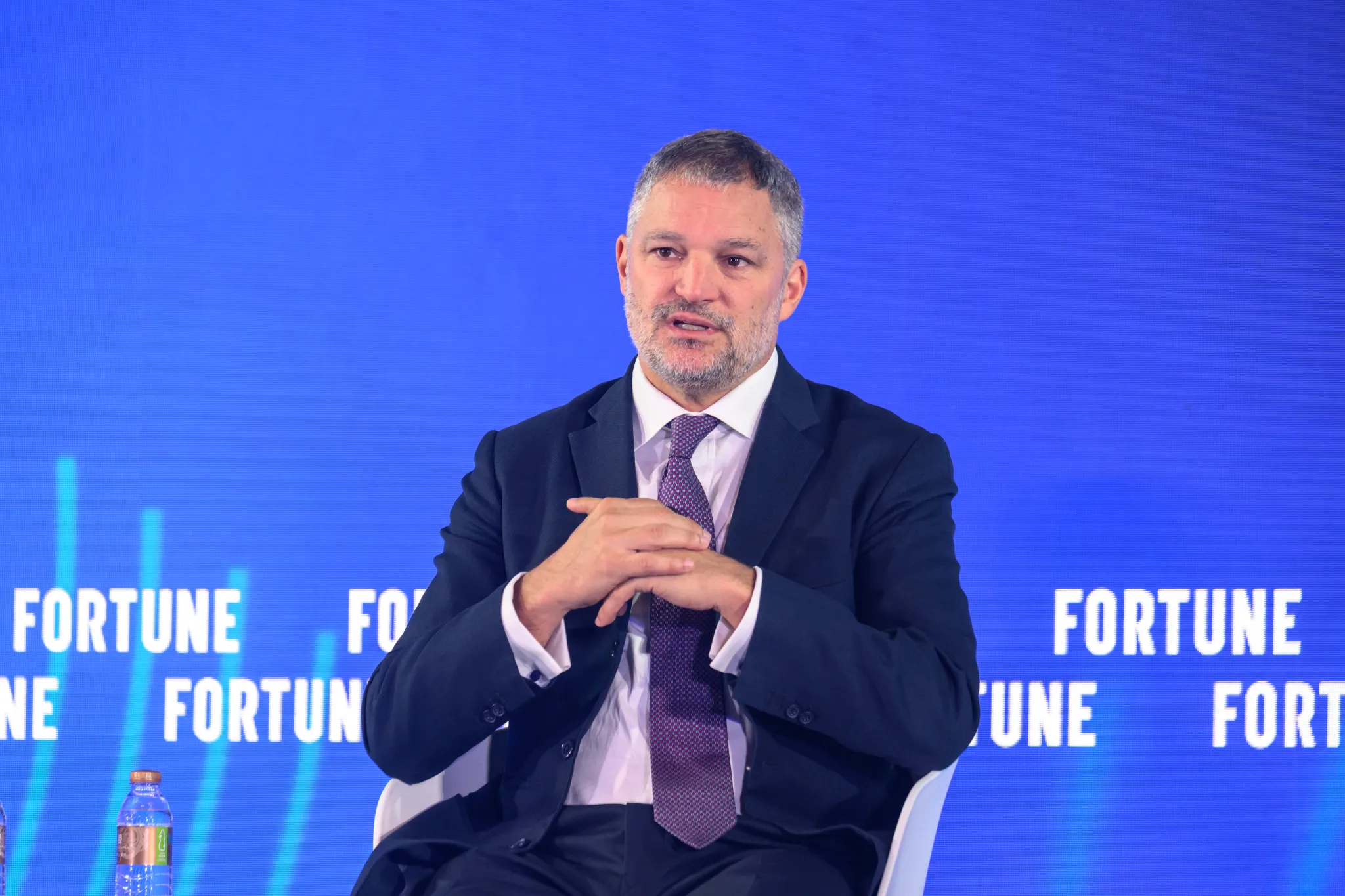
“When there’s a hit to the system, do you want to be with the anti-fragile or the profit-maximizing?” economist Louis-Vincent Gave asked at the Fortune Leaders Forum in Macau on Sept. 8. “This is where, increasingly, the markets are starting to diverge, where you’re looking at the U.S. Treasuries delivering horrible returns, and Chinese government bonds delivering very good returns.”
The yield on the benchmark 10-year Chinese government bond currently sits below 1.7%, far beneath the 4.8% offered by the 10-year U.S. Treasury note. Bond investors are growing wary of debt across the Western world: U.S. national debt now sits at $40 trillion.
That means Chinese government bonds, buoyed by deflation and a vast pool of domestic savings, are offering investors a safe-haven asset.
China is now reaping the fruits of its investments in social stability, says Gave, founding partner and CEO of Hong Kong–based financial services firm Gavekal. “Ninety percent of the time, when things go well, you want to be [invested] in the U.S,” he noted. “But the 10% of times where it goes badly, you want to be in China.”
That may be a tough judgment to make given China’s weak GDP growth, retail sales, and investment. “China should be going gangbusters, and it’s not,” Gave said, blaming “crushed” consumer and business confidence. “The match that turns around business and consumer confidence? That’s the key.”
Rising complexity
Even as the world fragments along geopolitical fault lines, business leaders should not fixate solely on geopolitics, argued Ziad Haider, McKinsey’s global director of geopolitics. “It’s not the only point of transition,” he said. “We’re seeing changes on the energy, technology, and demographic fronts.”
Governments are also turning to geoeconomics, or the strategic use of tariffs, sanctions, and industrial policy, to achieve national security goals. U.S. President Donald Trump has recently launched a new round of tariffs, targeting Canada in particular; Canada’s retaliatory tariffs kick in on Sept. 8.
“Traditionally, we’ve thought about geopolitics as the contestation of security and political issues,” Haider said, pointing to examples like Russia’s invasion of Ukraine and the Middle East conflict. “But that whole world of security has now been complemented by a world of geoeconomics … And the chessboard that boards have to look at on geopolitics has become significantly wider.”
Both speakers pointed to energy as today’s biggest geopolitical stress point. “The lower the cost of energy, the easier it is to produce economic growth,” Gave explained. “We live in a world where the uncertainty around the energy cost has grown considerably for mostly geopolitical reasons.”
Oil prices have surged since the Iran war began earlier this year, sparking energy shortages across much of the Asia-Pacific region. While prices have come down since the peak in April, they still remain far above where they were at the beginning of the year.
Still, Haider was optmistic that businesses can find opportunities in this more complicated political environment. Companies may see tariffs as a source of risk, but Haider argued that they’re also driving the creation of new trade agreements, citing the EU-Mercosur deal and ASEAN’s Digital Economy Framework Agreement. Similarly, he suggested that fossil fuel constraints spurred by the war in Iran could drive demand for renewables and other types of energy.
“The greatest danger in an era of turbulence is not the turbulence itself,” Haider concluded. “It’s to act with yesterday’s logic.”
Gave, for his part, has a simpler rule for navigating the unknown: “When it comes to Chinese policymaking, I’m not paid to forecast; I’m paid to adapt,” he said. “Anybody who tells you they know what goes on inside the Politburo is either delusional or lying to you.”