Tehran, Iran – The United States continues to rely on a mix of military force and economic sanctions against Iran, which has so far only prompted authorities in Tehran to consider more forceful responses.
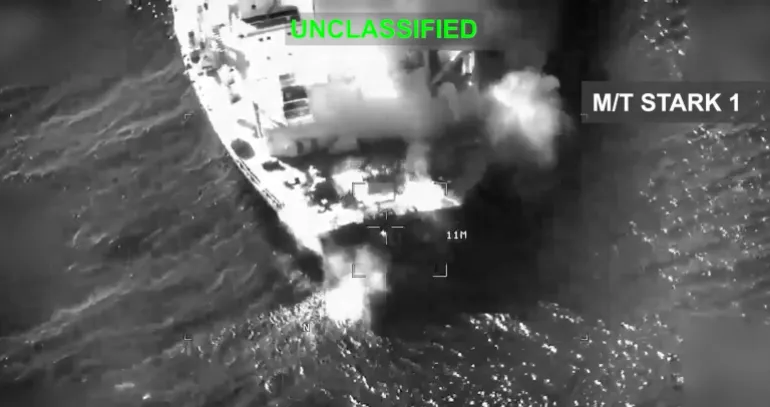
The US Central Command (CENTCOM) released video on Saturday showing three Iranian crude oil tankers being hit – one off Kharg Island, Iran’s main oil export hub, another near Jask and a third in the Gulf of Oman. Two were “permanently disabled”, while a third sank after extensive bombing, CENTCOM said.
Recommended Stories
list of 3 itemsend of list
Iran’s Islamic Revolutionary Guard Corps (IRGC) later aired video of its own, showing explosives-laden projectiles crashing into multiple ships in the Strait of Hormuz.
“Aggressor US must know that it has no way but to leave the region and stop its malignance,” the IRGC said in a statement on Sunday. It added that a US-built sea drone was hit while trying to enter Iranian waters in the vital waterway, through which one fifth of the world’s oil and gas passes in peacetime.
The IRGC also said on Sunday it had fired several ballistic missiles towards a US aircraft carrier and another warship that are part of the network of vessels imposing the months-long naval blockade of Iran’s southern ports. Both vessels sustained some damage and fled, said the IRGC, although there was no immediate evidence of a successful hit and CENTCOM said the attacks were “evaded”.
The IRGC said it considered the acknowledgement by the US that missiles were launched towards its warships as “live evidence of the enemy’s strategic defeat and proof” of the force’s “offensive capabilities”.
Speaking during a private meeting of parliament members on Sunday, Speaker Mohammad Bagher Ghalibaf said Tehran has inflicted “significant blows” to US bases across the region to the “frustration” of leaders in Washington.
“The Americans have surely understood that the era of proportionate responses has come to an end and our recent strikes against aggressor bases was only a start,” said Ghalibaf, who is also Iran’s chief negotiator with the US.
Any further attacks against Iranian interests will be met with “faster, heavier and more painful” strikes from Iran, he warned.
The Ministry of Foreign Affairs called the US attacks on Iranian ships illegal and a “war crime” that runs counter to the United Nations Charter.
Who is the blockade hurting?
US and Iranian officials provide different readings of what is transpiring after months of disruptions in the Strait of Hormuz and the naval blockade imposed since mid-July.
The administration of President Donald Trump says more vessels have transited the strategically important waterway over recent weeks under US guidance, despite threats and attacks from Iran, with traffic allegedly nearing pre-war levels on some days. That account is countered by Iranian authorities, which say the strait remains closed.
The US military said about 90 commercial vessels have been redirected as part of the blockade, with several more disabled or boarded.
Crude oil exports from the Middle East during August were down 39 percent since the January and February baseline of 18.5 million barrels per day (mbpd), according to TankerTrackers. It said the current deficit is now 7.2mbpd, down from 12.4mbpd in May.
“Although most may recover in the coming months, Iran’s exports of 1.68mbpd (baseline number) may likely remain at zero for the foreseeable future; depending on any agreement,” the maritime intelligence company posted online on Sunday.
Iranian authorities have confirmed that they have been unable to get crude oil past the US warships imposing the blockade.
But they pointed out it does not equal a total halt to exports, with President Masoud Pezeshkian saying late last month that up to 90 million barrels of oil were exported during the brief period that the memorandum of understanding signed with the US in June was in effect.
Some of the oil is kept in floating storage outside the blockade, allowing Iran to gradually sell it at a discount to its main oil customer, China, despite US sanctions.
Washington is counting on those supplies running out in the foreseeable future.
“There’s probably only about 30 million barrels of Iranian crude oil left that China hasn’t bought,” Treasury Secretary Scott Bessent told Fox News on Sunday. “So that will run out soon and there will be no problem with China buying because they have no product.”
Bessent again hailed the “one-two punch” of the blockade and sanctions as part of what the Trump administration has branded Operation Economic Outcast, aimed at reducing Iran’s trade with neighbours and further isolating 90 million Iranians.
Iranian authorities have not said how much longer they expect to be able to sell oil amid the US onslaught, nor have they elaborated on whether they are exploring potential alternative routes.
But experts have said that while overland and rail routes can move limited refined products, fuel oil and liquefied petroleum gas towards Afghanistan, Iraq, Central Asia and beyond, they cannot offer a viable and scalable replacement for the volume transported by very large crude carriers through the Strait of Hormuz.
Iran’s Economy Ministry on Sunday established an “economic war headquarters” to counter the pressure, as the country deals with one of the world’s highest inflation rates, unemployment, energy imbalance and a host of other deep-seated issues.
But IRGC spokesman Hossein Mohebbi suggested that the US was taking several times more economic damage from the war and blockade than Iran.
“If the US wants to deal one dollar in economic damage to Iran, it may deal several dollars’ worth of costs and damages to itself,” he said, pointing to lowered US strategic energy reserves and decreased aluminium exports from the region as examples.