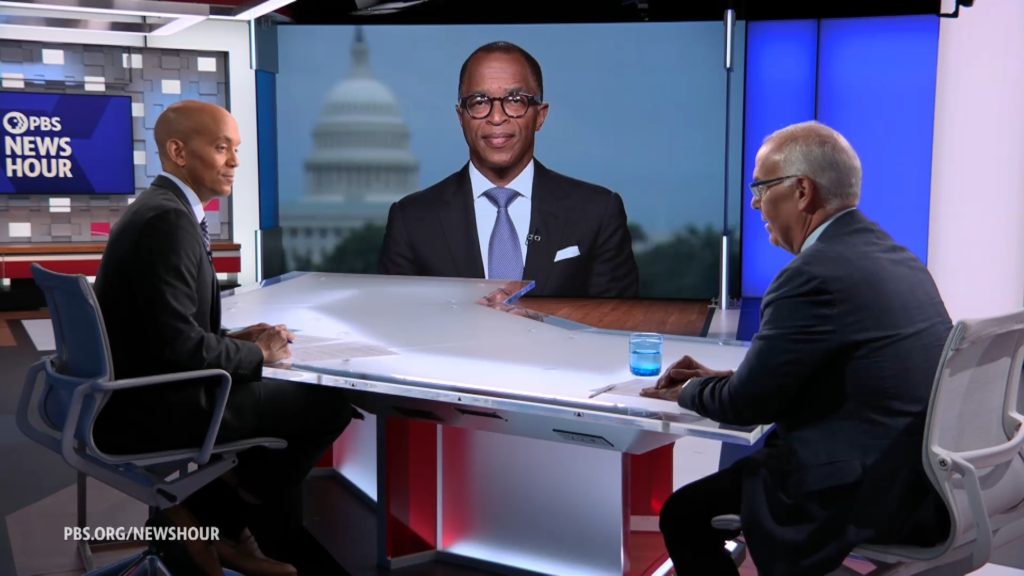
Geoff Bennett:
Now to discuss President Trump’s remarks today about the war with Iran and President Trump’s influence over the midterm elections, we turn to the analysis of Brooks and Capehart. That’s “The Atlantic”‘s David Brooks and Jonathan Capehart of MS NOW.
It’s always great to see you both.
So we will start with the war in Iran, because, yesterday, J.D. Vance said he would not describe the conflict with Iran as a war. Today, the president was in the Oval Office. He was asked by reporters how he would characterize it, and here’s what he said:
President Donald Trump:
A lot of people don’t call it a war. I call it a military conflict because it’s small potatoes for us. It’s not a big thing. We did Venezuela and we did this. In Venezuela, we lost nobody.
In this, we lost 18 people. And, in Vietnam, you lost 100,000 people, and, in other conflicts, you lost tens of thousands of people.
Geoff Bennett:
Small potatoes. How does that strike you?
David Brooks:
Good — nice thing to tell the families of those 18 people.
This is a little flippant, but this is like a guy who started a race, saying, I’m going to kill you guys in this race. It’s a mile. I’m going to kill you guys. Third lap, he starts giving up and says, I didn’t really want to win this race anyway. And it’s not a race. It’s just a contest.
And so he’s, like, trying to get out of being blamed for this. The more serious points are two. The first is that, because of drone technology, it’s too easy to go to war. And it’s a temptation for presidents to think that we can go to war, we will bomb the heck out of another country, and we don’t have to pay a price, and our folks back home won’t notice.
And that’s just a very perilous place to be, because it’s so easy to start them, they’re going to be tempted to do it over and over again. And the second thing to be said, look on the ground who’s acting with confidence and who’s not acting with confidence.
Iran is acting with confidence. They don’t care what happens to their people, but they are acting with confidence in attacking and in defending and knowing how they can control the world economy. And Trump just doesn’t have the morale.
Geoff Bennett:
And, Jonathan, your assessment of President Trump’s apparent effort to downplay this war that has lasted far longer than he initially said it would.
Jonathan Capehart:
I have given up trying to figure out what the president is trying to do, because, earlier this week, he was threatening them once again with total annihilation if he didn’t get his way. Now it’s small potatoes.
And I just want to echo what David said. It is reprehensible for the president of the United States to call a war he started, a war of choice now, small potatoes, when 18 U.S. service members have lost their lives, 50,000 service members are going to be in that region through the new — through the new year.
So, if this isn’t a war, if this is small potatoes, then why are there so many troops in the area? Why is so much of the American military in that area? I wish the president would just make a decision, just declare victory, and bring our service members home.
Geoff Bennett:
Meantime, at a Rose Garden event this past week, President Trump urged Republicans running in these tight races to run on his record, saying that’s all they need to do to win big is to embrace him.
What’s striking, David, is that the president seems to be arguing that the midterms should be a referendum on his presidency, when so many other past presidents have basically argued the opposite.
David Brooks:
Yes, I — Charlie Cook was prognosticating the election, which is what he’s really good at. And he said the Republicans have three likely outcomes. One is bad, the other is really bad, and the other is horrible.
And so the winds are not on the Republican side. And so normally in these circumstances, the president lays low because he knows he’s a problem for people in swing districts. But Donald Trump is incapable of laying low. And maybe they think he can bring out some base in some places, but I just — I think it — making himself the center of this is yet another blunder.
Geoff Bennett:
And contrast this, Jonathan, to what the former Vice President Kamala Harris said. She was asked about the red state Democrats, who have in most cases sort of shied away from her record, stayed away from her, didn’t want what didn’t want her campaigning with them, and she said: “They need to do whatever they need to do to win. Bottom line, we need to win.”
Jonathan Capehart:
Yes, those are the exact same words Nancy Pelosi said to members of her caucus and folks who are hoping to be a part of the Democratic Caucus in multiple elections when she was minority leader and then when she became speaker, because the mantra for Pelosi and the mantra I’m hearing from former Vice President Kamala Harris is, win, baby, win.
Do whatever you need to do to get elected, and then we can sort out whatever stuff needs to be sorted out. But getting the majority is the number one priority of the Democrats.
Geoff Bennett:
And, David, Republicans won in 2024 in part by promising to bring prices down. Two years later, affordability is still a major concern. Of course, now you have got the war in Iran. How difficult is it for the GOP to tell voters, just stay the course?
David Brooks:
It’s pretty difficult. The country has not been happy with where the country is going for a long time. The Democrats have made it so much — a little easier by all these DSA candidates in states like Michigan.
But I have to say, when I look at the Democratic side, I do see the more — the more progressive sides, they are campaigning ardently to win, and they have big ideas. When I look at the mainstream establishment Democrats, I think they have one really good policy which they’re talking about, which is the abundance agenda to change some of the regulation on how to make it more affordable so there’s more house-building.
But they don’t have much beyond that. And what they don’t have is what mainstream Democrats used to have, which is a growth agenda, an economic growth agenda. We’re going to need a lot more new jobs because A.I. is going to disrupt a lot of jobs. We need to produce new ones. And the Democrats do not have an agenda about that.
And then finally, frankly, with the exception of Rahm Emanuel, they are not talking about education. And test scores are collapsing. They’re collapsing especially in blue states. The red states are doing better in education than the blue states. And Joe Biden did not have an education agenda. Kamala Harris did not have an education agenda.
And I don’t see too many Democrats having an education agenda, with the exception, I guess, of Rahm Emanuel. And so these are areas where the mainstream Democrats are not really being as aggressive on policy terms as the more progressive.
Geoff Bennett:
Jonathan, what are Democrats offering voters and what would they do if they win the midterm?
Jonathan Capehart:
Democrats have been talking about affordability since, what is this, ’26, 20 — since this time last year. I believe it was last year, maybe it was ’24, but preparing people for the health care bomb that Republicans were about to set on the American people. And they have been talking about affordability ever since.
And on my MS NOW show, when we talk to candidates around the country, and we ask them, what are you hearing from your constituents, what is your campaign message, and, to a one, it is about affordability, the prices at the pump, prices of health care, prices in the stores, inflation.
And so that’s what Democrats are running on, at least the Democrats I have been talking to over these last few months.
Geoff Bennett:
As we wrap up our conversation here, I want to shift our focus to Republican Senator Susan Collins of Maine. She sat down for an interview with our friend Jonathan Martin of Politico, and he asked her about this debate within the GOP over this idea of principle versus relevance.
And he posed the question this way. Does she follow the model of former Congresswoman Liz Cheney, who stood on principle and paid a price for it with her career, her political career, or does she follow the approach of the late Lindsey Graham, who you could argue knew better, but went along with President Trump because he wanted to keep his seat?
So here’s what she said.
Jonathan Martin, Politico:
Where do you find yourself between those two poles?
Sen. Susan Collins (R-ME):
So I would say that I don’t fit either of those models. With the case of Liz Cheney, what influence does she have today? Really none. It’s not just that she lost her seat. It’s that she has no impact, in my view.
Geoff Bennett:
Where do you come down on that tension that maintaining a voice in the party requires accepting things you otherwise would have opposed?
David Brooks:
First, I admire Jonathan Martin for taking a big honking bite of something in the middle of that interview.
(Laughter)
David Brooks:
Wow, I’m impressed.
I thought she handled that interview exceptionally well, and it shows what a political pro she is. And I think what she told Jonathan about this two parallel is accurate. She was a little rough on Liz Cheney. Liz Cheney did have an impact. It was important for the future of the Republican Party for some Republican conservatives to say, no, January 6 is not acceptable. That was a very important thing to do for the future of the party.
But Senator Susan Collins is not Lindsey Graham. Lindsey Graham really had at first a close relationship with John McCain, and then switched over and had a very close relationship with Donald Trump, which involved a lot of moral compromises. Susan Collins has had a problematic relationship with Donald Trump the whole time.
She’s stood up for Maine on the tariffs and other things. And in this dance, she’s done I think as good a job as it’s possible to do for a moderate Republican, the only one left, to stay relevant, in political terms, be Appropriations chair, and not run too afoul of the MAGA crowd. And I think she’s handled a very difficult job quite exceptionally well.
Geoff Bennett:
Jonathan, how do you assess all of this?
Jonathan Capehart:
I agree with David that the Senator Collins was rough on Liz Cheney, but I bet, if you were to go to Liz Cheney and ask her what she thought of the senator’s comments about her, I would suspect that Liz Cheney, former Congresswoman Liz Cheney, is unbothered by the choices that she made and the consequences that she suffered as a result of standing up on principle.
And I think there are a lot of folks in Maine who are wondering, where were the senators’ principles when it came to standing up for her long-held right of being pro-choice and then voting for Brett Kavanaugh to be on the Supreme Court, or her vote on ICE funding and then running away from a reporter asking her about her stance when someone was killed in her state?
I can understand her not wanting to choose either — wanting to choose either side, but, again, given everything that I said, Susan Collins is someone you cannot sleep on, in the sense that thinking that she is up against the ropes and she’s going to lose. She is a political athlete. And we will see whether the compromises, small-C compromises she has made will be her undoing in this reelection fight.
Geoff Bennett:
Jonathan Capehart and David Brooks, our thanks, as always, to you both.
David Brooks:
Thanks, Geoff.
Jonathan Capehart:
Thanks.