Scientists are warning that a sudden solar storm could lead to chaos on roadways throughout the US, as self-driving cars suffer a potentially fatal flaw to their GPS systems.
A team of researchers in Boston confirmed for the first time that GPS radio signals can be disrupted by the energy released from powerful solar flares hitting the Earth.
In self-driving vehicles, their guidance computers were thrown off by more than 30 feet, potentially meaning the difference between driving in the wrong lane in traffic or running a red light and causing a deadly accident.
The study also found that automated farming equipment, which also relies on GPS to plant and harvest crops in perfectly straight lines, were disrupted by recent solar storms striking the Earth’s atmosphere – leading to $500 million in damages.
Scientists typically get one to three days of warning once they see the sun eject a large amount of energy, but they still cannot reliably predict how strong it will be or whether it will hit Earth head-on.
The team examined what happened to GPS and similar satellite navigation signals during a powerful solar storm in November 2025.
The errors lasted for hours during the most intense part of the storm on November 12, lining up with peaks in auroras seen across the US.
That same burst of solar activity also hit passenger jets, scrambling some planes’ onboard computers with bursts of radiation and forcing airlines to update thousands of Airbus A320s after one flight suddenly dropped thousands of feet.
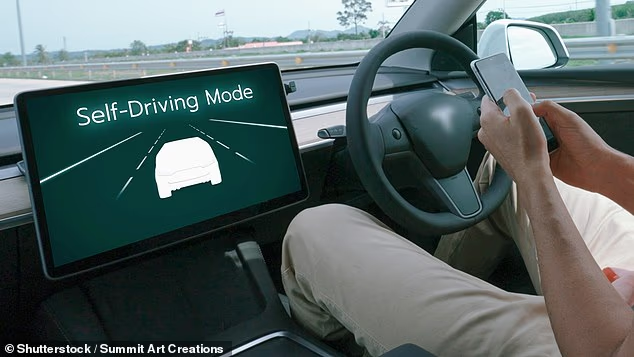
Scientists have confirmed that self-driving vehicles could make an error of more than 30 feet during strong solar storms (Stock Image)

Intense solar activity in Earth’s atmosphere results from solar flares or coronal mass ejections striking the planet with charged particles that can damage electronic (Stock Image)
The study, led by space physicist Endawoke Yizengaw from The Aerospace Corporation, a nonprofit research group, called their findings ‘significant positioning errors… large enough to disrupt precision agriculture and autonomous transportation industries’ across the continental US.
There are about 10,000 fully driverless cars in commercial use worldwide today. These include Waymo robotaxis in US cities such as Austin, Los Angeles, Phoenix and San Francisco, plus smaller fleets from Zoox and Tesla’s robotaxi service.
While these vehicles also use cameras, radar and detailed maps to navigate, they still depend on GPS to help pinpoint their exact spot on the road.
A major solar storm can hurl a blast of energy from the sun that disrupts the ionosphere, a layer of electrically charged air about 50 to 600 miles above the Earth’s surface.
GPS signals have to pass through that disturbed layer, so they wobble and arrive a little late or with weakened strength, causing the car’s computer to calculate the wrong location.
A 30 to 33-foot difference on the road can be wider than most driving lanes in the US, posing a severe danger to passengers or force them to take control back from the computer.
Mild solar storms are fairly common during solar maximum, the peak phase of energy release in the sun’s 11-year cycle of activity. Storms strong enough to throw off GPS signals across the US are less common.
However, the study, published in Geophysical Research Letters, found that a similar geomagnetic storm was also seen in May 2024, which led to severe disruptions for American farmers.

Pictured: A fleet of Waymo self-driving cars. There are more than 8,000 self-driving cars in commercial use worldwide in 2026

In 2025, Airbus issued an emergency alert for the A320 passenger jet (Pictured) which could suffer electronics problems during solar storms
Solar radiation can do more than just throw off GPS computers. A powerful burst of charged particles hitting Earth could potentially scramble radio transmissions and even overload electrical transformers and power lines – causing blackouts.
Last year, Airbus, one of the biggest aircraft makers globally, issued an urgent software update for its 6,000 A320 passenger jets worldwide after one plane fell thousands of feet during a solar storm.
Industry safety experts believe the problem originated on a JetBlue flight from Cancun, Mexico to Newark, New Jersey that suddenly suffered an uncontrolled drop in altitude of thousands of feet on October 30, injuring at least 15 people.
An investigation involving the Federal Aviation Administration (FAA) found intense solar radiation corrupted critical data in the flight control computers, causing the plane to momentarily lose accurate positioning information and plunge downwards.
Previous solar storms have also interfered with satellite communication throughout the world, including causing outages among Elon Musk’s Starlink internet service.