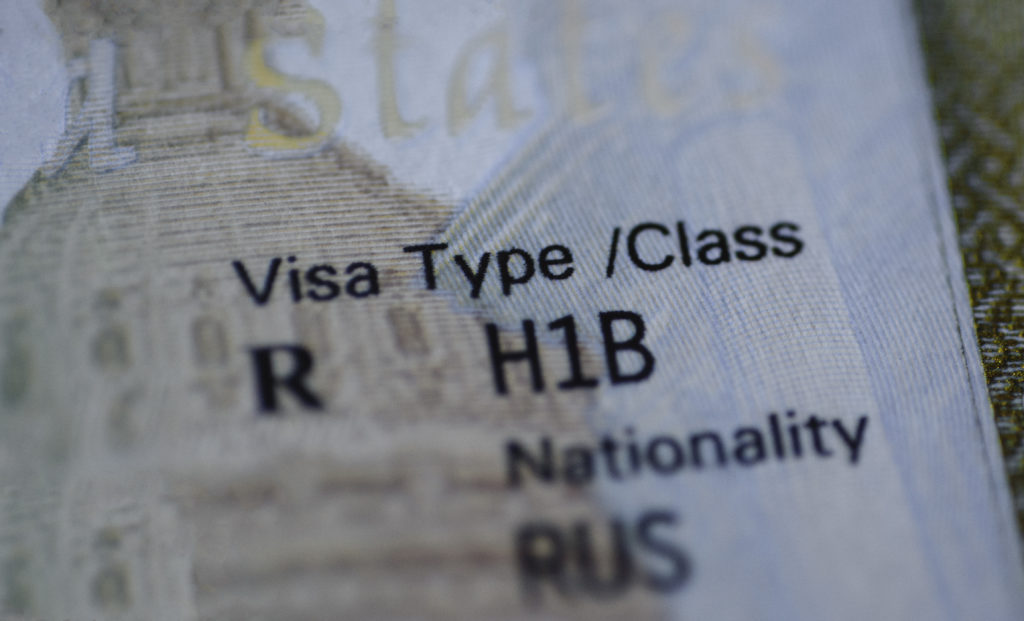
The Trump administration wants to impose a $103,265 filing fee for visas given to skilled foreign workers in the U.S., a move aiming to further target the H-1B visa program and a workforce that largely supports the tech industry.
The new rule, proposed by the Department of Homeland Security last month, would apply to all applicants seeking an H-1B visa, with exceptions for those with positions at universities, hospitals and other nonprofit organizations, said David Bier, director of immigration studies at the Cato Institute.
The White House has tried taking a similar action before. Last year, the administration said it would make U.S. companies pay $100,000 for every new H-1B visa holder they employed. But a federal judge struck that executive order down, ruling that the administration exceeded its authority by implementing the fee hike without congressional approval.
With the new rule, the administration relies on a different legal framework, Bier said.
DHS says the fee will generate revenue to help cover immigration-related administrative costs. At the time of the initial fee hike, the White House said the program had been “deliberately exploited to replace” American workers with lower-skilled workers who are paid less. Officials also said some employers “have abused the H-1B statute and its regulations to artificially suppress wages.”
On both claims, experts told PBS News the reality is more complicated.
Which workers rely on H-1B visas the most?
H-1B visa holders are largely tech workers, according to a 2025 fiscal year report released in April by U.S. Citizenship and Immigration Services, the agency that allocates the visas. The vast majority of visa holders — nearly 70% — are from India, with an additional 12% from China.
Some 9,300 H-1B visa-holders worked for Amazon this past year. Apple, Microsoft, Google, Meta and Oracle were all in the top 10 employers for H-1B visas as well. Overall, H-1B visa holders make a median income of $133,000 per year, though their median initial pay is lower, at $103,000, according to USCIS.
The H-1B visa program allows foreign professionals in “specialty occupations” to temporarily work in the U.S.
WATCH: How H-1B visa changes could impact American businesses and workers
The visas fall under a nonimmigrant category of workers who have a set time they’re in the U.S. H-1B visa holders can generally stay for up to three years and possibly add up to three years to that initial period. Some foreign workers can stay permanently, but it requires seeking a different visa.
New visas are capped at 65,000 each year, with an additional 20,000 visas available to workers who have earned a master’s degree or higher from a U.S. university. Because there are more applicants than available H-1B visas, beneficiaries are selected through a lottery.
Do H-1B visa holders broadly take jobs away from American workers?
While there’s no evidence that H-1B workers take jobs away from Americans, there is nuance to the question, said Britta Glennon, assistant professor of management at the University of Pennsylvania’s Wharton School.
Economists have studied the impacts H-1B workers have within individual companies and at the local labor market level, she said, reaching similar conclusions.
At the local level, a foreign worker, including an H-1B visa holder, isn’t “just a body that has a job,” Glennon said. Foreign workers create jobs too because they buy goods and services.
It’s hard to know exactly what jobs are created in local economies when H-1B workers move in, she said, but it can range from house cleaners and Uber drivers to teachers for their kids.
Research has shown that H-1B workers “seem to act more as complementary workers as opposed to substitute workers,” Glennon said. “So they’re creating slightly different types of jobs that Americans have to take.”
Jobs being filled by H-1B workers probably would not have been filled otherwise, she said.
“It’s really a pain to hire H-1B workers,” Glennon said. Companies need to hire lawyers and pay fees all without knowing if the worker they want will get a visa through the government’s lottery system. Most employers would rather have the certainty of an American worker, she said.
The fact that employers are willing to obtain legal counsel and pay fees “suggests that they’re having a hard time finding someone else,” she added.
Glennon’s work has also shown that when companies can’t get H-1B visas for employees, such as when policies restrict skilled immigration, they hire more abroad.
If a company applies for a visa for a specific employee and doesn’t get it, they may then deploy a common strategy: Hire that employee in an office based in a different country, she said, such as Canada or England.
Where Americans may be feeling the pressure of H-1B workers is specifically in the tech sector, said Jennifer Hunt, an economics professor at Rutgers University and former chief economist at the Labor Department in the Obama administration.
READ MORE: Here’s why experts think Trump took ‘a sledgehammer’ to the H-1B visa worker program
Though it’s been harder to study, Hunt said it’s possible that some native-born workers might have been deterred from going into computer science because wages may be suppressed industry-wide as a result of companies paying foreigners less.
But that’s a relatively small group of people, Hunt said. A much larger group — those not in the computer sciences — are likely helped by the arrival of foreign computer programmers whose work makes other people’s jobs more productive, she said.
Though the IT worker pool may be smaller, they’re affected more acutely than the rest of the population of American workers, Hunt said.
“I think the number of people helped is a lot more than the number hurt, but each helped person is helped less than each hurt person is hurt,” she said. “It’s often the case in economics that the pain or gain is sometimes concentrated in a small group that then lobbies for or against something.”
It’s not as though tech companies aren’t searching for American workers, Glennon said. In some cases, it might be true that large outsourcing firms bring in Indian IT workers in particular to contract out to U.S. companies on a short-term basis. There aren’t a lot of great studies on these outsourcers, Glennon said, so it’s hard to completely characterize their business model.
In other instances, companies are largely hiring out of universities, she said. But many computer science and engineering grads are international students, so the pool is skewed away from American workers in those fields. As companies are searching for the best person for the job, many applicants will likely be foreign workers.
“It’s actually quite difficult for a lot of them to find any Americans who are trained in the way that they want them to be trained,” Glennon said.
When companies hire H-1B workers, do they suppress Americans’ wages by paying foreigners less?
There’s likely some validity to the idea that American companies can pay foreign workers less than Americans, Glennon said.
Because H-1B visas are tied to the company and not the workers, employees can be reliant on their employer for their ability to stay in the country until and unless they get a green card — a process that has a huge backlog in particular for Indian and Chinese immigrants.
In the long run, that could put downward pressure on wages and promotions, Glennon said.
It’s not that a company is likely to pay an American worker a higher initial wage than a foreign worker, she added. But changing jobs can help boost wages and H-1B workers have a much harder time doing that.
A 2025 study by the Federal Reserve Bank of Richmond found that at companies who successfully obtained H-1B visas for employees, young and college-educated workers who had not been at the firm for long saw a 4 to 5% wage increase, regardless of whether they were native-born or foreign. At the same time, native-born employees who were young, college-educated and had been at the company for a while saw a 5% wage reduction and a 3.6% increased likelihood of leaving the firm.
The study’s authors said their results indicated that those workers — high-tenure, young, college-educated and native-born — may be most substitutable by H-1B employees. But they’re also a small percent of employees; “a clear majority” of current employees appeared to benefit from exposure to new H-1B coworkers, the study said.
When studying immigration broadly, economists generally find no effect on average wages, Hunt said. That’s because American workers shift jobs to avoid competition with immigrants, often moving into roles that immigrants may not be as well suited to, such as communications.
“We think this fits more broadly into a picture of immigration leading people to specialize more in what they’re best at, and that increases the efficiency of the economy,” Hunt said.