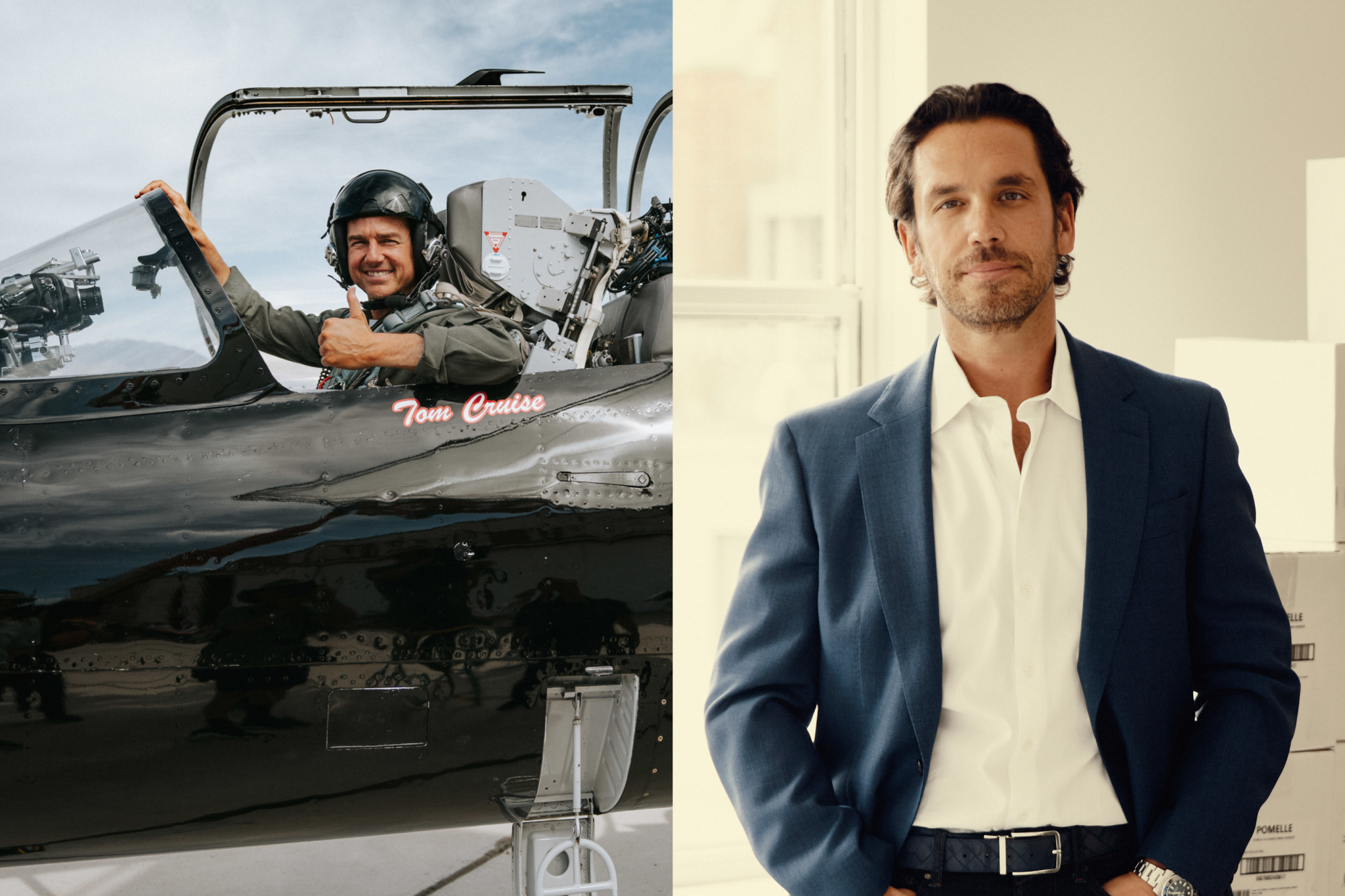
As a child, Jonathan Spano had one dream: to be a military pilot. It was swiftly shattered when he learned the U.S. Navy required near-perfect eyesight to fly—a standard he could never meet. So he launched his own business instead. And it’s done so well that decades later, he’s been able to splash out millions on flying lessons and his own aircraft to fulfill his childhood dream. Now, he’s the stunt pilot behind some of Top Gun: Maverick‘s most acclaimed aerial sequences.
“I was just fascinated with airplanes; I would build little models of them, hang them from the ceiling with a fishing line in my room. And like many, many young boys, when the Top Gun movie came out, I was obsessed and wanted to fly planes in the Navy and land on aircraft carriers,” Spano told Fortune.
As he got older, the now 48-year-old CEO realized that no amount of passion, pining, or studying would set him on that career course. “I learned that you had to have better than perfect eyesight, really—2020 is kind of the minimum standard,” he said. “I didn’t meet that criteria, so that took that off the table for me… My eyesight was just not that good. I wore glasses as a kid.”
So Spano worked towards a new dream: Growing up in a “very blue-collar” family in California, he and his brother started doing traffic control work as teenagers—setting out cones and barricades for a crane company their father worked for.
“We identified pretty early on that there was demand for the services that we were providing. At that time, you could go to a company and rent some barricades, but they wouldn’t put them out for you. Or you could go to a company, and they would get the permits, but they didn’t do the other traffic control services.” So in 1995, the brothers launched a side hustle of their own, offering traffic safety—rental equipment, cones, barricades, and signs on the road, plus 24/7 emergency dispatch —all in one place.
“That continued to progress and eventually turned into an office in our great-grandmother’s garage,” he said. “The plan was never to build a national company. It was really a way to just make some money, and it just continued to grow.”
It grew a lot. Thirty years later, that company, Traffic Management Inc, operates across more than 50 locations in the U.S and, according to Spano, is the largest privately held traffic control company in the United States, making over $1 million a day in revenue. Perhaps surprisingly, that same business has quietly bankrolled Spano’s path to the sky.
“It’s funny, the business I originally started just to make ends meet has ended up funding and giving me the opportunity to live the dream that I had as a child,” Spano added.
A tax tip from his accountant led him back to the cockpit
It all started when two decades into running the business, Traffic Management’s finance chief suggested buying a small plane—both as a tax write-off and a faster way to reach the company’s growing list of locations.
“It had never occurred to me that I would maybe be able to fulfill that dream as a pilot,” he said. He bought a Cessna, learned to fly it, and started using it to save hours that would have been driving across California to visit the company’s other offices. That TK enabled the company to keep expanding its presence.
“Two offices became three offices, became 10 offices, became 20 offices in the state of California, and aviation was certainly a part of that success story.”
One plane led to another—bigger, faster, eventually a private jet, costing him a few hundred thousand dollars each step of the way. Along the way, Spano also chased a second childhood passion: filmmaking. He bought a helicopter for around $2 million and partnered with Fred North, a Hollywood aerial coordinator, to mount camera rigs on it for film and commercial shoots.
North first floated the idea that would change everything. “They’re making another Top Gun film,” Spano recalled him saying. “You should try to modify your jet to carry the same cameras that we do on the helicopter, and if you can pull it off and get it done, you could work on and fly your airplane in this next Top Gun movie.”
Spano spent roughly 18 months and, by his own estimate, well into seven figures modifying his jet—an Embraer Phenom 300—to carry two camera systems and clear FAA certification. “We pulled it off in time to have the jet work on production and fly in the Top Gun: Maverick film,” he said. Flying alongside veteran film pilot Kevin LaRosa Jr., Spano flew “a large portion of the jet-to-jet aerial sequences, including all of the aircraft carrier sequences” in the movie.
The work earned the team a Screen Actors Guild Award for stunts.
He studied at 11 p.m. and woke up at 6 a.m.—here’s his advice for anyone chasing a dream job
Paramount has since greenlit a third Top Gun film, with production expected to begin in 2027—and Spano is already in talks with the director. “Considering we have the only platform in the world that is capable of what it is capable of,” he said, “I’m optimistic that we will be participating in that project.”
And since building the only camera jet of its kind in the world, he’s already used it on a string of other projects: commercials for private aviation companies including NetJets, FlexJet, Gulfstream, Embraer, and Delta, plus work for the U.S. Air Force. He was also part of the team behind National Geographic’s America the Beautiful, including aerial footage of the Northern Lights over Alaska, which earned an Emmy nomination.
“I’m living proof that anything is possible, and though these things don’t happen on their own, and you have to make your dreams reality,” Spano said of his success.
His advice to anyone looking to chase their dreams? “Be bold, take risks, but you know also you have to put in the hard work and dedication.”
After all, he waited decades to turn his childhood dream into a reality instead of giving up on it—and once he finally started, he still had to squeeze the training in around a full-time job.
“I look back at how hard I worked to get to where I am while running a business and getting my license, and it’s not a matter of just getting your license. To get to where I am as an aviator, it was thousands of hours of training,” he explained, adding that he’d be up studying at 11 p.m. while his family was asleep and still had to get ready for work the next morning at 6 a.m.
“If I had to say what one of the things that was really fundamental in me being successful was I picked the things that I wanted to achieve, and I was just fearless in pushing for them,” Spano added. “I stuck to it, I just believed that I was going to get there, and I just overcame whatever obstacle was in my way.”