
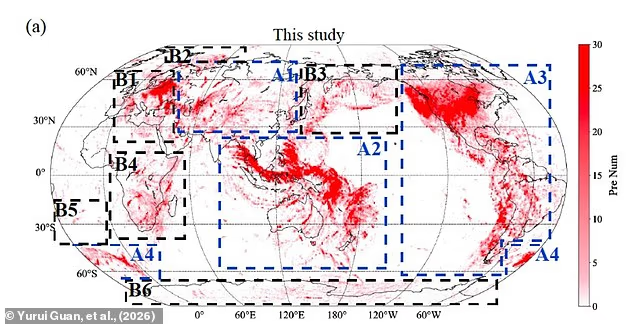
Scientists have uncovered six never-before-seen mystery structures lurking deep inside the Earth.
Although our planet’s deep layers are totally inaccessible, scientists can use the seismic waves from powerful earthquakes to probe the hidden depths.
Now, Chinese scientists have uncovered structures sitting on the boundary between the viscous mantle and the liquid outer core, 1,800 miles (2,900km) beneath our feet.
These ‘deep-seated scatterers’ are all but invisible, except for the way that they subtly influence the path of passing seismic waves.
In their paper, published in the journal JGR Solid Earth, the scientists suggest these structures could have been formed when material from the outer layers was dragged deep into the Earth.
They could include pieces of the continental crust or even the remains of Theia, a Mars-sized protoplanet believed to have formed the moon after hitting Earth 4.5 billion years ago.
Under the vast pressures and incredible temperatures at the mantle boundary, these chunks transform, partially melt, or undergo mineral transformation.
The researchers suggest that this has left six ‘thermochemical piles’ of material very different from the surrounding mantle.
Scientists have uncovered six never-before-seen mystery structures lurking deep inside the Earth (labelled in dashed boxes)

These structures are located right on the boundary between the solid yet malleable mantle and the liquid metal outer core (stock image)
While Earth looks relatively stable from our perspective up on the surface, deep below the planet is violent and dynamic, especially at the boundaries between layers.
One particularly dramatic boundary is the one between the mantle and the outer core, where solid-yet-viscous rocks meet liquid nickel and iron.
There is an enormous temperature jump across the boundary, with a difference of about 1,000°C (1,800°F) from one layer to another.
The massive heat escaping from the outer core drives convection currents in the mantle known as mantle plumes, which play a key role in determining where volcanic activity occurs on the surface.
Due to the huge density differences, seismic waves also dramatically slow down at this boundary, which allows geologists to ‘see’ what is going on.
To learn more about this strange part of the planet, the researchers looked at a special type of seismic wave called a PKP precursor.
These are relatively weak waves that arrive shortly before the stronger seismic waves triggered by earthquakes.
PKP precursors are extremely useful for scientists because they get scattered by the subtle differences in the hidden structures, known as heterogeneities, on the mantle boundary.

To learn more about this strange part of the planet, the researchers looked at a special type of seismic wave called a PKP precursor, weak waves that arrive shortly before the stronger seismic waves triggered by earthquakes
These scattered waves then pass through the liquid outer core, but not the solid inner core, and bounce back to arrive at seismic detectors before the main wave.
The issue is, because they are so weak, PKP precursors are extremely difficult to find in seismic data and have to be manually searched for among the thousands of signals collected every year.
In their paper, the researchers explain: ‘Manual identification of these precursors is inefficient, subjective, and insufficient for vast global seismic data sets.’
To get around this, the researchers trained an artificial intelligence (AI) model to spot PKP precursors in seismic data.
After training the model on human-identified waves, the team let their AI loose on over two million recordings from 5,000 different earthquakes.
Eventually, their model identified 174,929 high-quality PKP precursor signals – more than ten times all previous studies combined.
That has given an unprecedented view of the mantle boundary, revealing huge areas of previously unknown structures.
The researchers write: ‘We also discovered six areas that likely host significant heterogeneities that had never been documented before, providing clear priority targets for future exploration of Earth’s deep interior.’

Using an AI model, the researchers identified 174,929 high-quality PKP precursor signals from over two million recordings of 500 earthquakes. Pictured: Earthquakes with identified PKP precursors that travelled from the source (pink stars) to seismic array detectors (blue triangles).
Earlier studies have found fragmented, seemingly random structures in a few locations around the world.
But this new map shows that those fragments were actually connected into much larger, continuous belts.
Currently, the researchers aren’t exactly sure what these structures are made of or how they formed, only that they are different from the surrounding mantle.
However, with AI models allowing even more powerful analysis of data collected over the last few decades, the picture could soon become clearer.
The researchers add: ‘As the catalogue continues to expand, its high-resolution spatiotemporal coverage will advance the refinement of fine-scale structural models of the lowermost mantle, and offer increasingly rich constraints for deepening our understanding of the geodynamic state of Earth’s deep interior.’


