
Amna Nawaz:
For perspective on the latest developments in the war with Iran, we now get two views.
Retired Rear Admiral Mark Montgomery spent 32 years in the U.S. Navy. He served on the National Security Council staff and later was policy director on the Republican staff of the Senate Armed Services Committee. He’s now a senior fellow at the Foundation for Defense of Democracies. And Michelle Wiese Bockmann is an analyst at Windward. That’s a London-based maritime intelligence company.
Welcome to you both.
Admiral, I will begin with you and this U.S. bombing of the Iranian island of Larak by the Strait of Hormuz. The U.S. says that it hits — rather, it hit Iranian rocket launchers there, and we know it’s not the first time that the U.S. has targeted this island and other military forces in Southern Iran.
Do we know what kind of an impact those U.S. strikes have had on Iran’s ability to threaten shipping passing through that Strait of Hormuz?
Rear Adm. Mark Montgomery (Ret.), Foundation for Defense of Democracies: Yes, thank you for having me.
And I do think they have broadly been helpful. What they do is, they take out radars and other beaconing sensors so that the IRGC has less accurate targeting and less situational awareness of the movement of ships when they’re not using their automatic indication systems and beaconing themselves.
So it has that effect. And then, very specifically, last night, they just they destroyed what I suspect were Fajr-5 rocket launchers, which have been known. In 2025, the IRGC used them to launch floating mines in an exercise, but they could launch floating mines or even submerged mines that have influence or magnetic or acoustic sensors on them.
So this was an effort to prevent Iran from mining transit lane, and probably the southern transit lane that’s closest to Oman right now.
Amna Nawaz:
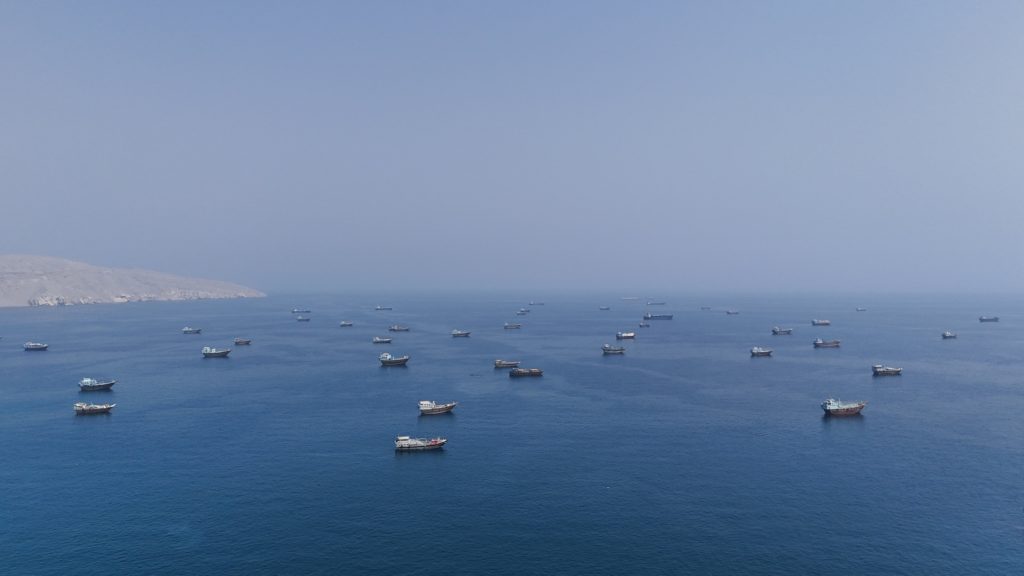
So, Michelle, when it comes to how much oil makes its way out of that region, we know before the war it was over 20 million barrels of oil a day moved out of the Gulf largely through that Strait of Hormuz. We know there are a number of routes out of that Gulf region, right? There’s the Strait of Hormuz, the Bab al-Mandab, the Port of Fujairah.
We did hear the president earlier today say on average now they’re getting out 30 ships a night. What is your understanding of how much oil is actually making it out of the Gulf every day?
Michelle Wiese Bockmann, Senior Intelligence Analyst, Windward:
Well, if you look at crude only and look at preliminary figures for August, it’s about between two-thirds and three-quarters of prewar volume levels.
If you add on the extra oil that is being diverted to the Red Sea via the East-West Pipeline from Saudi Arabia, you can see that quite a substantial amount has now scaled up and is getting out through other pipelines, as well as through that southern corridor through Oman, which the president was referencing.
The average of 30 vessels a day, he didn’t say over what period, but certainly these transits are being done dark, so it’s very hard to get visibility. And so, from a preliminary perspective, those numbers usually increase over time as those tankers that have loaded and leave the Gulf of Oman arrive at their destination ports.
It’s very, very difficult to put precise figures on them.
Amna Nawaz:
So, Michelle, let me stay with you for a moment because we know Iran’s ability to threaten those shipping lanes is diminished, but is not gone entirely.
What companies are willing right now to take on the risk and try to make that transit through the Strait of Hormuz?
Michelle Wiese Bockmann:
Well, obviously, this is a very high risk proposition. And what some ship owners may view as a reckless disregard for the lives of seafarers, others see as a high profit opportunity.
And on Friday, the spot rate to charter a tanker to take on these shuttle runs in and out of the Strait of Hormuz hit $650,000 a day. So that’s 27 times the break-even level. And if you are chartered for 30 days, you earn back a quarter of the value of your ship. So, high risk, high rewards, very high insurance premiums, but there are ship owners that are prepared to send their vessels in because of the enormous amounts of money that can be made.
Amna Nawaz:
So, Admiral, we know the U.S. military has been bombing those Iranian military assets that threaten the shipping. They have also been providing protection for ships leaving the Gulf.
I’m sure you have seen this Washington Post new reporting that shows there are a number of American commanders were in charge of forces in the Pacific and in Europe, the chief of naval operations who all warned against the risks of keeping that many forces in the Middle East for much longer. How did you find that reporting? And what are those concerns about?
Rear Adm. Mark Montgomery (Ret.):
Well, I suspect that report is completely accurate. And I would commend those commanders for saying the truth, even in the face of possible retribution, because, for the combatant commanders, this is a loss of current capability.
In other words, our ability to not have a carrier strike group in the Pacific region makes our deterrent efforts against China less. But, more importantly, assurances to Korea, to Japan, to Taiwan, to Philippines are down. On the service side, that’s the Navy, the chief of naval operations, he just said the truth.
The truth is having 18 to 20 destroyers and two carrier strike groups stationed in the Middle East means that one, two, three years from now, we’re going to have a lot less destroyers and carrier strike groups available for deployment. We have done this before. We did this in 2012-2013.
And about four years later, we had the first month ever where no U.S. carrier strike groups were available for deployment. There’s a direct tie from excessive contributions force posture in the Middle East to an inability to do our job anywhere a few years later. So he just said the truth. I’m glad he did.
Amna Nawaz:
There is the longer-term readiness question for sure, as you raise, Admiral. There’s the short-term impact here because the tankers that are getting out seem to be only getting out because of U.S. protection. How sustainable is the current force deployment there?
Rear Adm. Mark Montgomery (Ret.):
Well, paradoxically, we can keep this up for another nine, 12, 15 months, because the challenge isn’t readiness in nine, 12, 15 months, but the readiness of the forces that are doing these extended deployments in two, three, four years from now to come back on deployment.
So the Navy can keep this up, but I’m sure they’re — in the end, they acknowledge they could do that and they could do it for another year. But what the CNO, the chief of naval operations, is warning the secretary of defense and warning the president, is that, if you do this, your successors will have a significantly less capable force to deal with a recalcitrant China or Russia.
Amna Nawaz:
So, Michelle, if the shipping companies are obviously relying on U.S. protection here to get out the number of ships the president claims are getting out, they’re seeing news about these commanders’ concerns and what could be ahead, how are they going to take this in?
What kind of impact could it have on their decisions and the ability of oil to get out of the Gulf?
Michelle Wiese Bockmann:
Well, it all depends, I think, on the success of the blockade that the U.S. has reimposed on Iran, because that’s also having enormous pressure on Iran.
And I think, as the corridor scales up and they lose their leverage over the Strait of Hormuz, that we may see in maybe by the end of the year, I think analysts are saying, some sort of not return to normal, but a new normal that will allow ships to continue using that southern corridor while an agreement is reached on the future management of the strait.
Amna Nawaz:
All right, that is Michelle Wiese Bockmann and retired Rear Admiral Mark Montgomery joining us tonight. Thank you both for your time.
Michelle Wiese Bockmann:
Thank you.
Rear Adm. Mark Montgomery (Ret.):
Thank you.


