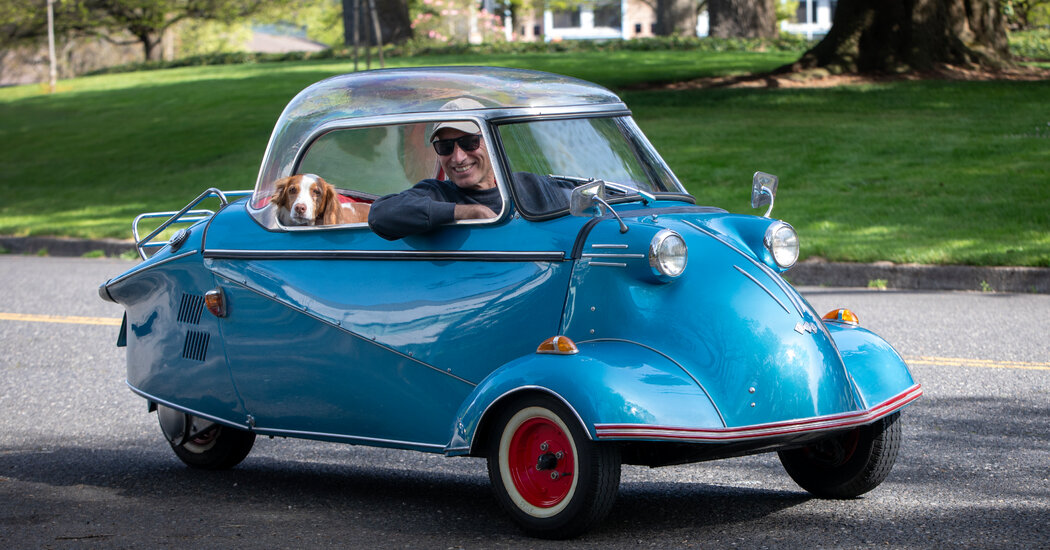
Somewhere between a Matchbox car and your daily driver sits a perfect balance of whimsy and fuel economy.
Microcars are (yes, tiny) lightweight vehicles for economical urban commuting. There’s no global definition, but the specs generally go like this: They can seat up to four passengers; they have at least three wheels (otherwise we’d probably be talking about motorcycles); weight limits may depend on legal classifications, but generally they’re under 500 kilograms (roughly 1,100 pounds); and their engines are under 700 cubic centimeters, which means they might get 70 miles per gallon or better.
In Portland, Ore., Mark Hatten is the founder of a one-man automotive repair shop, MPH Specialties.
He caught the microcar bug by chance three decades ago. “I was given a 1966 Subaru 360 sedan by a good Japanese friend,” he said. His friend’s work visa was up, and he had to return to Japan. “I could have the car for free, as long as he got to ride in it when he returned 10 years later.”
It sat for eight years. “I didn’t know how to fix it,” Mr. Hatten said. “I thought our relationship would cease.” But he got to work. He found used parts to rebuild the engine; he fixed the brakes. “Once it was driving, it was the most fun car ever,” he said, and added, “I still drive it today, 34 years later.”
There is nothing else like a microcar: “They’re challenging and quirky,” said Mr. Hatten, who plays unicycle hockey in his spare time. “Check your ego at the door.”
They’re rare on city streets, and for some good reasons. But still, Mr. Hatten has lost count of how many microcars he owns. “I’m always fixing them,” he said, and “they’re fragile and easily broken.” He added, “Every drive is a race to keep up with traffic.” When they work, however, it gives Mr. Hatten a “hit rush of satisfaction.”
Microcars are the stars of his YouTube channel — he has his 11 Subaru 360 Super Deluxe cars and a 1962 Messerschmitt KR200 with a bubble top. “I like making people’s heads explode, then drive away,” he said.
They are not for the faint of heart, and it helps if you’re good with a wrench. They’re underpowered, noisy and sometimes smoky, and they may not have heat or wipers. “The struggle is what makes it fun,” Mr. Hatten said.
He is quick to tip his hat to other devotees, too, including personal collectors or those with significant collections. Charles Gould and his Matchbox Motors Microcar, Minicar & Motorcycle Museum in Massachusetts and the Midwest Micro Car Museum in Wisconsin have helped pave the way for many microcar enthusiasts.
In Battleground, Wash., Damian Donesky, 38, restored a 1958 BMW Isetta microcar passed down within his family from his great-grandparents. His tiny transporter, Constanteeny, was nicknamed after his great-grandfather, Constantine. The Isetta has been in the family since the early ’60s.
Mr. Donesky, a product designer for Rough Country, which makes aftermarket products for trucks and Jeeps, called himself a longtime “car nerd.”
Mr. Donesky became a mechanic and has preserved his family’s automotive treasures. “I have three cars from the family,” he said — “my dad’s 1952 Willys M38 Army jeep, my great-grandparents’ BMW Isetta and BMW 700.
“As a child I used to play on the Isetta outside my great-grandparents’ house. I always loved that car, but never really thought I would own it.”
His great-uncle passed the Isetta to Mr. Donesky. In 2020, during the pandemic, Mr. Donesky had months of leave for his first child’s birth. He started a restoration project, enlisting help from the Isetta Owners Club of Great Britain and Isettas R Us.
Mr. Donesky did the bulk of the drivetrain assembly on the kitchen counter. “My wife didn’t want me out in the shop all day after the birth of our first baby and suggested I come inside and work on it,” he said. The car was ready in 2022.
The Isetta has one notably quirky feature: Its one door is at the front. That’s not all that’s unusual. “It shifts with the left hand,” Mr. Donesky said, “the shift pattern is backwards. It stops fine, steers OK and moves reasonably well with 13 horsepower.”
Mr. Donesky runs a small local race team, Team Fieroline, and competes in the Lucky Dog Racing League. The league’s founder, Cathy Fuss, asked if the team would bring the Isetta to Portland International Raceway, in Oregon, to be an honorary member of the pace car team there. They accepted. Heads turned when the car was on the track.
For Todd Hill, a project engineering manager for a major automaker who lives in New Jersey, the path to microcar ownership was also through a friend. He thought old Minis were cool, but found the idea of owning one intimidating. But during the pandemic, a faraway friend sold him his 1980 Austin Mini.
It helped to know the seller.
The Mini has right-hand drive, but Mr. Hill said he had found that it was “not only fun to drive, it was fun to be in and around — the tiny size and cheerful design make everyone smile.”
“I didn’t really want to fix up an old car,” Mr. Hill added, “but the engine died, and one thing led to another. I ended up rebuilding much of the car.”
Mr. Hill doesn’t necessarily enjoy working on cars. His Mini isn’t his only vehicle. That adds flexibility when addressing issues. “I didn’t set out to rescue anything,” he said. “But in my case, when it broke, I had no choice but to fix it.”
“Microcars make larger cars feel excessive,” he said, and while they might not be able to keep pace on interstates, “the tiny size makes parking simple.” There’s another perk in this era of high gasoline prices. “My gas tank is only five and a half gallons,” he added.
Mr. Hill acknowledges his Mini is an “objectively terrible car.” But what else is “troublesome and needs lots of tending to?” he asked. “Puppies. Boy oh boy, are they loads of fun.”
Mr. Hill puts it in terms of “smiles per gallon”: “Will it fit on the sidewalk?” he said. “Yes. Will it fit in the shopping cart return? Yes, with room to spare. Does it corner well? Yes. Does it feel fast? Yes. Very fast. Is it fast? No. Does that matter? Also, no.”
Diminutive dimensions make it as big and heavy as a refrigerator. “It can fit four people,” Mr. Hill said, but joked, “unlike stuffing them in the refrigerator, they’d be alive.”
This is proof that good things come in small packages. “It’ll even mark its territory” with leaking fluids, Mr. Hill quipped, “just like a puppy. It’s just harder to clean up.”