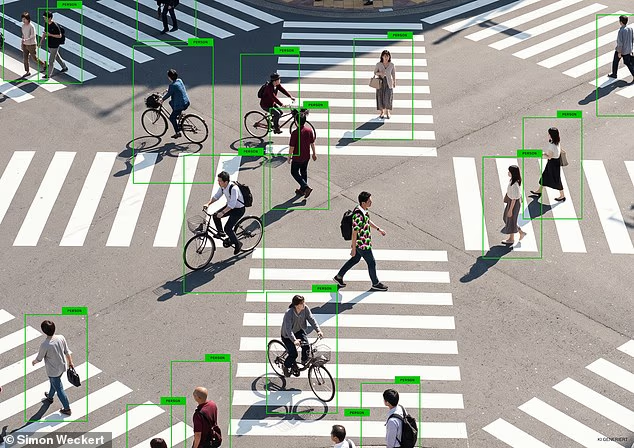
As AI–powered cameras become an increasingly common sight on streets, in shops and at transport hubs, it seems the days of anonymity are numbered.
But one artist claims to have found an unlikely solution – a psychedelic shirt designed to confuse artificial intelligence into thinking you’re not there at all.
Berlin–based artist Simon Weckert has created a ‘Digital Camouflage’ top covered in a swirling explosion of colours, gradients and abstract shapes.
He says the garment is so outlandish it can ‘trick’ computer–vision systems, confusing them so much that they cannot detect the person wearing it.
According to its creator, the shirt exploits a technique known as an ‘adversarial attack’, in which images are deliberately manipulated to fool AI.
While human observers can clearly see the wearer, the software may fail to recognise them as a person at all.
‘Digital Camouflage is not a tool for evading the police, and it is not a promise of anonymity,’ Mr Weckert said.
‘No pattern can promise to defeat every system under every condition – but worn in public, it is a visible signal that being read by machines is not something everyone consents to.’
Mr Weckert says the garment is so outlandish it can ‘trick’ computer–vision systems, confusing them so much that they cannot detect the person wearing it


While human observers can clearly see the wearer, the AI software may fail to recognise them as a person at all. The project was developed in response to the rollout of AI–assisted video surveillance at Berlin’s Kottbusser Tor
The project was developed in response to the rollout of AI–assisted video surveillance at Berlin’s Kottbusser Tor, where police have been testing systems designed to analyse behaviour in public spaces.
Mr Weckert argues that such technology raises difficult questions about privacy and the growing role of automated monitoring in everyday life.
His answer was to turn those concerns into something people can wear.
Demonstration videos show AI surveillance software drawing boxes around every passer–by in a public square – except for the individual wearing the shirt.
‘The algorithm no longer registers a person,’ Mr Weckert said.
‘The wearer becomes, in effect, invisible to the machine – present to every human eye, absent to the model.
‘When systems that cannot be publicly tested can be undone by a piece of fabric, how much trust should we place in them before we hand them the public square—in Berlin, or anywhere else?’
The shirt is currently on sale for $75.60 (£55.65) alongside other items designed by Mr Weckert, including a Bluetooth jammer.

According to its creator, the shirt exploits a technique known as an ‘adversarial attack’, in which images are deliberately manipulated to fool artificial intelligence systems


Although the shirt may hide you from a machine, it is unlikely to help you blend into a crowd. It is currently on sale for $75.60 (£55.65)
There is, however, one obvious drawback.
Although the shirt may hide you from a machine, it is unlikely to help you blend into a crowd.
The garment’s loud psychedelic design is arguably more attention–grabbing than almost anything else on the street.
Rather than disappearing, wearers may simply find themselves becoming the most noticeable person in the area.
AI–powered surveillance is becoming increasingly common in the UK, with police forces using facial–recognition cameras to identify wanted suspects in public spaces.
Supporters say the technology helps tackle crime, while critics have raised concerns about privacy and the risk of innocent people being monitored.