
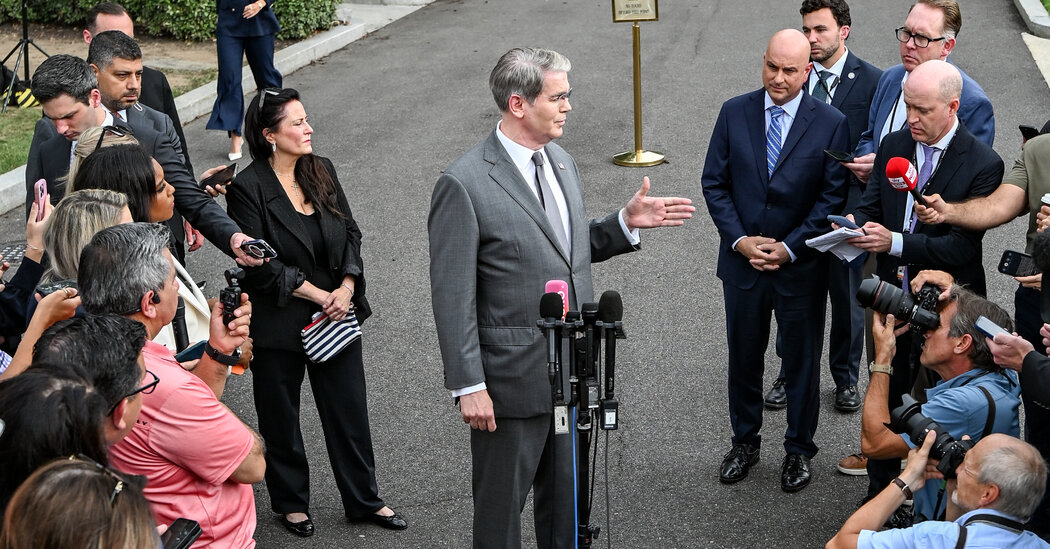
When auditioning to be President Trump’s Treasury secretary, Scott Bessent accused Democrats of constructing a centrally planned economy. He argued that their interventions in markets were politically motivated and said the sitting Treasury secretary, Janet L. Yellen, was purposely changing how government bonds were being sold to stimulate the economy before the 2024 election.
“History teaches us that prioritizing free enterprise and limiting government’s role in the economy are key to raising living standards,” Mr. Bessent said at a Manhattan Institute conference.
Two years later, as Treasury secretary, Mr. Bessent is seeking his own interventions into the markets and the economy in ways that conflict with his stated philosophy. Since entering the White House, the second Trump administration has taken equity stakes in more than two dozen companies and subsidized the U.S. critical minerals industry. A former skeptic of tariffs, Mr. Bessent last week called the taxes that the government collected from companies for their imports “the people’s money.”
But global anxiety about America’s heavy, sustained borrowing and the war in Iran has been impossible to obscure, and Mr. Bessent is starting to see the limits of his powers to bend the global economy to his will.
This week, six months into a war with Iran that has exacerbated inflation, the Treasury secretary unveiled a new round of economic warfare that he billed as D-Day and Operation Economic Outcast. It largely amounted to a warning to other nations that they would face U.S. sanctions if they did not cut ties with Iran.
Mr. Bessent also tried to meddle this month in global financial markets as part of an effort to lower interest rates. He did so by announcing surprising interventions in currency and bond markets and by signaling that the U.S. government was prepared to take further action.
When markets rejected his move — which even his mentor, the investor Stanley Druckenmiller, panned as senseless — he used his megaphone to make the case that investors were misguided about the fundamentals of the U.S. economy. Mr. Bessent is pushing to curb long term bond yields and allay fears about America’s $40 trillion debt burden.
“He’s trying to see if he can persuade the markets by flicking his wrist to bring them to command,” said Kenneth Rogoff, a Harvard University economics professor.
The strategy of jawboning markets is not new. For decades political leaders facing looming debt crises have attempted to talk their way out of trouble.
Silvio Berlusconi, the former Italian prime minister, tried unsuccessfully to alleviate concerns about Italy’s debt problems during Europe’s 2011 debt crisis before ultimately stepping down as bond yields soared. In Britain, former Prime Minister Liz Truss was unable to convince markets that economic growth would cure her economy’s fiscal problems. She was forced to step down after a month and a half amid market backlash.
“He has a lot of credibility, but he’s spending it on this,” Mr. Rogoff said of Mr. Bessent.
A test for Trump’s market whisperer
Mr. Trump tapped Mr. Bessent in 2024 to be his Treasury secretary because he needed someone who could both articulate and enact his economic agenda while calming markets that tended to recoil from the president’s chaotic style.
Although he was not the most likely candidate for the job at first glance, Mr. Bessent won Mr. Trump’s trust with combative television appearances defending his policies, fresh ideas for how to assert control over the Federal Reserve and a new affinity for tariffs.
A South Carolina native, Mr. Bessent earned his credibility on Wall Street by making billions of dollars as the top investor for George Soros, the liberal philanthropist and longtime enemy of Republicans.
Mr. Bessent got his start in the 1980s as an intern working for Jim Rogers, a Yale alumnus who founded the Quantum Fund with Mr. Soros.
“Scott knew essentially nothing about investing when he showed up,” Mr. Rogers said. “I was trying to show him the numbers, the financial statements, return on equity, spreadsheets.”
Mr. Rogers recalled Mr. Bessent being smart and eager to learn the basics of investing. He tutored Mr. Bessent, who slept in the office where he was working, on how to spot companies in depressed industries where there were signs of positive change ahead.
Ultimately, Mr. Bessent made much of his fortune betting against the currencies of other countries. When he was 29, Mr. Bessent helped “break” the Bank of England with crushing trades against the British pound. He was on a small team at Mr. Soros’s investment firm that, in 1992, amassed a $10 billion bet that the pound was overvalued. Mr. Soros’s fund earned more than $1 billion.
In the 1990s, Mr. Bessent, who is gay, was active in supporting gay rights and regularly donated money to Democrats running for office. The fiscal responsibility measures that the Clinton-Gore administration took were aligned with his concerns about deficits. In 2000, Mr. Bessent co-hosted a fund-raiser for former Vice President Al Gore that was aimed at collecting money from gay and lesbian donors.
Sean Patrick Maloney, a former Democratic congressman from New York who has known Mr. Bessent for decades, said that he was not surprised by Mr. Bessent’s rise in Mr. Trump’s orbit. The sharp elbows that Mr. Bessent developed on Wall Street, he said, translated to Washington.
“Whether it was in a big law firm or on Wall Street, where he and I grew up, or here in politics, you realize there are certain guys out there who think gay guys are weak and you have to disabuse them of that notion,” said Mr. Maloney, who is also gay. “And sometimes that means getting in their face and telling them to go [expletive] themselves. And Scott can do that with the best of them.”
The political pugilist
In Washington, Mr. Bessent has ditched his bookish southern charm in favor of brass-knuckle politics.
Asked at a House hearing last year about reports that he had gotten into a physical altercation with Elon Musk, the billionaire from South Africa who was running the Department of Government Efficiency, Mr. Bessent said: “I’ll take South Carolina over South Africa any day.”
Mr. Bessent acknowledged that he had told Bill Pulte, the housing finance director, that he was going to “kick his ass” during another argument.
“Many teams have fights in the locker room and then go out and win for the team on the field,” Mr. Bessent said at a Senate hearing in June when he was asked about Mr. Pulte.
The Treasury secretary has won praise from Republicans for insulting Democrats.
Mr. Bessent billed Senator Elizabeth Warren of Massachusetts an “American Peronist” following her criticism of the Trump administration’s support of Argentina’s president, Javier Millei. And at a gala for the Texas Republican Party in Houston in June, Mr. Bessent mocked Gov. Gavin Newsom of California for being a man who was “in over his hairplugs.”
Mr. Bessent has also not shied away from clashes with left-wing protesters. When hecklers from the liberal group Code Pink interrupted the Treasury secretary at a Washington restaurant last December and criticized the Trump administration’s economic sanctions policies, Mr. Bessent called them ignorant and erupted at the owner of the restaurant for not removing them. According to the owner of the restaurant, Mr. Bessent spit in his food and said he was leaving without paying the bill.
The Treasury Department declined to comment.
A White House spokesman, Kush Desai, called Mr. Bessent a “a maestro of the financial markets” and one of the most transformative Treasury secretaries in history.
“Secretary Bessent has consistently leveraged – and augmented – his gravitas and the power of the American economy to deliver for both President Trump and the American people,” Mr. Desai said.
Monica Crowley, who served in the Treasury Department in Mr. Trump’s first term and is now his chief of protocol, said that Mr. Bessent was a “genteel southern gentleman with a spine of steel” who had been loyally carrying out the president’s agenda.
The visible hand on the market
The taste for political theater that Mr. Bessent has developed over the last year could come with a price.
As he warned on Monday of a barrage of secondary sanctions on countries that continued to do business with Iran, Mr. Bessent acknowledged that being forced to make good on such threats could have unwanted consequences: It might erode the dominance of the dollar and create chaos for banks.
“Why would I want to blow up the global financial system?” Mr. Bessent said when asked why he was giving countries time to sever trade ties with Iran.
Taming the bond market could be equally challenging.
With midterm elections less than three months away, Mr. Trump and Republicans are under pressure to lower the cost of living in the United States. Mr. Bessent had already been trying to keep borrowing costs down before last week, when he announced a plan to repurchase longer-term U.S. debt to stabilize the bond market.
Treasury market traders did not wait long to test Mr. Bessent and how far he might be willing to go to keep a lid on Treasury yields, which had shot up to their highest level since 2007.
Within 24 hours of announcing the bolstered buybacks, yields on long-term government bonds had essentially taken a round trip, returning after an initial decline back to levels notched before Mr. Bessent intervened. Subsequent efforts by the Treasury secretary to alleviate concerns in media appearances failed to arrest the sell-off. Bond yields, which are the return on the investment, move inversely to the prices investors pay to buy them.
The move laid bare the limitations of trying to influence dynamics in a $28 trillion debt market that is central to the global financial system. While the Federal Reserve sets overnight interest rates, which have an outsize impact on short-term yields, long-term rates are far harder to control.
Traders say the recent move was driven by a confluence of factors, from concerns about the country’s fiscal profligacy to inflation worries as the war with Iran drags on. It also probably reflects the higher growth prospects from a splurge of investment in artificial intelligence. Those technology companies are also issuing large amounts of debt, providing some competition for Treasuries.
The most prominent voice of skepticism came from Mr. Bessent’s close friend, Mr. Druckenmiller. A former partner of Mr. Soros, Mr. Druckenmiller called on Mr. Bessent to stop intervening in the bond market and focus on reducing deficits.
“You can’t buy your way out of a solvency conversation with liquidity tools,” Mr. Druckenmiller wrote in The Wall Street Journal on Tuesday. “You can only postpone the conversation and raise the eventual price.”
In recognition that markets are looking for something substantive that might change the economic fundamentals, Mr. Bessent said the administration was working on fiscal consolidation measures that would soon be announced. Ultimately, Mr. Bessent made no mention of embarking on major austerity measures such as reducing spending on social safety net programs or the military that could bring political pain. He concluded that the U.S. economy would need to grow its way out of its mountain of debt.
Stephen A. Myrow, a top aide to former Treasury Secretary Henry Paulson during the 2008 financial crisis, said that Mr. Bessent risked “losing the room” in Washington and on Wall Street if his creative efforts to intervene in markets failed.
“The market knows what the tools are — he doesn’t have imaginary tools,” Mr. Myrow said.
He added that by echoing Mr. Trump’s bombastic style and being overly political, Mr. Bessent wasn’t helping calm investors.
“When Bessent starts talking and acting like Trump, I think the market starts getting nervous,” Mr. Myrow said.
For now, Mr. Bessent appears to have the president’s full support. Speaking to reporters last Friday, Mr. Trump said he approved of the Treasury secretary’s intervention in the bond market and that he was prepared to take even more aggressive action if necessary.
“He has a good touch, a very good natural touch for the bonds and interest,” Mr. Trump said of Mr. Bessent. “We have many types of intervention — that’s one — the ultimate intervention is our military. If we have to use that we will.”
Colby Smith contributed reporting.


