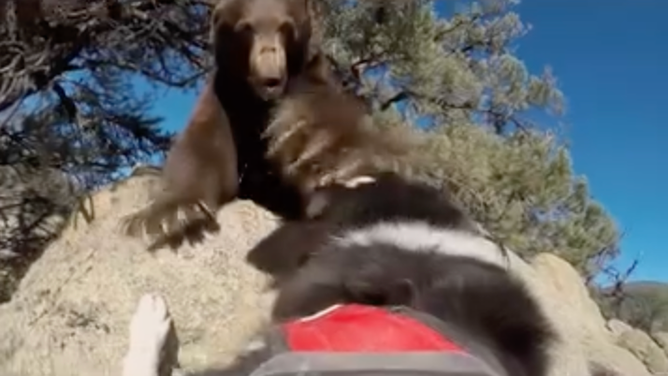
Some courageous dogs chased down a bear as part of the Nevada Department of Wildlife’s bear reorientation operation. The program is designed to encourage bears to leave public spaces and return to the wild.
RENO, Nev.- Karelian Bear Dogs are putting their skills to the test, helping wildlife officials safely haze bears and encourage them to stay away from neighborhoods.
The Nevada Department of Wildlife (NDOW) recently took to Facebook to highlight GoPro footage showing one of its trained Karelian Bear Dogs working alongside wildlife biologists during a bear hazing operation.
The neat thing about the video is that it’s from the dog’s perspective, so you truly feel immersed in the chase.
Courageous dogs chase bear back into the wild in Nevada wildlife operation
(Nevada Department of Wildlife )
“Originally developed in Finland, Karelian Bear Dogs have been used for generations to work around large game, including bears. They are known for their courage, intelligence and strong instincts, making them well suited for wildlife management,” NDOW said.
THESE ARE THE 6 BIGGEST BEARS ON EARTH
The dogs play an important role in helping wildlife officials restore a bear’s natural apprehension towards people.
According to NDOW, “More than 90 percent of black bear conflict calls in western Nevada involve unsecured garbage or other human food sources.”
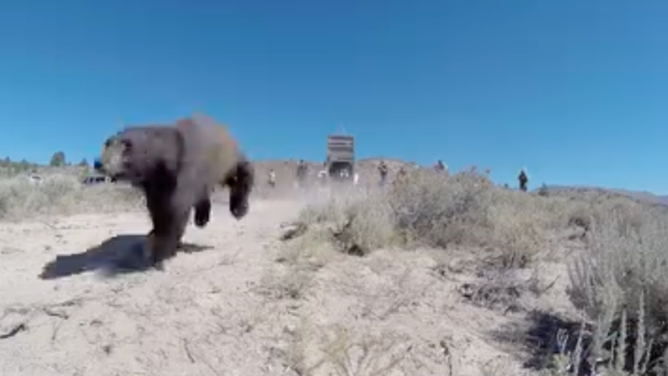
A bear runs away after being chased by a Karelian bear dog
(Nevada Department of Wildlife )
RUNNER COMES FACE-TO-FACE WITH BROWN BEAR DURING FRIGHTENING ALASKA TRAIL ENCOUNTER
Rather than capturing or fighting the animals, the goal is to create a negative experience that encourages bears to leave communities and return to their natural habitat.
“Keeping bears wild sometimes starts with four paws,” NDOW said while sharing the footage.
TINY DETECTIVES ARRIVE AT SACRAMENTO ZOO AS CRIME-FIGHTING RATS MAKE THEIR DEBUT
According to the department, hazing is designed to reduce conflicts between bears and people by reinforcing the idea that areas heavily populated by humans are not safe or good places for wildlife.
It is a science-based approach known as aversive conditioning.
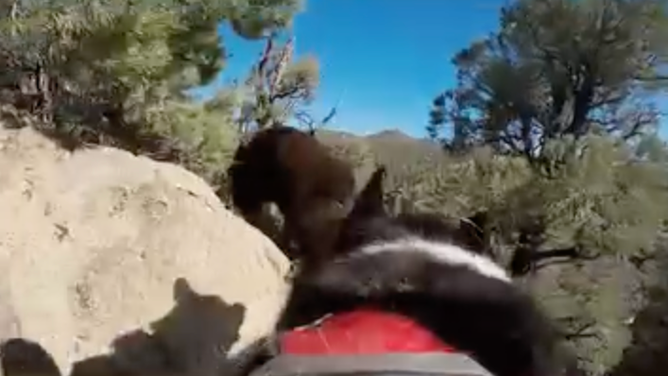
Karelian bear dog chases bear back into the wild
(Nevada Department of Wildlife )
NDOW emphasized that each hazing operation is carefully planned and carried out by professionals, with safety of both people and bears as the primary goal.
By utilizing this approach for over two decades, wildlife officials hope to ensure that both growing neighborhoods and local wildlife can safely coexist for years to come.