Tropical Storm Moke targets the Big Island of Hawaii on Sunday with mounting flood risks in a rare back-to-back threat for the state. As it makes its closest approach to the island, over a foot of rain is possible in some areas, accompanied by strong gusts. FOX Weather Meteorologist Melanie Black breaks down Moke’s tracking and impacts:
Updated at 10:15 A.M. ET on Sunday, Aug. 22.
34 YEARS AGO TODAY
Coincidentally, it was a Sunday that year, too: Sunday, August 23, 1992.
A couple of quick showers blew across Miami in the morning. Otherwise, it was a bright and sunny summer day. By afternoon, there was a nice breeze – the outer reaches of Hurricane Andrew‘s circulation.
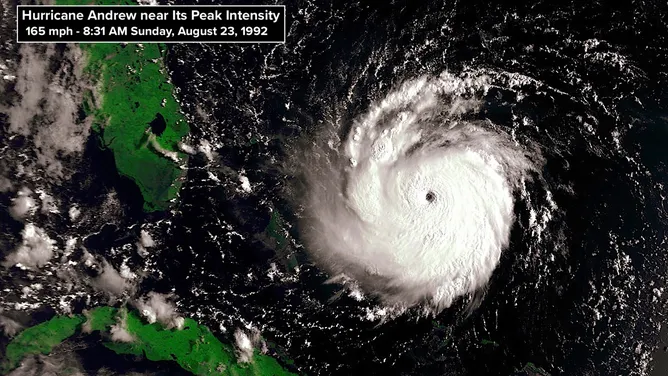
At 8:31 that morning, this iconic high-resolution image was taken. It was just by chance that the NOAA-12 polar-orbiting satellite was in just the right place at that moment to take the historic shot.
Hurricane Andrew seen on satellite imagery 34 years ago.
(FOX Weather)
It’s actually a composite of multiple images, and the color is imagined by the computer.
The 9:00 a.m. intensity estimate from the National Hurricane Center (NHC) was 140 mph. Modern analysis techniques put it at 165 to 170 mph. The north end of Eleuthera Island in the Bahamas was dead ahead. They would take the full impact of the 170 mph buzzsaw that afternoon.
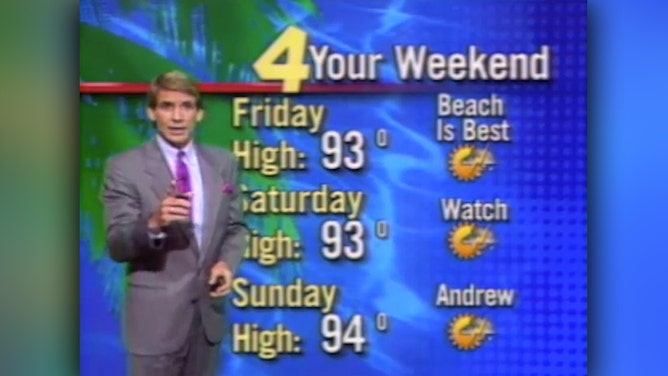
On this day 34 years ago, Tropical Storm Andrew was just a big smudge on the satellite.
(WTJV / FOX Weather)
Hurricane Warnings were in effect for the Florida coast from Vero Beach to Key West. Evacuations were ordered for South Florida coastal areas, including Fort Lauderdale Beach, Hollywood Beach and Miami Beach.
Many people headed out of town, but more stayed, often heading to the homes of friends or family in the inland suburbs. Millions were on the move.
There were hiccups during the day, but by evening, a calm settled over South Florida. Wherever people were, they would be … come what may.
MIAMI BEACHES BURIED UNDER RECORD SARGASSUM AS EXPERTS RACE TO FIND A SOLUTION
That evening I said on TV something like, “Look around your neighborhood because nothing is likely to look the same in the morning.” And it wasn’t.
IN THE ATLANTIC
The National Hurricane Center has boosted the odds that a disturbance currently over Africa will develop into at least a tropical depression. The consensus of the various computer forecast models is that the system will become a tropical storm and curve north before it gets to the Caribbean.
FIRST TASTE OF FALL ON THE WAY AS COOLER AIR TARGETS THE EASTERN US
Some long-range forecasts intensify it into a hurricane well offshore of the U.S. East Coast. Bermuda might eventually have to pay attention.
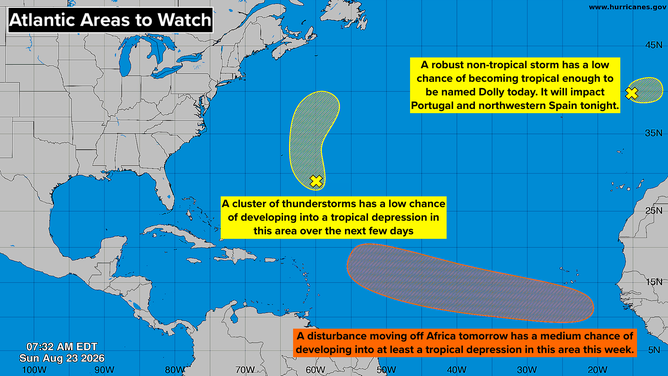
Areas to watch in the Atlantic.
(Bryan Norcross)
The disturbance currently near Bermuda has a low chance of developing into a depression in the next day or two as it heads north. There’s no apparent significant threat to land.
The potential development area in the upper right of the map is related to a strong non-tropical storm heading toward Portugal and northwestern Spain. It could get named Dolly today before it makes landfall. The NHC puts the odds in the low range.
WHY IS IT SO RARE FOR HURRICANES TO MAKE LANDFALL ON HAWAII?
IN THE PACIFIC
Tropical Storm Moke is tracking west well south of Hawaii. It has never strengthened very much. Dry air has wrapped into its circulation, which is now forecast to cause weakening.
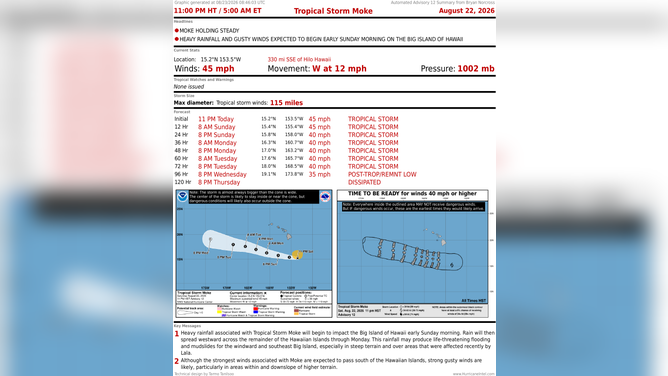
Tropical Storm Moke makes its closest approach to Hawaii on Sunday.
(Bryan Norcross)
Some heavy rain is possible over the Hawaiian Islands, however, especially the Big Island. Unfortunately, the areas devastated by Hurricane Lala are especially vulnerable.
RAIN, WIND AND… SNOW? TROPICAL STORM LALA BRINGS A WINTRY SURPRISE TO HAWAII
ELSEWHERE IN THE PACIFIC
Tropical Storm Lala is weakening. It is not a threat to land.
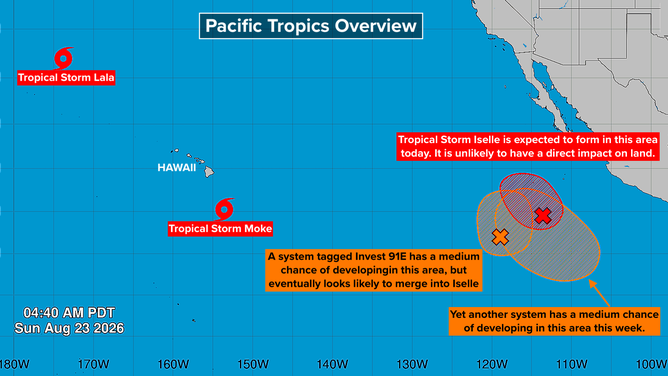
Areas the watch in the Pacific.
(Bryan Norcros / FOX Weather)
The conglomeration of development areas in the Eastern Pacific will likely yield two hurricanes in the end. The first one, Hurricane Iselle, will head north offshore of Mexico.
The other will head in the general direction of Hawaii, but currently there’s no indication of a threat to land.