Geoff Bennett:
Part of Washington, D.C., is being transformed into a racetrack for this weekend’s IndyCar race around the National Mall.
The event has sparked plenty of controversy, but, across the country, smaller local racetracks are at the center of a very different debate, one that’s prompting some state legislatures to protect what supporters call the right to race.
Digital reporter Tim McPhillips traveled to a track in Virginia to learn more.
Tim McPhillips:
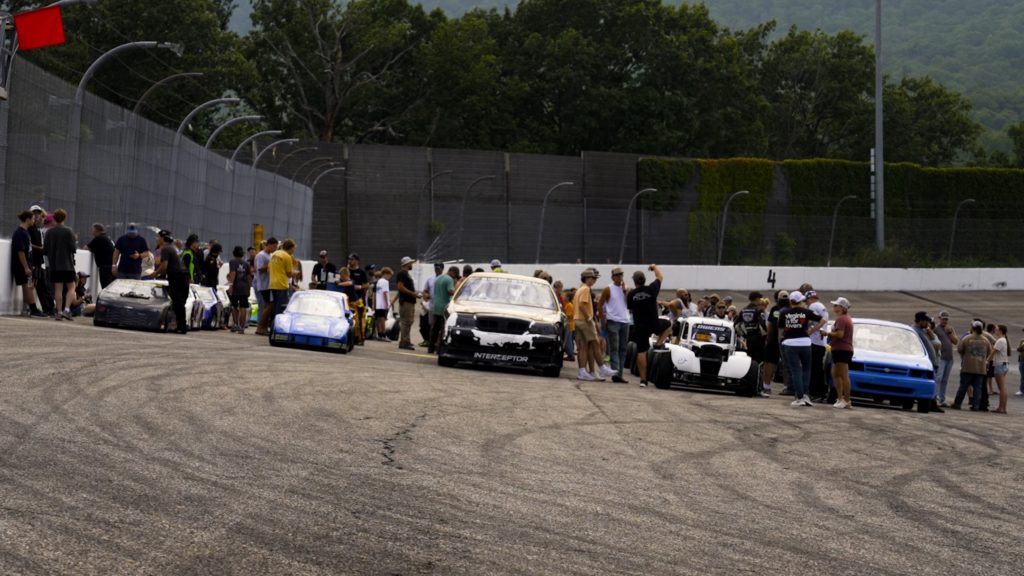
It’s race day at Shenandoah Speedway, like it is most Saturdays in the summer.
Stepfon Hawkins Jr., Race Fan:
I’m thinking about getting back down myself, honestly. I love it.
Wayne Townsend, Race Fan:
It’s a great way to bring people together, people who enjoy racing, who enjoy cars.
Chris Lilly, Promoter, Shenandoah Speedway, I will say it’s definitely going to be one of the most scenic tracks I think you will go to.
Tim McPhillips:
Shenandoah Speedway, opened in 2005, sits in the heart of the Blue Ridge Mountains, tucked behind a cornfield like something out of “Field of Dreams.”
Chris Lilly grew up racing here and now manages the track. That means he does it all, from pre-race logistics coordinator.
Chris Lilly:
I answer every e-mail, every phone call, every text.
Tim McPhillips:
To event day race director to crash responder.
Chris Lilly:
I live 35 minutes away, but this is my home.
Tim McPhillips:
But Shenandoah Speedway and local tracks around the country are under threat. The Specialty Equipment Market Association, or SEMA, a nonprofit that represents the automobile aftermarket and racing industry, says that, in the past 25 years, the number of motorsports facilities like this one have decreased by nearly a quarter from just about 2,000 to now 1,500.
Joshua Vadeboncoeur, Gardner-Webb University:
That loss can be especially significant in a lot of these smaller towns or rural areas that have already lost other institutions. And the racetrack may be one of the pieces of social infrastructure that still gives people a reason to gather.
Tim McPhillips:
Joshua Vadeboncoeur studies the racing industry at Gardner-Webb University. One major issue putting the brakes on racetracks, he says the rise of noise complaints and nuisance lawsuits.
Joshua Vadeboncoeur:
The track didn’t necessarily move close to the neighborhood. The neighborhood gradually moved closer to the track.
Tim McPhillips:
And even frivolous lawsuits can leave speedways with heavy legal fees.
Joshua Vadeboncoeur:
For a local racetrack that’s already operating on a very narrow margin in the first place, the process itself can become the punishment.
Tim McPhillips:
These issues have prompted some state legislatures to take up so-called right-to-race laws, which protect existing tracks from noise or nuisance complaints from nearby property owners.
So far, four states have passed right-to-race laws Iowa, Kansas, North Carolina, and South Carolina. Similar bills have advanced or been introduced in 12 other states. But with no right-to-race law on the books in Virginia, Lilly sees one thing, future risk.
Chris Lilly:
If the farm next to us sells and they build 300 houses there, then that immediately puts us in a critical position.
Tim McPhillips:
The speedway, like other community tracks around the nation, is an economic driver for this historic railroad town, Lilly says.
Chris Lilly:
This district we’re in is probably one of the lower income districts in all of Page County. And this track means a lot to the town of Shenandoah, to the local businesses.
Tim McPhillips:
And for drivers, racing is more than a hobby.
Kenny Snow races alongside his son, Kenan (ph), and his friend, Travis.
Kenny Snow, Driver:
This is a backbone of motorsports. I mean, you can watch big dogs on TV, but this is where it all starts right here.
Tim McPhillips:
That is especially important for younger drivers.
Jack Owens, Driver:
I am 14 years old, and I started racing about 10 years ago. Racing in itself is like its own community, different from everything else.
Jillian Crowder, Driver:
Me and my family used to always go to the track and stuff and just kind of looking at them, and you kind of get the itch.
Zach Sprouse, Driver:
My dream is one day to work in NASCAR somehow, whether that’s as a driver maybe or as a crew chief.
Tim McPhillips:
But when one track closes, the social community built there can’t just transfer to another one, which might be hours away.
Joshua Vadeboncoeur:
For the town, obviously, there might be certainly a big time economic loss if the track goes away. The harder loss to measure is social and cultural.
Tim McPhillips:
John Allen is the general manager of two longstanding speedways in Kansas. He recalls when tracks were forced to close prior to the state’s right-to-race law.
John Allen, General Manager, 81 Speedway and Humboldt Speedway: They got shut down because somebody had more money than they did.
Tim McPhillips:
Now protected from nuisance claims:
John Allen:
Gives me optimism that we will be able to operate for a long time.
Tim McPhillips:
But noise and nuisance complaints aren’t the only pressure point for both local racetracks and the racing community. Rising land values can make it hard for racetracks to expand or simply become too valuable to hold on to.
Joshua Vadeboncoeur:
But, economically speaking, the property may be worth far more to a developer than it has as a weekly operation for racing purposes.
Tim McPhillips:
Back in Virginia, Lilly says his community at Shenandoah Speedway brings tourists and locals to where the mountain roars. He doesn’t want that to change.
Chris Lilly:
Long term, I just want this place to be the — to its full potential.
Tim McPhillips:
For the “PBS News Hour,” I’m Tim McPhillips in Shenandoah, Virginia.