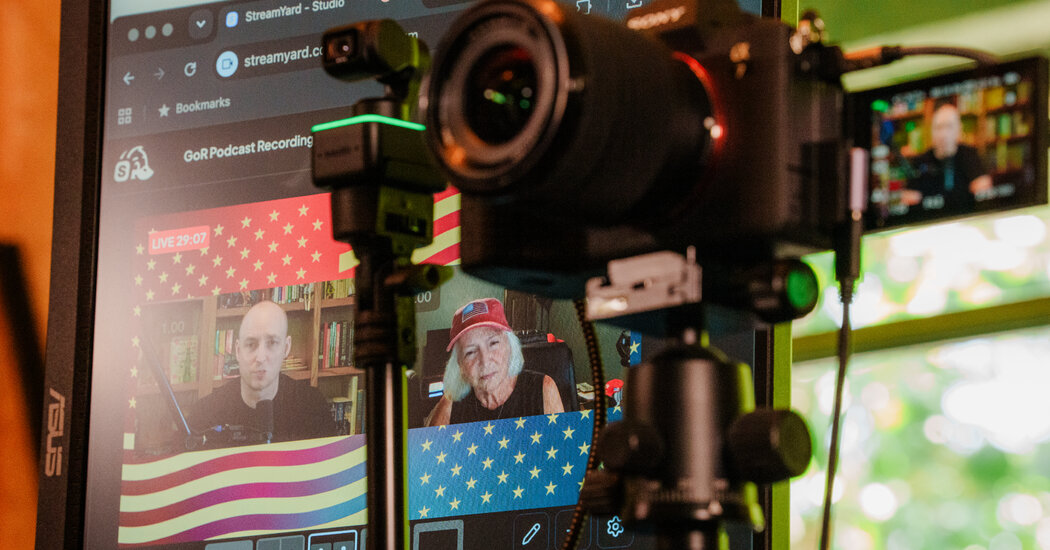
Every Sunday, the Kultgen-Popp family gathers on Zoom and yells at one another. From California and Texas, the adult siblings Chad Kultgen and Haley Popp try to convince their parents, Mary Lou and Bob Kultgen, that President Trump is evil. And from their living room in Oklahoma, their parents reject every argument.
The family members lob contradictory headlines at one another, trading irreconcilable claims about the war in Iran, the Epstein files and other breaking news stories. These arguments always end with each exhausted family member saying, “I love you.” Then Chad, 50, who generally leads these debates, shares the video on YouTube in the form of a podcast called “The Necessary Conversation,” typically drawing more than 100,000 viewers an episode.
For years, politics has been straining, and breaking, relationships. More than a third of Americans say political differences have led to breakups with family members, romantic partners, friends and co-workers, according to a 2026 study by psychologists at the University of California, Irvine. In December 2025, 56 percent of Americans surveyed by the Pew Research Center said they’d stopped talking to someone about political or election news because of something they said — up from 45 percent in 2024.
The internet is awash in steel-cage-match-style debates such as Jubilee shows or “Change My Mind,” where strangers try to roast each other for the audience’s entertainment. But “The Necessary Conversation” stands out as a public manifestation of something families have been doing in private all over the country. And family fights can cut more deeply than a sparring match with a stranger.
For the Kultgen-Popp family, at least, fighting feels like progress. In Trump’s first term, after Chad posted anti-Trump memes on Facebook, his mother blew up at him and the family went no-contact for something approaching a year. They were too angry to talk politics — but too partisan to avoid the subject altogether.
Estrangement only made things worse. “I was accustomed to speaking to my mother quite literally every day,” Haley, 45, said. “To go from that to absolutely nothing was devastating.” This is one thing the whole family seems to agree on. “It almost ripped my heart out,” Mary Lou, 71, said.
One day in 2021, Mary Lou’s phone rang. It was Chad. “Mom, I have an idea,” he said. “How about we talk once a week as a family on Zoom?” Mary Lou said OK. “But it’s about politics.” She paused. “Oh, I don’t know.”
Chad has hosted other podcasts and cowrote a book about how to succeed on reality TV. Haley has appeared on Food Network contests and owns a bakery with an unapologetically progressive online presence. But for their parents, the podcast was a new and risky experience.
At the beginning of every episode, Chad shares recent headlines that, he hopes, will shock his parents into abandoning Trump. Then Mary Lou reads her own headlines, to try to persuade Chad and Haley to see Trump in a new light.
Her husband, Bob, has the most far-right, provocative opinions (some of which his own kids describe as racist) and has missed recordings because of health concerns. But until this spring, Mary Lou had missed only one Sunday session — after her beloved Chihuahua, Kitty Kat Sugar Bear, had to be put to sleep.
“I think the hardest thing is just articulating what I want to say quickly enough,” Mary Lou said. “All the liberals are out there just listening, ready to get on me, you know, if I say the wrong thing. So I try very hard to think before I say my words.”
Intellectually, Chad and Haley recognize that arguing the facts doesn’t work. But they do it anyway, almost constantly. “I can’t help it,” Chad said. When he sees what is happening in the world, he added, “as much as I want it to be just about having a point of contact, it’s also maddening.”
Watching a family argue
A few patterns present themselves repeatedly throughout “The Necessary Conversation.” The harder the siblings push, for example, the more extreme the parents get. And vice versa.
In one episode, for example, they discussed the prospect of a military draft. Bob expressed his support for drafting 18-year-olds. It’s easy to miss Mary Lou’s initial disagreement. “I don’t think so,” she said quietly. “I don’t like that.” But her opinion got lost in the fray, and soon, she started defending the draft alongside her husband.
Viewers get glimpses of a deeper conversation in two episodes of the show, when a therapist named Karen Cunningham visits the family at Chad’s invitation. Cunningham has built an online following criticizing Trump, but that didn’t seem to bother the parents. “I love her,” Mary Lou said. “I want her back.”
In Cunningham’s presence, the father, Bob, 73, behaved very differently. He turned toward the camera more and stared out the window less. He revealed that he was abandoned as a baby and was treated with indifference by his adopted mother. He’s spent his entire life, he said, trying to prove his biological mother shouldn’t have given him up.
Occasional tender moments like this reveal a subtle effect the show has had on the family. So far, no one admits to changing their mind about anything political. But the show has helped them get along off-mic much better than they used to. “If we’re going to fight, we fight there,” Mary Lou said. She and Haley are back to talking almost daily — about Haley’s kids, Bob’s health, Mary Lou’s beloved horse and their everyday lives.
Through the podcast, they’ve created a scheduled time and place to contain their conflicts, much as other families do in therapy. And they’ve also created a shared project that binds them together.
But the podcast also takes a major toll. After each episode, Haley needs two to three hours to recover. “I go into my bedroom and shut the door, and I read a book,” she said. “I try to come back to reality. This is not easy for me.”
More than once, Mary Lou has ended an episode by saying she can’t continue. “There are some Sundays I feel like I’ve been in an athletic event,” she said. “My heart’s racing, I’m sweaty all over. I click off, and then I’ll go to my horse. It helps me de-stress.”
Is the conversation necessary?
The premise of “The Necessary Conversation” is an argument: Conversations like this should be happening in more living rooms across the country. But is that actually true?
Several conflict experts interviewed for this article admired the family for staying in the fight. “They’re having the conversation,” said Ryan Dunlap, a former hostage negotiator and crisis intervention officer who runs Conflictish, a conflict strategy firm. “And I know that sounds simple, but we really have become so polarized that we can’t even have hard conversations anymore. They are subjecting themselves to repeated discomfort.”
But the biggest mistake this family is making, the experts said, is beginning with the goal of changing one another’s minds. “It just doesn’t work,” said Orna Guralnik, the clinical psychologist featured in “Couples Therapy,” a Showtime documentary series. “It’s a fantasy.”
Humans have a deep need for autonomy, the experts agreed. If you pressure someone to agree with you, they generally resist — and sometimes move even further away from you.
The research on persuasion reveals a hard-to-accept paradox: The only way to change other people when they are entrenched in conflict is to demonstrate over and over that you are not trying to change them.
It helps to have a different goal. In hostage negotiations, Dunlap said, he’d try to understand the underlying need, which might be freedom, or respect. If you can have that conversation, you might find a path forward.
This is what happened when Karen Cunningham, the therapist, joined the show. She echoed words she’d heard the family say, proving she’d been listening: “Where did that come from, that you ‘had to be the best’?” she asked Bob. When he told her how hard his childhood had been, she acknowledged his suffering in three simple words: “I’m so sorry.”
Bob “was more open, more transparent in that conversation than in any of the other clips I’ve seen,” Dunlap said.
Once people feel heard and understood, they relax their grip on their argument, experts said. And they might even listen. “You’re not going to arrive at some joint resolution,” Guralnik said. “What you could arrive at is each side less doggedly holding onto their argument.”
In a series of studies, Julia Minson, a behavioral scientist at Harvard, and her colleagues found that people who start and end their arguments by stating that they want to learn from the other person were viewed as more intelligent, moral, trustworthy and objective. The bottom line: It’s not that changing minds is impossible; it’s that it takes much longer than we expect. And the prerequisite is understanding, which requires actual listening.
The paradox of persuasion
The four-year-old show’s modest audience has nearly quadrupled since 2025, around the time Chad started putting provocative clips on TikTok. Soon Mary Lou was getting recognized at Costco. Watching the siblings chastise their parents each week seems to give frustrated progressives a chance to live vicariously through them. But it will not bring the country closer together, the experts said. Trying so hard to persuade can make persuasion impossible.
In early May, Bob had a serious health scare. His heart stopped beating for three minutes because of congestive heart failure. Emergency medical workers revived him, and he is still recovering. Haley and Chad flew in to help shortly afterward. The ordeal has been harrowing for the whole family.
The Headway initiative is funded through grants from the Ford Foundation, the William and Flora Hewlett Foundation and the Stavros Niarchos Foundation (SNF), with Rockefeller Philanthropy Advisors serving as a fiscal sponsor. The Woodcock Foundation is a funder of Headway’s public square. Funders have no control over the selection, focus of stories or the editing process and do not review stories before publication. The Times retains full editorial control of the Headway initiative.