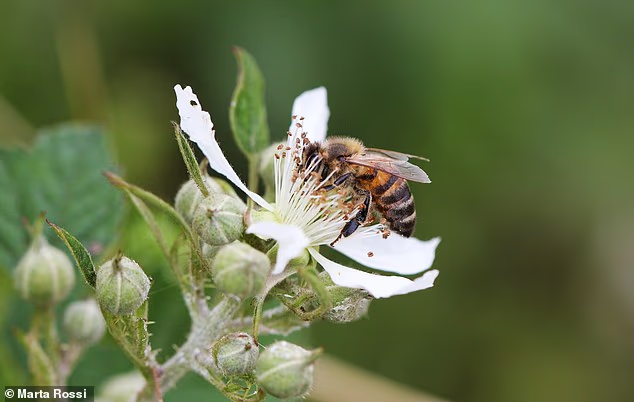
Forget reaching for the weedkiller – scientists say you should let the weeds grow in your garden this summer.
Letting scruffy thistles, ragwort and knapweed grow in your garden could help save hungry bees, according the experts from the University of Sussex.
Their new research has revealed that late summer is the toughest time of year for honeybees to find enough food, with August proving particularly challenging.
Bees get the least energy from foraging during this period, when fewer flowers are in bloom and more insects are competing for nectar.
The problem could be even worse during heatwaves, which can reduce the amount of nectar flowers produce and disrupt their flowering times.
Now, experts say gardeners can give bees a helping hand simply by turning off the lawnmower and tolerating a few weeds, which can provide a vital source of food when the insects need it most.
‘Our findings add to a growing body of literature indicating that late–summer is a particularly challenging season for pollinators,’ co–author Dr Nicholas Balfour said.
‘This is incredibly important, as this period of the year is when the vast majority of pollinator species are active and require forage to provision for their offspring.’
Scientists from the University of Sussex found that bees get the least energy from foraging during late summer, when fewer flowers are in bloom and more insects are competing for nectar
The study, published in the journal Functional Ecology, found that honeybee foraging is most efficient during spring.
This is a time when most insect–pollinated trees like horse chestnut, willow and cherry are in bloom.
But the research, which took place around Brighton and Edinburgh, found the insects struggled to gather nectar in July and August.
Dr Ciaran Harris, also a co–author on this study, explained: ‘Encouraging flowers that bloom in late summer when bees find it more challenging to gather nectar or pollen will be more valuable for helping them.
‘This could be achieved by planting late–summer blooming flowers, adjusting when lawns are mown, or being more tolerant of summer–blooming ‘weeds’ like thistle, ragwort, and knapweed.’
The findings from the study have implications for other pollinators too.
‘Late summer is likely challenging for other species of flower–visiting insects because honeybees visit a large variety of flower species,’ Dr Harris added.
‘This means that they’re a good indicator of overall availability of nectar in the landscape.’

Planting flowers that bloom in late summer could also provide a vital source of food when bees need it most, the researchers said
Over the course of the study, the researchers collected foraging data from 1,217 honeybees and nectar data from 1,426 flowers.
They found similar patterns in Brighton and Edinburgh, despite the cities being around 370 miles (600km) apart.
This suggests that late summer might be a challenging period for bees to gather food in many areas of Britain.
Professor Francis Ratnieks, a co–author on this study, said: ‘The results confirm the pattern that had emerged from a wide range of indirect studies done in our lab, which included decoding bee dances to see how far they had to fly to forage month by month.
‘These studies all point to late summer being the most challenging season for gathering nectar, and in doing so simplify the task of ‘helping the bees’.’
Last month, scientists revealed that bumblebees stick out their tongues and ‘lick their lips’ after tasting a sweet treat.
But when they are given salty or bitter drinks, they shake their heads in disgust and try to wipe their mouths.
This marked the first time that scientists have seen an insect make a reaction to food that it ‘likes’ or ‘dislikes’.
Experts have previously urged gardeners to embrace slugs and snails instead of trying to kill them off.
This would ‘take the stress out’ of looking after plants and restore ecosystems, the Royal Horticultural Society advisers said.
Allowing pests would help to restore nature in the UK, one of the ‘most nature–depleted countries in the world,’ Clare Matterson, director–general of the RHS, said.
However, she said she acknowledges that many gardeners will find the message that slugs are no longer ‘pests’ hard to accept.