There’s nothing like singing along at the top of your voice while driving – but scientists have discovered new album releases are linked to a spike in car crashes.
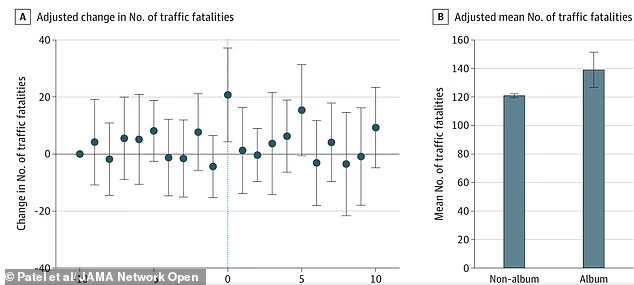
Researchers compared US traffic fatalities on the release dates of 10 of the most–streamed albums from 2017 to 2022.
These include new collections from Taylor Swift, Drake, Bad Bunny and Harry Styles.
They found that on release days, music streaming was 43 per cent higher and traffic fatalities increased by 15 per cent.
In all, there were 139 deaths on release days compared to 121 on surrounding days.
The team, from Harvard Medical School in Boston, cautioned the findings don’t prove streaming caused the increase – and they have no way of confirming that the drivers involved were streaming music.
But they said: ‘These findings suggest that online music streaming through smartphones is associated with distracted driving and traffic fatalities.’
They warned that potential distractions include the phone, the car’s infotainment system or even the music itself.
Traffic fatalities rose by 15 per cent on album release days, the researchers found. Potential distractions include the phone, the car’s infotainment system or even the music itself
The researchers used the US Fatality Analysis Reporting System, which records every fatal crash on public roads, to examine 233,809 deaths between 2017 and 2022.
They focused on the 10 albums with the highest number of first–day streams on Spotify during that period, including Midnights by Taylor Swift, Certified Lover Boy by Drake and Un Verano Sin Ti by Bad Bunny.
For each release, they compared the number of deaths on the day the album came out with the 10 days before and after it.
The researchers also took into account factors including the day of the week, time of year, calendar year and federal holidays, to make sure the results weren’t being driven by normal variations in road deaths.
Analysis revealed the jump in deaths was particularly pronounced among younger drivers and men.
And crashes involving just one person in the vehicle showed a larger increase than those involving multiple occupants.
The effect was also stronger in cars fitted with infotainment systems – the vehicle’s built–in central hub combining information and entertainment, which is often controlled via touchscreen.
This suggests that technology designed to make controlling music easier could also be providing a distraction at the wheel.

Bad Bunny (pictured here doing Carpool Karaoke with James Corden) had one of the most–streamed albums between 2017 and 2022
The researchers found no meaningful difference between crashes occurring during daylight and at night, or between rural and urban areas.
The increase was actually larger in clear weather, which the researchers suggested could be because drivers feel safer and therefore let their guard down when road conditions are good.
Another possibility is that people are more likely to listen to energetic, fast–tempo music when the weather is nice.
‘Although there are multiple mechanisms that could explain these findings, our results point to smartphone–enabled driver distraction as a likely contributor,’ they wrote in the journal JAMA Network Open.
‘Music is frequently streamed from online platforms, and managing music in the car through smartphones is an activity that may lead to distraction.’
They added that having passengers in the car could potentially reduce driver distraction as they are able to help control the infotainment system or smartphone, rather than the driver doing it themselves.
‘Further actions by smartphone and vehicle manufacturers, software developers, and policymakers to improve driver safety surrounding streaming media may be warranted to reduce traffic fatalities,’ they concluded.
Earlier this year, safety experts called for cars to go ‘back to basics’ amid warnings that high–tech features can prove deadly.
Experts said tapping your in–car entertainment system to change the music or adjust the heating can be even more risky than using your phone at the wheel.
Studies show that drivers’ reaction times worsen by over 50 per cent while fiddling with their touchscreen interface.
That is an even bigger impact on your safety than texting or taking a call on your mobile, which increase the time it takes to react by 35 per cent and 46 per cent respectively.
The issue is that touchscreen interfaces require drivers to look away from the road for unacceptably long periods of time to control basic functions.
Dr Milad Haghani, a safety expert from the University of Melbourne, told the Daily Mail: ‘This is the dangerous combination and a recipe for significant levels of distraction.’