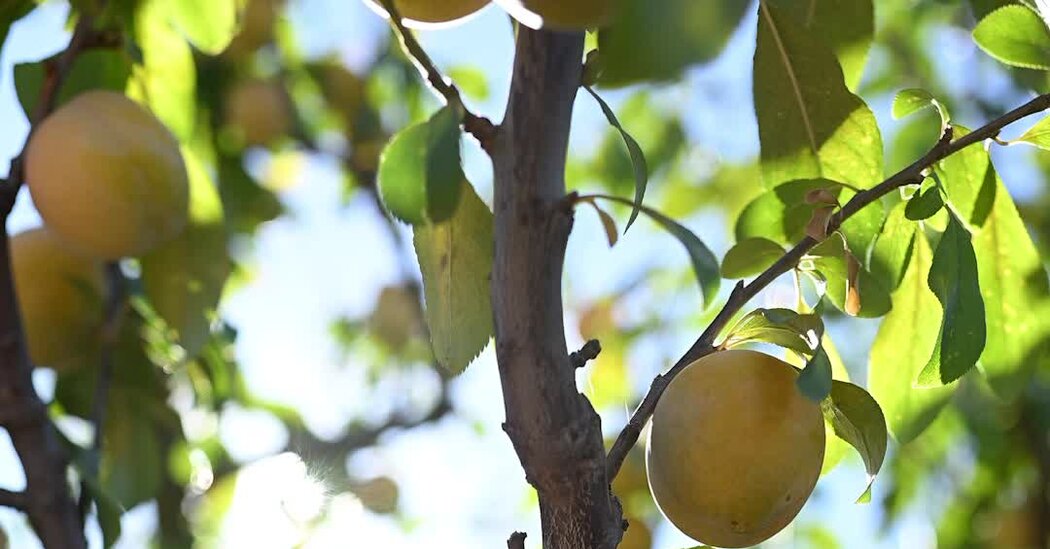
When Andy Mariani’s parents tended their orchards in the Santa Clara Valley nearly a century ago, the region was known as the Valley of Heart’s Delight. Blenheim apricots, Bing and Royal Ann cherries and French prunes with pink and white blossoms bejeweled the land.
Silicon eventually replaced the delight. But as crops gave way to computer chips and multimillion-dollar homes sprouted on former family farms, some 60 acres of the Mariani land remained stubbornly fruiting.
But not for much longer. If Santa Clara County officials approve, Andy’s Orchard, which sits on land his family purchased in 1957, will be sold. Mr. Mariani’s 7,000 trees will be uprooted and replaced with hundreds of homes, two parks, a playground and pickleball courts. Now 80, Mr. Mariani says his once profitable orchard is no longer sustainable.
“It’s time,” he said. “I have hardly any money in the bank.” He relies on Social Security payments.
Mr. Mariani’s 280 varieties of stone fruit, chosen for flavor, not shelf life, are cherished in the region. Hundreds attend his summertime tastings. At the Santa Monica Farmers’ Market, customers line up at 4:30 a.m. for the orchard’s Baby Crawford peaches, Greengage plums and Black Republican cherries. David Karp, a noted fruit writer, calls him “the Picasso of stone fruit.” Mélisse Restaurant, with two Michelin stars, serves wedges of Mariani’s Arctic Jay white nectarines unadorned on crushed ice at the end of a 20-course tasting menu.
“We always, always, always go to Andy’s Orchard,” said Ken Takayama, the restaurant’s co-chef. “The first time I tried a nectarine they produced, it was as if I never tasted a nectarine before.”
Mr. Mariani’s fruit is best eaten over the kitchen sink.
Or right from the tree. “When you’re out in the orchard,” he said, “you don’t worry about the juice.”
When he was young, Mr. Mariani plucked fruit in the orchard next to his family’s house in Morgan Hill, where he still lives. He learned grafting and other farming techniques from his father, who, along with his mother and two oldest siblings, emigrated in the 1930s from the island of Vis, now a part of Croatia.
Mr. Mariani remembers a seminal moment in his childhood when he tasted a peach his father had grown by grafting an early Crawford peach onto an apricot tree. “I spent my whole lifetime trying to bring back that flavor and relive that joy,” he said.
His older brothers were expected to operate the orchard. Andy got a master’s in public administration. But at 23, he was diagnosed with a rare, debilitating autoimmune disease. He quit work as assistant city manager in a nearby town, and for years suffered at home. Experimental medications eventually helped, and when he was 40, the disease went into remission.
“Because of that illness I had, I almost died, and I thought, I want to enjoy my life,” Mr. Mariani said.
He returned to the orchard.
In his search for fruit that is sweet, acidic and aromatic, he digs through old nursery catalogs, visits backyard collectors, university collections and obscure nurseries. In Tashkent, Uzbekistan, a botanist gave him two seeds from golden yellow nectarines. He planted and replanted seeds, selecting the best strain, which became his Silk Road nectarines.
He rescued a peach that the University of California, Davis, had rejected for being too small and delicate for commercial use. Mr. Mariani tasted in it the exotic flavor of his father’s Crawford peach. He named the new fruit Baby Crawford, which became his most popular peach.
As Mr. Mariani farmed, his orchard became increasingly locked in. Technology companies like Hewlett-Packard, Apple, Google and Meta grew, and so did the population. In 1950, when Mr. Mariani was 5, Santa Clara County had 290,547 residents. Today, it has 1.9 million, and a raging demand for housing. Urbanization and farming are incompatible, Mr. Mariani said.
Deer and squirrels dine on his fruit. He also copes with an invasive fruit fly, an insidious oak root fungus and “catastrophic climate change,” he said. This winter’s inadequate chill resulted in almost no Baby Crawford peaches or cherries, his largest and traditionally most profitable crop.
Farming Mr. Mariani’s way is expensive. “If you grow one variety on 30 acres, you have one method of thinning, pruning and irrigation,” he said. But with so many varieties, cultivation must be customized.
Some trees must be picked every other day for two weeks, said Jose Garcia, Mr. Mariani’s foreman. “Sometimes if the fruit turns yellow that doesn’t mean it’s ripe,” he said. “You have to taste it.”
Mr. Garcia earns $24 an hour and is one of about 15 workers who live rent-free on the farm. All but the newest hires earn above the California minimum wage, Mr. Mariani said. Few work full time. Most have side jobs. Mr. Garcia, with Mr. Mariani’s encouragement, attended college and started a maintenance business.
For decades, family farms have been disappearing as corporate farms with lower pricing have expanded and young people find jobs elsewhere.
“Aging farmers are met with an alternative of developing their land or going broke,” said Julie F. Morris, the Santa Clara County agricultural liaison. Unlike soybeans, corn and wheat, she said, specialty fruit is not subsidized by the federal government. “The fact that we are losing the land and conditions that create those Blenheim apricots is a tragedy.”
“Blenheim apricots are so delicate you can hardly take them across the street without their falling apart,” said Mitch Mariani, Andy’s older brother, who farms 12 acres. Andy’s Orchard is one of the few remaining farms that grow the once plentiful fruit.
For generations, farmers grew fruit in this region with its alluvial soil, sun-punched summers and cool winters. At midcentury, an estimated 109,000 acres were orchards; fewer than 4,000 acres remain.
While other family orchards sold chunks of land to keep their farms going, Mr. Mariani survived by operating a country store where he sells fruit, chocolate-dipped dried apricots and jams. He also sells wholesale to high-end specialty markets.
He calls himself a “dirt farmer,” which he says is a farmer who earns all his income from farming, as opposed to a “gentleman farmer,” who has money from other sources. Now he is joining their ranks.
After a decade of losses, Mr. Mariani agreed with his brother to sell the farm. He never married and has no offspring. And no one in the younger Mariani generation wants to operate a failing business.
Mana Investments, a California real estate investment firm, has an option to buy what it calls the Mariani Ranch, with plans to build 376 homes. Mr. Mariani and his brother won’t discuss the terms of the offer.
Scott Murray, a Mana Investments partner, said that “at a minimum” one acre that “is ready to break ground is worth a million dollars.” When the project is completed, Mana Investments anticipates revenue of $600 million. An environmental impact report is expected to be completed within a year.
Mr. Mariani expects that some orchard workers will return to their families in Mexico and that others will attend school or search for work. And he will move out of the family homestead to a friend’s house in town.
“I’m for preserving agriculture,” he said, “but not where it’s no longer viable.” He will continue farming on 20 acres of leased land.
Still, he said, the demise of Andy’s Orchard will be “heartbreaking.” At this year’s final tasting, as Mr. Mariani sat in a weathered chair near the tasting tables, a young boy called out, “Thank you, Andy, for growing amazing fruit!”
Mr. Mariani applauded. He was reminded of his first taste of his father’s Crawford peach. “That’s what I’ll miss,” he said. “I’m trying to give kids the same experience I got.”