Britons despairing over their increasingly yellow and crispy lawns can breathe a sigh of relief – the grass may not be dead at all, according to experts.
After weeks of scorching sunshine and barely a drop of rain, gardens across the country have been transformed from lush green carpets into straw-coloured patches.
But Dr Stuart Thompson, emeritus fellow in Plant Biochemistry at the University of Westminster, said there is no need to panic about the dramatic change.
The grass is responding to the extreme lack of water by effectively shutting down its growth, rather than dying, he explained.
‘As a group, grasses are good at surviving dry conditions and their resilience has helped make them one of the most successful groups of plants on Earth,’ he wrote on The Conversation.
‘Under really dry conditions, such as those we are seeing at the moment, they have no choice but to shut down and wait for better conditions.
‘After previous droughts, apparently dead expanses of stalks have slowly recovered when rain comes back.
‘Our lawns will return this time too.’
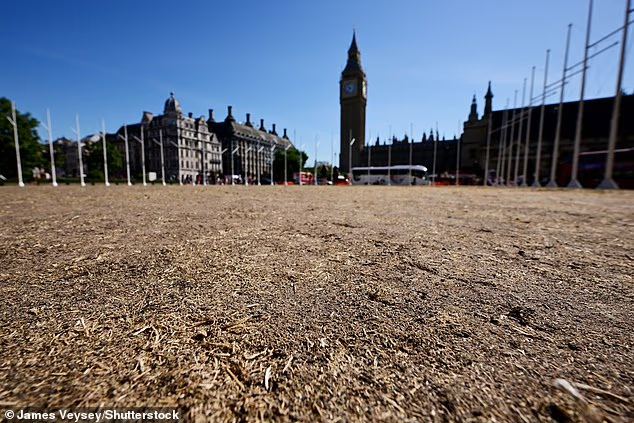
Parliament Square during the drought conditions that have hit 71.3 per cent of England, after the UK recorded its driest July since records began

The grass is responding to the extreme lack of water by effectively shutting down its growth, rather than dying, the expert said. Pictured: An aerial view of dried fields, on August 12, 2026 in Weymouth

Britain’s prolonged lack of rain has left reservoirs, rivers, farmland and gardens under increasing pressure, while millions of people are now affected by water restrictions
Britain is currently in the grip of an extraordinary drought, with almost three-quarters of England now in drought status.
July was particularly brutal, with the Met Office recording just 10 per cent of England’s long-term average rainfall.
This made it the driest July on record for the country.
Across the UK as a whole, July was the third-driest on record, with only 28.9mm of rain recorded – just 35 per cent of the average.
The dry spell has continued into August, with the Environment Agency reporting that just 5 per cent of average August rainfall had fallen by August 10.
The prolonged lack of rain has left reservoirs, rivers, farmland and gardens under increasing pressure, while millions of people are now affected by water restrictions.
But while the situation is serious for Britain’s water supplies and agriculture, your yellow lawn is not necessarily something to lose sleep over.
Dr Thompson explained that when it is this dry, grass moves what water remains to the parts of the plant that will produce new leaves, which are protected deep inside the outer leaves.

Large swathes of England and Wales barely saw a drop of rain across the whole of July, figures show
‘These outer leaves dry out and die, giving some of their water to the critical growing parts, which survive and are ready to produce new leaves when it rains again,’ he said.
‘The growing centres also accumulate sugars that help draw in water and protect their cells from drying out.’
This means the yellow colour can be a sign that the plant is protecting itself from the harsh conditions rather than dying completely.
‘That’s why a yellow lawn can be deceptive,’ he added.
And there is good news for anyone dreaming of getting their pristine green lawn back – as the grass can recover when conditions improve.
As Britain experiences hotter and drier summers, Dr Thompson said our obsession with green grass may need to change.
‘The public may need to accept that lawns will be yellow during dry summers,’ he wrote.
‘In a warmer, less predictable climate, adapting to the new environment may mean rethinking what we expect parks and gardens to look like.’

Allotments in Basingstoke, Hampshire, today as parts of the UK are set to bake in scorching 38C heat
According to the Royal Horticultural Society (RHS), your yellow or brown grass will ‘green up again once rain returns’.
They recommend mowing less in dry conditions and allowing the grass to grow longer, which should encourage deeper rooting.
‘Resist the temptation to water established lawns through the summer months, however brown they get, as the grass will send up new leaves once it rains,’ its website reads.
‘Only water if absolutely necessary, for example if you laid or sowed a new lawn in spring.’
It added: ‘To help your lawn cope better in future droughts, make sure it’s in good condition – healthy, strong-growing and with deep, well-established roots.
‘This is best achieved by regular lawn maintenance, including scarifying and aerating the soil.’