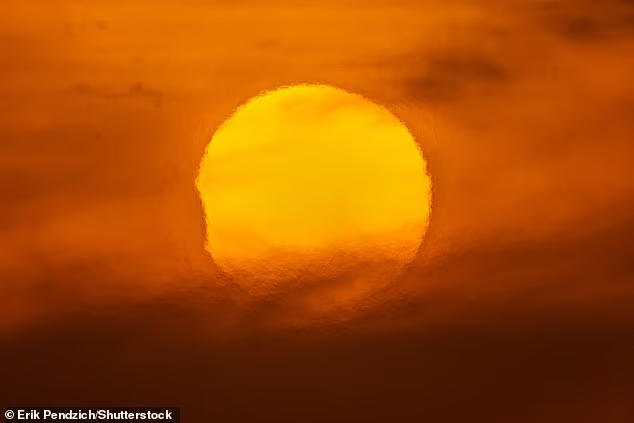
A partial solar eclipse will sweep across parts of the US on Wednesday, giving millions of Americans a chance to witness the rare celestial spectacle.
The cosmic event occurs when the sun, moon and Earth align, causing the moon to cast a shadow across the planet. Unlike during a total eclipse, however, only a portion of the sun will be obscured.
The phenomenon may be visible from Alaska, the Pacific Northwest, and the northern Rockies to parts of the Upper Midwest and the Great Lakes.
Those across much of the Northeast and New England could also catch a glimpse, with visibility potentially extending south along the East Coast into North Carolina.
The amount of the sun concealed will vary significantly by location, ranging from 37 percent in Fairbanks, Alaska, to 9 percent in New York City and just 3 percent in Detroit.
Americans will have to wait until 2045 for the next total solar eclipse to sweep from coast to coast.
Skywatchers should never look directly at the sun during a partial solar eclipse without specialized eye protection, as doing so can cause permanent eye damage.
Later tonight, the Perseids will streak across the night sky as Mercury, Jupiter, Mars, Saturn, Uranus and Neptune appear spread across a broad arc overhead.
The cosmic event occurs when the sun, moon and Earth align, causing the moon to cast a shadow across the planet. Unlike during a total eclipse, however, only a portion of the sun will be obscured
Unlike a total eclipse, there is no point at which it is safe to remove protective filters.
The full spectacle will be visible along a narrow path spanning parts of Greenland, Iceland, Portugal, Russia and Spain.
A partial eclipse will also be visible across most of Europe and northwestern Africa, according to NASA.
In Anchorage, the event will begin at 7.36am local time, peak with 28 percent coverage at 8.21am and end at 9.09am.
Fairbanks will see the greatest coverage among the listed US cities at 8.27am, while Juneau will experience 17 percent coverage at 8.24am.
In the Northeast, the eclipse will begin shortly before or after 1pm local time. Bangor will reach 24 percent coverage at 1.53pm, while Portland, Maine, will see 19 percent at the same time.
Boston will experience 16 percent coverage at 1.55pm, compared with 9 percent in New York City and seven percent in Philadelphia.
Farther west and south, the effect will be less dramatic. Detroit will see 3 percent of the sun obscured at 1.36pm, while Washington, DC, will experience 4 percent coverage at 1.53pm.
Depending on the location, the eclipse will end between approximately 2.08pm and 2.49pm in the eastern US.
The Perseid meteor shower will reach its peak overnight from August 12 into August 13, with the greatest activity expected during the predawn hours.
Under clear, dark skies, viewers could see as many as 100 meteors per hour. A new moon will provide ideal conditions by keeping the sky free from interfering moonlight.
Although the shower will remain active through August 24, the best time to watch will be from approximately 11pm local time until dawn.
To finish off the trinity will be the parade of planets, a visual event when several planets appear together in the same area of the night sky from Earth’s perspective.
Before dawn, Jupiter, Mercury, Mars, Uranus, Saturn and Neptune will appear spread across the sky in a broad arc known as a planetary parade.
Mars and Saturn should be visible to the naked eye, while Mercury and Jupiter will be more difficult to spot because they will sit low on the eastern horizon as sunrise approaches.
Viewers will likely need binoculars to see Uranus and a telescope to find Neptune.
Across much of the Northern Hemisphere, the best viewing window will be approximately 30 to 60 minutes before sunrise, although visibility will depend on location, weather and an unobstructed horizon.