The growing global trade in mummified body parts could unleash ancient fungal spores on the world, scientists have warned.
Experts say the buying and selling of centuries–old hands, feet and heads could release ‘a real mummy’s curse’.
They revealed there are alarming risks from dormant microorganisms and the toxic materials used to preserve the dead hundreds of years ago.
Dormant fungal spores can become airborne when moved or disturbed, posing health risks to the living, the experts said.
Some could even cause severe poisoning, brain damage, cancer, liver and kidney issues, skin lesions and lung irritation.
‘Where mummified remains are transported without appropriate controls or documentation, the living are exposed to various risks,’ they wrote in the International Journal of Cultural Property.
‘This includes the potential presence of toxic substances historically used to preserve the dead and subsequent changes to the body and associated personal effects due to microbial growth.’
The idea of a ‘mummy’s curse’ first arose after the opening of Tutankhamun’s tomb in 1922. It is believed that inhaling spores from the crypt may have contributed to the death of Lord Carnarvon, the chief financial backer for the project.
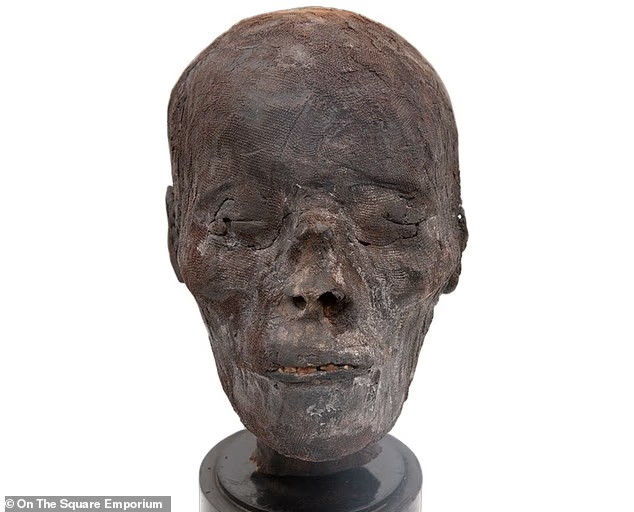
This ancient Egyptian mummy head was previously up for sale for £35,000. Experts have warned there could be alarming risks from dormant microorganisms and the toxic materials used to preserve the remains

It is believed that inhaling spores from Tutankhamun’s tomb may have contributed to the death of Lord Carnarvon, the chief financial backer for the project. Pictured: Experts in the burial chamber during the excavation of the mummy

For the study the team analysed 128 online posts on Meta platforms, e–commerce sites, web stores and auction houses and found numerous cases of mummified remains on sale
For the study, the team analysed 128 online posts on Meta platforms, e–commerce sites, web stores and auction houses and found numerous cases of mummified remains on sale.
Some showed them out in the open, in living rooms and in homes with no evidence of temperature control. Sellers provided no safety guidance and often used the regular postal service to transport parts to buyers.
‘Isolated body parts, such as hands and feet, were most frequently identified, followed by whole mummified heads,’ the researchers said.
‘Over half of the sample, 51.6 per cent, consisted of heads in varying states of completeness and preservation, including whole or partial mummified heads, skulls or crania with soft tissue and/or hair, and tsantsas, so–called shrunken heads produced by the Shuar people of northern Peru/eastern Ecuador.’
They warned that 13 posts presented remains with ‘visible suspected fungal colonisation’ which indicates ‘inappropriate and unstable environmental storage conditions’.
Of these, six exhibited ‘extensive biodeterioration, posing a potential risk to those handling the remains’.
‘Most bacteria, fungi and yeasts survive, recolonise and multiply by using the body’s available organic material, especially when remains have been manipulated and subjected to suboptimal storage conditions,’ the paper warns.
‘These can result in additional biological hazards to the living.’

The researchers referenced a photograph posted to Facebook from a buyer (in the United States) who purchased mummified human remains from the United Kingdom. It is clear from the postage stamps and stickers that this shipment was sent via Royal Mail

In museums mummified remains are often displayed in climate–controlled glass cases, which help protect both the remains and the people viewing them. Pictured: A mummified severed hand displayed in the medieval Gruyeres castle in Switzerland (stock image)
The mummification process involves a series of chemical and physical processes designed to help delay decomposition. A range of toxic materials and substances are applied over time to preserve tissues, including heavy metals such as arsenic, mercury and lead.
In museums mummified remains are often displayed in climate–controlled glass cases, which help protect both the remains and the people viewing them.
But for private collectors such measures are usually not taken – and dormant spores can easily become airborne when disturbed.
‘We reveal that mummified remains sold online exhibit signs of biodeterioration, yet sellers provide no safety guidance, suggesting limited awareness or deliberate disregard of hazards,’ the researchers said.
‘Until more effective measures are implemented, the public should remain vigilant and report sales of mummified remains to relevant authorities and professional bodies.’
Inhalation of aspergillus spores was blamed for the deaths of 10 out of 12 of the conservation scientists who opened the tomb of King Casimir IV of Kraków, in modern–day Poland, in the 1970s, the paper notes.
It is believed that a severe form of aspergillosis may have contributed to Lord Carnarvon’s death, possibly resulting from inhaling Aspergillus spores in Tutankhamun’s tomb.
‘In these cases, fungal spores lay dormant for hundreds of years, and once disturbed they became airborne and dangerous to human health,’ the researchers said.
Last year, scientists solved the bizarre mystery of a green mummy that had baffled experts for decades.
A teenager, buried in Italy hundreds of years ago, developed a distinctive emerald sheen not usually found on human remains.
The clue to the green colour lies in the copper box the boy was buried in, experts told New Scientist.
This would have helped preserve the body’s hard and soft tissues thanks to the metal’s antimicrobial properties.
But it also likely reacted with acids that leaked out of the body and eroded away the box, creating corrosion products that interacted with chemical compounds in the bone.
Over time, copper ions replaced calcium in the boy’s skeleton, solidifying the bone structure while tinting the affected areas various shades of emerald.