Water managers in Colorado are budgeting for low water supply in the Colorado River Basin as summer approaches. Ken Curtis is one of the water managers preparing. He said a 30% water supply can be expected, which could impact farmers.
Government officials are taking a new approach to help preserve the Colorado River by asking the public to do its part.
Since 2000, the Colorado River Basin has experienced a severe, historic drought, affecting the regional water supply and other essential resources.
According to the U.S. Geological Survey, the Colorado River Basin has experienced its lowest 16-year period of inflow in more than 100 years of recordkeeping.
In response to the growing crisis and ongoing disagreements among the Colorado River Basin states, Arizona, California, Colorado, Nevada, New Mexico, Utah, and Wyoming, officials have asked for the public’s assistance.
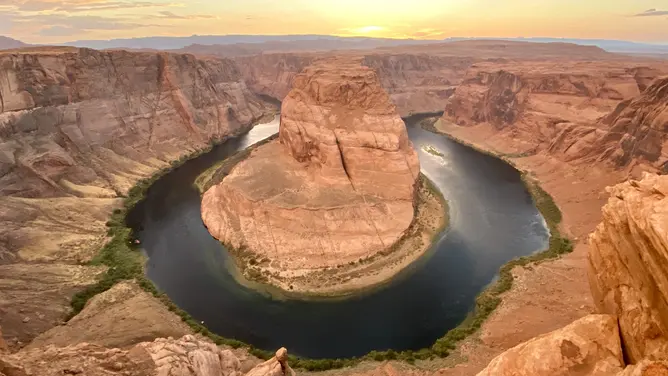
FILE: Horseshoe Bend.
(Daniel SLIM / AFP / Getty Images)
“As reservoir elevations continued to fall and risk continued to increase, a series of interdependent agreements involving local, state, tribal and federal governments, water users and non-governmental organizations in both the United States and Mexico have enabled the system to operate by negotiated agreement rather than court determinations,” said the Bureau of Reclamation.
This agreement includes the opportunity for people to be compensated for using less water, which benefits distribution, increases basin capacity, and benefits reservoir storage.
How much people could earn is undetermined, but nonetheless, it impacts water levels of the river.
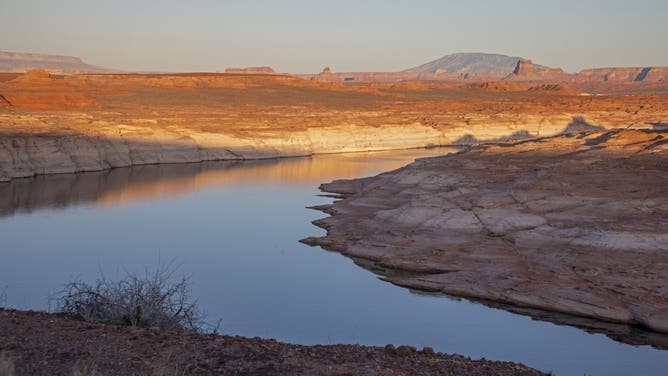
Page, Arizona, The water reservoir behind the Glen Canyon Dam is only 27 percent full. White rock around the lake is the ‘bathtub ring,’ which shows how dramatically the water has dropped.
(Jim West/UCG/Universal Images Group / Getty Images)
Today, Lake Mead, which is a part of the Colorado River Basin, is about 150 feet higher than its historic low because of these public agreements.
‘EVOLVING CRISIS’: COULD EL NIÑO BRING NEEDED RAIN TO THE 2 LARGEST RESERVOIRS IN THE US?
Lifeline for millions of people
The Colorado River is essential for life in the Southwestern U.S. and Northwestern Mexico. According to the USGS, the body of water serves numerous purposes for millions of people.
- Supply more than 1 in 10 Americans with some, if not all, of their water for municipal use, including drinking water.
- Provide irrigation water to more than 5.5 million acres (approximately 8,590 square miles) of land.
- They are essential as a physical, economic and cultural resource to at least 22 federally recognized tribes.
- Support 4,200 megawatts of electrical generating capacity, providing power to hundreds of local areas and millions of people.
- They are directly linked to nine National Park Service units and seven National Wildlife Refuges, supporting over $1 billion in tourism revenue associated with outdoor recreation and wildlife.
- Provide habitat for a wide range of species, including threatened and endangered species, as well as other species of wildlife and vegetation.
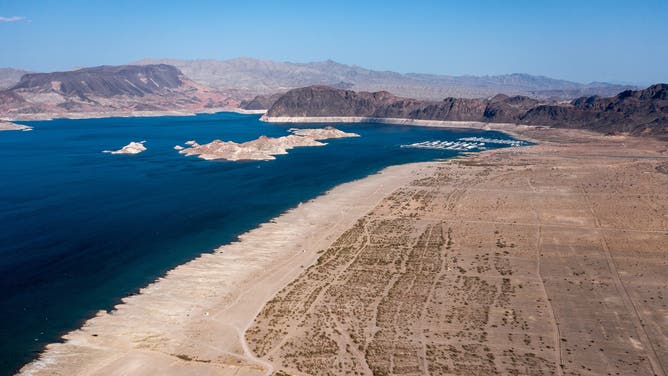
Lake Mead during low water levels in Boulder City, Nevada, U.S., on Thursday, Aug. 19, 2021. Federal officials ordered the first-ever water cuts on the Colorado River system that sustains 40 million people, the latest blow from a decades-long drought across the U.S. West that has shrunk reservoirs to historic lows, devastated farms and set the stage for deadly forest fires.
(Roger Kisby/Bloomberg / Getty Images)
ARIZONA DUST STORM CREATE UNHEALTHY AIR QUALITY FOR THOUSANDS IN THE PHOENIX METRO AREA
As state and federal government officials work together to implement an established 10-year plan, in the interim, consensus-based agreements continue to make an impact on the river system, which is vital to 40 million people.
“The preferred alternative establishes an adaptive decision framework that will be used to develop operating guidelines that are designed to ensure reliable operations while being able to respond to changing conditions over a 10-year period,” said the Bureau of Reclamation.
Additional efforts to aid the river basin have included the Department of Interior implementing unprecedented measures by dumping 660,000 to one million acre-feet of additional water flows from the Flaming River Gorge reservoir into Lake Powell.