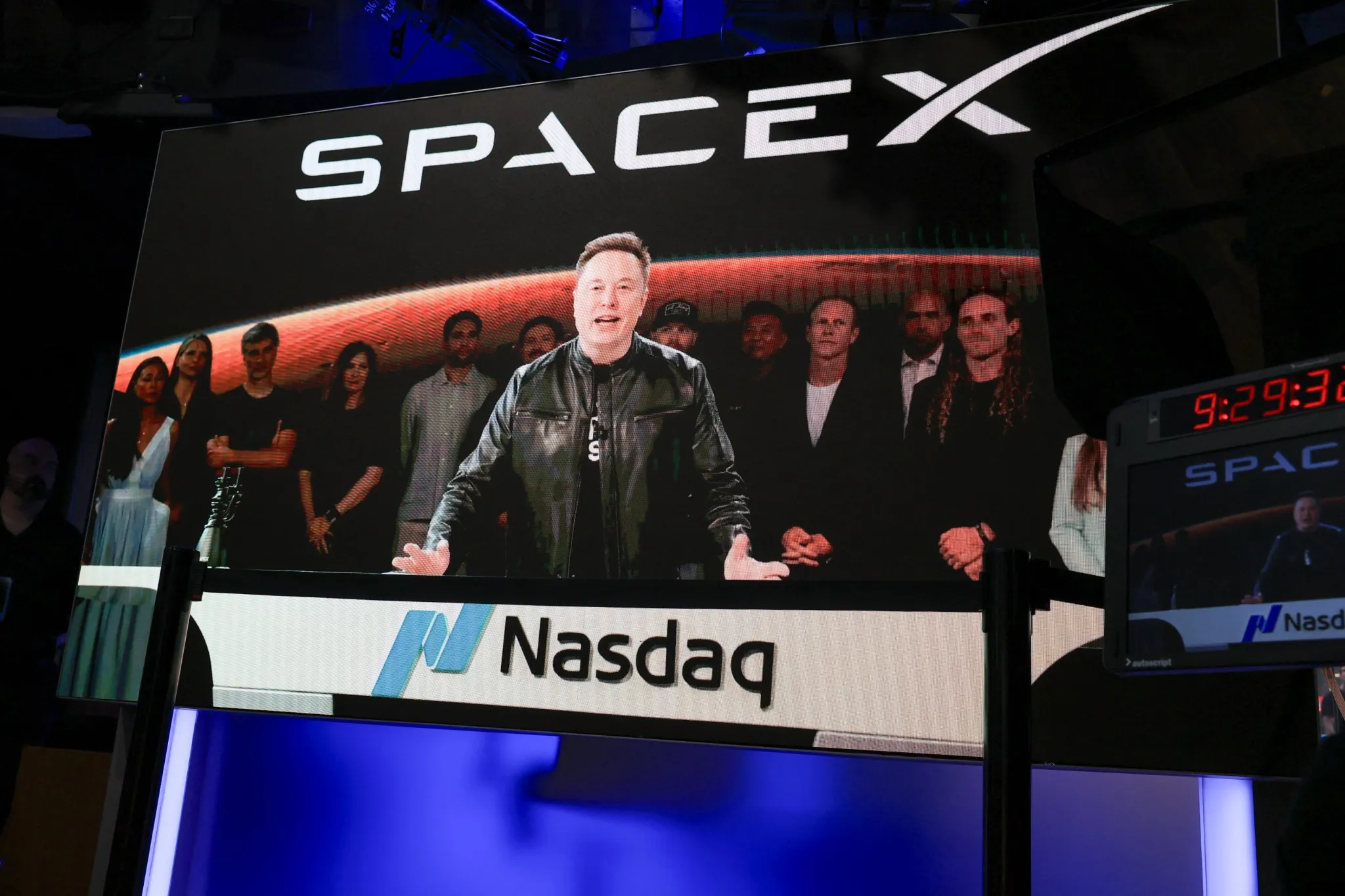
“I know this sounds totally nuts,” CEO Elon Musk told investors midway through SpaceX’s first earnings call as a public company on Tuesday. The remark came after Musk shared an overview of his bold plans to deploy a robot workforce on the moon to scale up SpaceX’s manufacturing capacity.
According to Musk, the plan calls for SpaceX building a mass accelerator after shipping the necessary components to the regolith layer of the moon via Musk’s colossal Starship rockets.
Ultimately, Musk’s goal is to build AI compute satellites at scale on the moon in a way Earth-based factories could never sustain, before shifting his sights to Mars. Once plans for the red planet are in place, Musk plans to use the experience SpaceX has garnered from its moon operations to build a human colony on Mars of a million inhabitants.
“We are going to land a lot of tonnage on the moon,” said Musk. “We’re going to build the factories on the moon. The robots will be helpful with that.”
The plan is also outlined in detail throughout SpaceX regulatory filings that preceded its record-breaking IPO in June. The language used in the official documents is less colorful than what Musk evoked on the earnings call, but both describe the same goals.
Namely, a major pillar of SpaceX’s strategic plan hinges on establishing lunar-based manufacturing, including “factories to produce large-scale AI compute satellites.” The goal would be to mine the moon’s regolith—its dusty surface layer of debris—to obtain raw minerals including aluminum, titanium, and silicon for satellite construction. Chips and other materials would be shipped from Earth but the bulk of new satellites would be sourced locally on the moon.
From there, installing the satellites would rely on a “lunar mass driver,” which SpaceX defines as an electromagnetic launcher that pushes payloads off the surface of the moon without the use of rockets.
The plan may sound like science-fiction but Greg Martin, managing director at Rainmaker Securities, believes that is sound from a SpaceX investor perspective.
“Getting to Mars is a 26-month launch, six-months in transit, versus a two-day trip to the moon,” Martin said. “As an investor, the moon feels much more palatable.”
And the progression matters, said Martin. Start with sending ships, then extract resources once you’re there, then scale manufacturing.
“He is building the building blocks to pull it off,” Martin added.
Others used different words to describe Musk’s audacious plans.
“It’s pure insanity,” said Jim Cantrell, Arizona space commissioner and CEO and co-founder of Phantom Space. “But he’s going to do it, because that’s what Elon does.”
None of this is new to Cantrell, who started working with Musk when the Tesla CEO got interested in rockets in July 2001. But Cantrell has been studying lunar resource prospecting since grad school in the 1980s when the notion was “a total pipe dream,” he said. Today, it’s all possible.
“That stuff is all there, aluminum in the soil, all sorts of rare minerals,” said Cantrell. “The idea of setting up factories, all that, it’s very feasible.”
He sees SpaceX’s moon and Mars ambitions as more than a corporate strategy and a path to $1 trillion in revenue, which Musk projected will happen by 2030 if not sooner.
Cantell added that all the pillars of SpaceX and Musk’s various businesses—including computing, Starlink connectivity, AI data centers, humanoid robots, autonomy, and boring tunnels underground—can prove useful for planetary resettlement, which is what Musk talked about when he called Cantrell 25 years ago, he said.
“He’s not building a company,” said Cantrell, who was the first vice president of business development at Spacex in 2001. “He’s building a nation state—and no other nation states are even competing with him.”
A New Continent
Before you build any factory on the moon or Mars, you need a road into the site, energy sources, and lines of communication. Jaret Matthews, CEO of Astrolab—whose company won a $219 million NASA contract and has a rover set to launch later this year—said the sequencing works the same as it would on a remote parcel of undeveloped land.
“I like to tell people the moon is equivalent in surface area to Africa,” Matthews said. “Gaining access to the moon is essentially like gaining access to a whole new continent.”
There’s a huge plus, however. Mining minerals on the moon, which appear in about the same relative abundance as they do on Earth, carries no ecological cost with it, said Matthews, who left SpaceX in 2019 to found Astrolab. Even better, launching material off the moon takes about 20 times less energy than from Earth. Since there is no atmosphere, the massive launcher SpaceX describes in its filings can do most of the heavy lifting.
“A high speed train is a good way to think about it,” said Matthews. “You can huck mass off the moon without burning propellant.”
But the moon fights every step. Lunar dust—which Matthews calls “everyone’s favorite boogeyman”— is abrasive, jagged at a microscopic level, and electrostatically charged, leaping onto solar arrays and degrading performance. Temperature swings between negative 300 degrees and above boiling can hit a single piece of equipment simultaneously.
“Everything is trying to kill you on the moon,” said Matthews, who worked for nine years at NASA’s jet propulsion lab before spending seven years at SpaceX. “The moon is a harsh mistress and a pretty tough place to operate.”
The factories themselves, said Matthews, would be fully robotic systems, launched in pieces and assembled on the surface.
“Anyone who is thinking about doing industrial processes on the moon, they aren’t imagining a workforce of humans wrenching on things there,” Matthews said. “That’s going to be prohibitively expensive and dangerous. But those are the things that robots are good at.”
Cantrell said Tesla’s humanoid Optimus robots are likely to make up the workforce.
“Robots just need electricity, solar power, and a little bit of lubrication in the joints,” he said. “That’s about it.”
But a major drawback is the day-to-night differences. The moon gets 14 days of sunlight followed by 14 days of darkness, he said. “You’re going to have to somehow have nuclear power there,” he added.
The Musk Timeline
The underpinnings of the entire strategy rely on Starship rockets. During the earnings call Musk said SpaceX currently delivers about 2,500 tons per year to orbit via Falcon rockets, which Musk claimed is about 80% to 90% of total global mass to orbit. With Starship, Musk said SpaceX is working toward 1 million tons per year, and ultimately will get to 10 million tons.
Ryan Westerdahl, CEO and co-founder of Turion Space and a former SpaceX engineer who spent nearly a decade at the company, described Musk’s planning cadence with the familiarity of someone who has seen it up close and personal.
“He’s usually off by a few years and a little on the optimistic side,” Westerdahl said. “But I get his thinking.”
The typical Musk timeline is tantamount to, “This is what I think we can accomplish, and engineers haven’t convinced me it’s impossible yet,” said Westerdahl, who added that he operates the same way at Turion. “I’m a little bit off too,” he said. “Not because I’m trying to copy Elon, I just kind of get it.”
The commercial case for the moon, said Westerdahl, comes down to data-center satellites and helium-3, which is considered a promising fuel for fusion reactors. But it won’t just be SpaceX alone, said Westerdahl; NASA has committed $20 billion in additional funding over seven years for moon base developments.
Moreover, the moon is closer and easier to travel to and communicate with. Cantrell said it takes about 10 minutes for a text to get to the moon, whereas it takes about 30 minutes for the same message to get to Mars. Humans need a few days to get to the moon and about 18 to 24 months to get to Mars.
“Your opportunities to go [to the moon] are much more frequent,” noted Matthews. “You don’t have to wait for the planets to literally align.”
Westerdahl said the prospect of building on the moon before Mars makes sense because SpaceX can take the learnings from the moon manufacturing experience and then apply them to settling on Mars.
“By the time we get there, there’s a very real possibility that Optimus robots are doing the vast majority of the heavy lifting and Starship is autonomously depositing cargo,” he said.
What Investors Should Know
SpaceX reported Q2 revenue of $7.8 billion this week, up 92% year-over-year and adjusted EBITDA of $3.5 billion. The space segment, which includes launch services, Starship development, and all the company’s lunar ambitions, posted $962 million in revenue with an adjusted EBITDA loss of $205 million from Starship development investments.
Cantrell compares the prospect of moon-based satellite manufacturing to the settlement of the Americas. In the long view, the plan to scale on the moon is both feasible and “immensely profitable,” he said. Cantrell questions whether he will be alive to see it come to fruition. But he doesn’t bet against Musk, not after a flight home from Moscow decades ago when Musk’s plan to build a rocket from scratch struck Cantrell as deranged.
“This guy’s lost his mind,” Cantrell recalled thinking. “Normal people don’t say things like that. But look where we are 25 years later.”
Martin says this is what it means to be an investor in Musk’s companies.
“Scientifically it makes sense,” he said. “It does feel very speculative at this point, but he’s looking to grow a space economy and I wouldn’t put it past him to accomplish it.”
The real question for SpaceX shareholders, Martin said, is whether they trust the trajectory.
“He’s made more investors more money than any entrepreneur in the history of man—he’s earned our trust,” said Martin. “But you have to go along with the ride a little bit.”