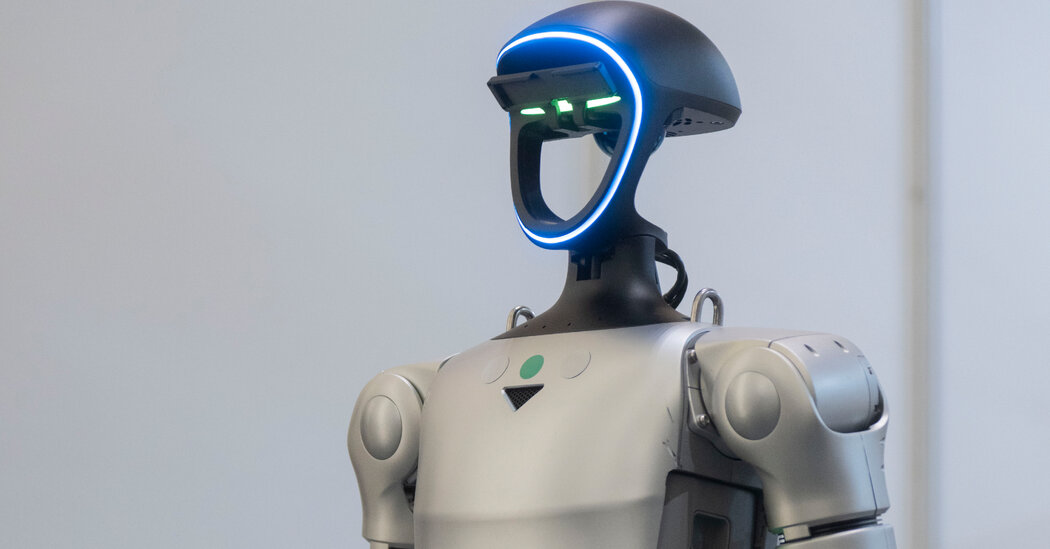
Unitree Robotics may be little known outside China. Its robots are not. Millions around the world have watched videos of the company’s machines carrying out remarkable feats that seem almost superhuman.
During China’s nationally televised Lunar New Year celebration, a troupe of Unitree humanoid robots performed an elaborate kung fu routine, scaling walls, executing back flips and wielding swords.
Now the company is taking its biggest step yet: an initial public offering on the Shanghai Stock Exchange. On Thursday, Unitree priced its shares at the equivalent of around $22, seeking to raise about $900 million in a deal valuing it at about $9 billion.
The listing comes at a pivotal moment for the humanoid robot industry. Investors are betting that machines built to look and move like humans will become the next major technology breakthrough. Governments increasingly see them as strategic assets as well.
Last month, the Federal Communications Commission announced plans to ban new Chinese-made humanoid and quadruped robots, citing national security concerns. U.S. officials argue that as such robots become commonplace in factories, offices and homes, they could surreptitiously collect sensitive commercial, government and personal information or provide new avenues for cybersecurity attacks on critical infrastructure. Last year, European researchers identified security vulnerabilities in a Unitree robot that could potentially be exploited by hackers.
China accused the United States of “overstretching the concept of national security,” and threatened retaliation. On Wednesday, Beijing announced a series of retaliatory measures against the United States, citing actions taken by the F.C.C. as one factor behind the moves.
Washington also appears determined to avoid a repeat of what happened in the electric vehicle industry, where Chinese manufacturers, aided by generous state support, rapidly scaled production and came to dominate the global market.
Unitree has emerged as China’s leading contender to dominate humanoid robotics. Its importance was underscored when its founder, Wang Xingxing, sat prominently across from Xi Jinping, the country’s top leader, at a symposium last year showcasing China’s technological advances.
The company, based in the eastern Chinese city of Hangzhou, traces its origins to Mr. Wang, who began tinkering with robots at age 19 while a university student. After graduate school and a stint at a drone maker, he founded the company a decade ago.
What started as a one-person start-up has become one of China’s leading robotics companies and a national champion in Beijing’s drive to lead the humanoid robot market. At 36, Mr. Wang has become the public face of that ambition.
Yet Unitree also embodies the central question hanging over the industry. The technology is advancing rapidly, as the company’s demonstrations make clear. Whether there will be a large commercial market anytime soon remains far less certain.
“The Unitree stock sale will be a bellwether for how the capital markets view this exciting but nascent technology,” said Lian Jye Su, a Singapore-based analyst for Omdia, a technology research firm.
According to the company and market researchers, Unitree shipped more humanoid robots than any other manufacturer last year. The company remains relatively small, generating about $250 million in revenue in 2025. But sales more than quadrupled, and it is profitable.
Even as doubts linger about the immediate commercial viability of humanoid robots, their long-term importance is widely acknowledged as a significant step in the advancement of artificial intelligence.
Today’s A.I. systems, like chatbots, learn primarily from analyzing vast quantities of digital data culled from the internet and elsewhere. But humanoid robots will increasingly learn by interacting with people and objects in the physical world.
That emerging field is known as “embodied A.I.” or “physical A.I.” Self-driving cars are one application, but humanoid robots are expected to operate in more varied and unpredictable environments — from factories and warehouses to stores and, eventually, homes.
For technology companies, humanoids represent an emerging market for chips and software. Jensen Huang, the chief executive of American chip giant Nvidia, has declared physical A.I. as the “next frontier” for artificial intelligence.
In June, Nvidia announced a partnership with Unitree to build a research robot. Unitree will supply the mechanical body and Nvidia the digital brain — a specialized A.I. chip designed specifically for a robot.
Demand for humanoid robots, some analysts predict, could accelerate over the next several years. A recent report from CLSA, an investment research firm, forecasts that the global market will reach $69 billion by 2030, up from roughly $2 billion this year.
Adoption is expected to unfold in stages stretched over decades, according to the report. Manufacturers, particularly automakers, are likely to be the first large customers, followed by service and retail industries before eventual household use.
Looking further out, Morgan Stanley estimates the humanoid robot market could exceed $5 trillion by 2050, with as many as one billion models in operation worldwide. Those projections remain highly speculative but illustrate investors’ grandiose visions for the sector.
In its offering prospectus, Unitree identifies uncertainty over U.S. trade policy as a risk. The company also warned that intensifying competition and softer demand slowed growth in the first quarter of 2026.
Revenue still rose 68 percent from a year earlier. Profit fell 55 percent, hit by competitive pressure but also increased spending on research and development.
Most of Unitree’s biggest rivals are domestic, including Agibot, UBTech, Leju Robotics, EngineAI and Fourier Intelligence. UBTech went public in Hong Kong in late 2023 and now has a market capitalization of $5.6 billion. Unitree is the first humanoid robotics company to list in mainland China.
American competitors — including Agility Robotics, Figure AI, Apptronik, 1X Technologies and Boston Dynamics, which is owned by the South Korean carmaker, Hyundai Motor — are also racing to develop humanoid robots. Tesla, which was named as a competitor in Unitree’s prospectus, has said it eventually aims to produce one million humanoid robots annually.
For now, Tesla and most American robot makers are proceeding cautiously, focusing on technological refinement before mass production.
China, however, is moving faster toward mass production. Chinese manufacturers shipped roughly 18,500 humanoid robots in the first half of this year, compared with about 4,000 by U.S. companies, according to Omdia. Unitree’s products range from less than $5,000 to more than $150,000, spanning industrial, educational and consumer markets.
For now, however, dazzling demonstrations remain easier than building a business. Much of today’s industrial demand consists of pilot projects, training robots to sort, move and assemble parts. Fully autonomous teams of humanoids are still years away.
A kung fu performance can showcase what humanoid robots are capable of. Whether it points to a mass market is another question.
“It’s not clear yet where the large-scale consumption of humanoid robots will be,” Mr. Su of Omdia said.