Tuesday, August 4, 2026
No Result
View All Result
LJ News Opinions
  • Home
  • U.S.
  • Politics
  • World News
  • Business
  • Entertainment
  • Sports
  • Technology
  • Health
  • Opinions
  • Home
  • U.S.
  • Politics
  • World News
  • Business
  • Entertainment
  • Sports
  • Technology
  • Health
  • Opinions
No Result
View All Result
LJ News Opinions
No Result
View All Result
Home Technology

Are you a Flat Earther? You’ve probably had a tough life! People who have experienced hardship are more likely to believe conspiracy theories, study finds

by LJ News Opinions
August 4, 2026
in Technology
0
Share on FacebookShare on Twitter


By SHIVALI BEST, SCIENCE & TECHNOLOGY EDITOR

Published: 19:01 EDT, 4 August 2026 | Updated: 19:01 EDT, 4 August 2026

Are you convinced the Earth is flat? If so, you’ve probably had a tough life. 

That’s according to a new study, which has revealed why some people are more likely to be swayed by conspiracy theories. 

Researchers from the University of Nottingham and the University of Cumbria carried out three experiments with over 1,200 participants. 

The results revealed that participants who had experienced greater hardships throughout their lives were more susceptible to conspiracies theories. 

However, this only applied when those experiences led them to see the world as fundamentally unfair.

Dr Daniel Jolley, lead author of the study, explained: ‘Many people experience significant adversity during their lives, yet most do not become conspiracy believers. 

‘Our findings suggest it isn’t hardship alone that matters, but how those experiences shape the way people see the world. 

‘When adversity leads people to feel that the world is fundamentally unfair, conspiracy theories may become more appealing because they offer an explanation for that injustice.’ 

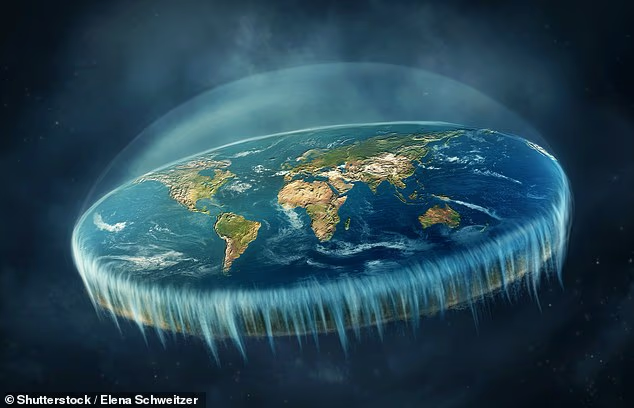
Are you still convinced the Earth is flat? If so, you’ve probably had a tough life. That’s according to a new study, which has revealed why some people are more likely to be swayed by conspiracy theories (stock image)

From the Flat Earth theory to the belief that NASA faked the moon landings, conspiracy theories have circulated for years. 

However, until now, exactly why some people are more susceptible to them than others has remained unclear. 

To get to the bottom of it, the researchers carried out a series of three experiments involving a total of 1,284 participants. 

In the first experiment, participants were surveyed about the adversities in their lives, including experiences such as serious illness or injury, bereavement, financial difficulties, relationship breakdown and violence. 

They were also quizzed about their conspiracy thinking. 

The results revealed that people who had been through more adverse life events were more likely to perceive the world as unjust – and these perceptions were linked with stronger conspiracy beliefs.

In the second experiment, the researchers compared people who had experienced a violent crime with those who had not. 

Again, the results showed that those who had experienced violence reported stronger perceptions of injustice, which in turn were associated with stronger conspiracy beliefs.

People who have experienced hardship are more likely to believe conspiracy theories (stock image)

People who have experienced hardship are more likely to believe conspiracy theories (stock image) 

Finally, in the third experiment, the researchers tested the role of perceived fairness. 

The participants were led to think society was becoming more unfair – and subsequently reported stronger conspiracy beliefs.

According to the researchers, the findings have ‘wider implications for societal trust’.

Dr Laura Blackie, co–author of the study, explained: ‘Clinical psychologists have long documented the detrimental impact of acute trauma on individuals’ worldviews. 

‘Our findings suggest that perceptions of unfairness in society might be one such detrimental outcome to result from adversity, and these perceptions may have consequences for the receptivity of conspiracy beliefs and trust in societal institutions. 

‘While our findings do not establish causality, they point to an important pathway through which adversity may shape how people view society’. 

BELIEVE IN CONSPIRACY THEORIES? YOU’RE PROBABLY A NARCISSIST, RESEARCHERS SAY

People who doubt the moon landings are more likely to be selfish and attention-seeking, according to a 2015 study.

Over the course of three online-based studies, researchers at the University of Kent showed strong links between the belief in conspiracy theories and negative psychological traits.

Writing in the journal Social Psychological and Personality Science, the team explained: ‘Previous research linked the endorsement of conspiracy theories to low self-esteem.’

In the first study, a total of 202 participants completed questionnaires on conspiracy beliefs, asking how strongly they agreed with specific statements, such as whether governments carried out acts of terrorism on their own soil.

Alongside this, they were asked to complete a narcissist scale and a self-esteem assessment.

The results showed that those people who rated highly on the narcissism scale and who had low self-esteem were more likely to be conspiracy believers.

Share or comment on this article:
Are you a Flat Earther? You’ve probably had a tough life! People who have experienced hardship are more likely to believe conspiracy theories, study finds


Source link

Tags: dailymailsciencetech
LJ News Opinions

LJ News Opinions

Next Post

Roddy White questions 49ers' handling of Brandon Aiyuk amid uncertain future

Recommended

Trump Signs Executive Order Seeking Oversight of A.I. Models

2 months ago

Videos show crane piece falling and crashing onto moving car in Fort Lauderdale

2 years ago

Popular News

    Connect with us

    LJ News Opinions

    Welcome to LJ News Opinions, where breaking news stories have captivated us for over 20 years.
    Join us in this journey of sharing points of view about the news – read, react, engage, and unleash your opinion!

    Category

    • Business
    • Entertainment
    • Health
    • Opinions
    • Politics
    • Sports
    • Technology
    • U.S.
    • World News

    Site links

    • Home
    • About us
    • Contact

    Legal Pages

    • Privacy Policy
    • Cookie Privacy Policy
    • Terms of Use
    • Disclaimer
    • California Consumer Privacy Act (CCPA)
    • DMCA
    • About us
    • Advertise
    • Contact

    © 2024, All rights reserved.

    No Result
    View All Result
    • Home
    • U.S.
    • Politics
    • World News
    • Business
    • Entertainment
    • Sports
    • Technology
    • Health
    • Opinions

    © 2024, All rights reserved.