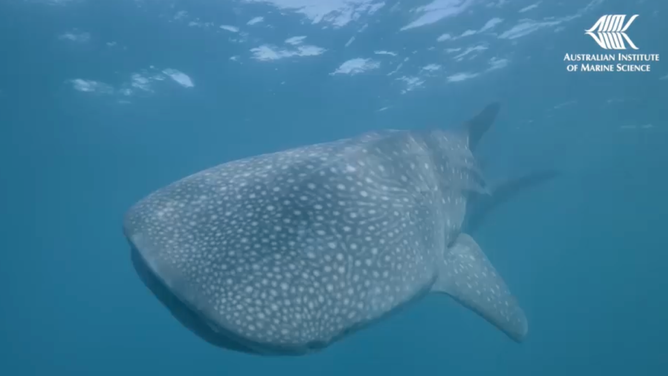
Newly obtained footage has given researchers a rare window into the feeding behaviors of whale sharks, helping them identify 36 distinct behavioral traits. The findings represent the largest catalog of whale shark behaviors to date.
NINGALOO REEF, Western Australia — Newly obtained footage has given researchers an unprecedented point-of-view look into whale sharks’ feeding habits, helping them identify 36 distinct behavioral traits.
ATLANTIC SHARK INSTITUTE TAGS ITS FIRST-EVER HAMMERHEAD SHARK OFF COAST OF RHODE ISLAND
Using the video footage alongside more than 100 scientific articles on the subject, the Australian Institute of Marine Science (AIMS) said, “this is the largest catalog of whale shark behaviors to date.”
Newly obtained footage has offered researchers an unprecedented window into the hidden feeding behaviors of whale sharks.
(AIMS and Murdoch University via Storyful)
Because whale sharks live in tropical oceans where food is often scarce and unevenly distributed, they must continually adjust how they find and consume food.
Although the comprehensive study was published in late July 2026, the footage analyzed in the research was originally captured during a field study in 2018.
EYES IN THE SKY: NYPD USES DRONES TO TRACK SHARKS OFF NEW YORK CITY BEACHES
To obtain this valuable footage, researchers used data tags equipped with small cameras that were attached to the fins of several whale sharks.
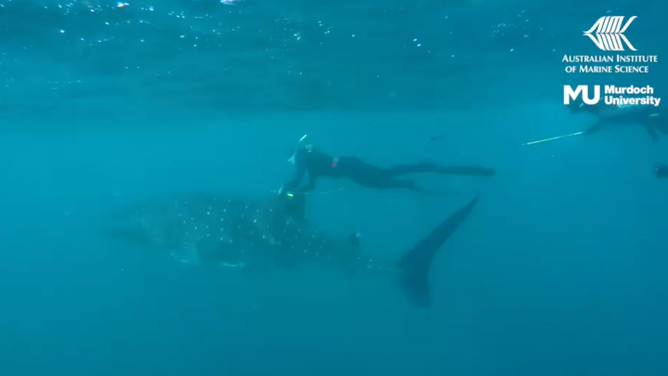
Video appears to show divers attaching a tag to a whale shark.
(AIMS and Murdoch University via Storyful)
“Unbothered, these gentle giants continued to swim while we watched them disappear into the open blue water,” AIMS stated, adding that the tags were programmed with a 24-hour preset period, allowing them to detach naturally without impacting the sharks.
The institute highlighted that tagging has long been valuable for understanding the movements and patterns of marine species, but traditional tags do not allow researchers to directly observe an animal’s behavior.
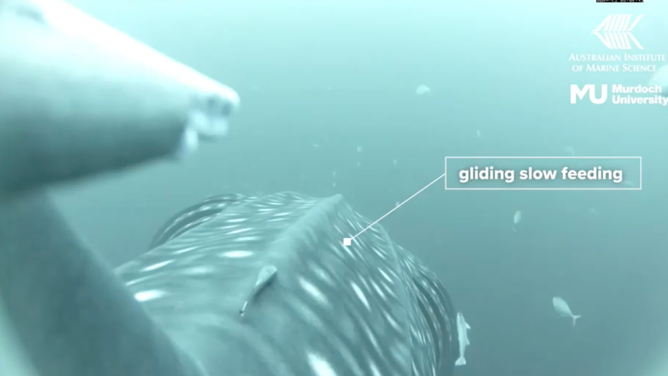
(AIMS and Murdoch University via Storyful)
“Through our new study, we could finally address the question: ‘What do whale sharks do when no one is watching?’ Filling these research gaps is essential so we can help protect these majestic yet endangered filter-feeding animals,” AIMS said.
MASSIVE GREAT HAMMERHEAD SHARK FOUND DEAD ON NORTH CAROLINA BEACH
The research revealed that whale sharks use a wider range of feeding behaviors than previously documented, feeding throughout the water column and along the seafloor.
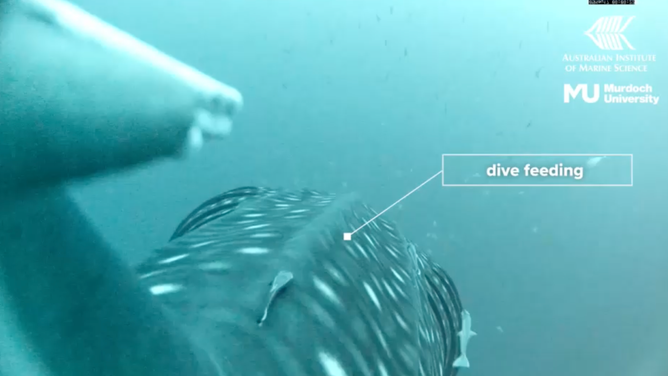
(AIMS and Murdoch University via Storyful)
Although whale sharks were already known to make deep dives, they were often thought to primarily feed near the surface.
WORLD’S LARGEST SEA TURTLE SPECIES NESTS IN VIRGINIA FOR FIRST TIME IN RECORDED HISTORY
Researchers found that whale sharks use a variety of strategies, from low-energy behaviors like slowly sinking to the seafloor with their mouths open, to high-energy behaviors like actively chasing krill swarms at the surface.
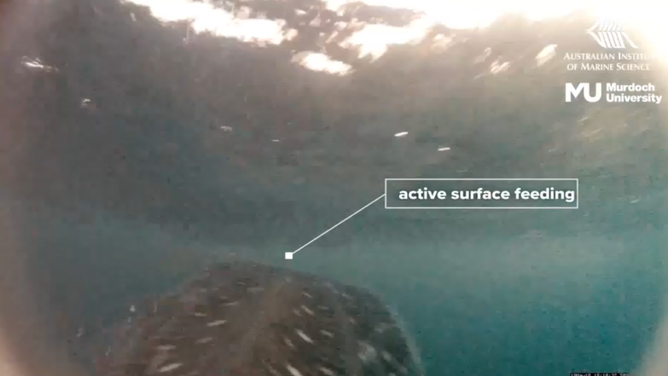
(AIMS and Murdoch University via Storyful)
Whale sharks have developed a diverse set of feeding strategies that help them survive in tropical oceans, where food sources are often scattered and unpredictable.
“If researchers can attach more cameras to whale sharks at aggregation sites around the world, we will hopefully discover new insights and continue to grow our understanding of this iconic species,” AIMS shared.