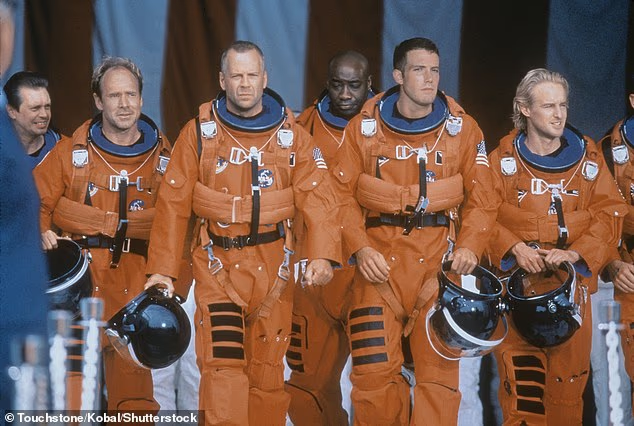
In 1998, the sci–fi blockbuster Armageddon drew the ire of scientists by proposing humanity could avert the apocalypse by nuking an asteroid before it hit Earth.
However, almost three decades later, new simulations suggest that this bonkers plot could actually be our best hope of avoiding a doomsday asteroid.
Chinese researchers now say that blowing up an asteroid by burying a nuclear bomb deep inside isn’t just possible, but the most efficient form of planetary defence.
The only difference from the Hollywood version is that this mission would be carried out by uncrewed spacecraft, rather than Bruce Willis and his crew of oil drillers.
Using computer simulations, the researchers found that a 164–foot (50m) asteroid could be completely blown apart by a 300–kiloton bomb.
That is about 20 times the size of ‘Little Boy’, the nuclear bomb detonated over Hiroshima during the Second World War.
Sending an even larger three–megaton bomb – 200 times the size of Little Boy – could shatter a 328–foot (100m) asteroid into safe pieces.
Even a 0.6–mile–wide (one kilometre) ‘city killer’ asteroid could be safely batted off its deadly trajectory using an explosion this large placed in just the right spot.
Scientists say that the sci–fi blockbuster Armageddon was right. We really could save Earth from an incoming asteroid by burning a nuclear weapon beneath the surface

Simulations showed that crashing a spacecraft into an asteroid and dropping a nuclear weapon into the crater could deflect an enormous ‘City Killer’ space rock. Pictured: The aftermath of a simulated explosion of a three–megaton bomb 20 metres beneath an asteroid’s surface
For now, scientists don’t know of any large space rocks that are actually due to hit the Earth.
However, experts are worried that we will soon find one on a collision course with the planet.
Since scientists started seriously tracking asteroids in the 1990s, astronomers have logged over 40,000 ‘near–Earth objects’ that could come near the planet in the future.
Of those, the Planetary Society estimates that 266 are big enough to destroy a city and have or will pass closer to Earth than the moon.
Scientists previously theorised that enormous nuclear explosions could be used to push the approaching space rocks off course or destroy them altogether.
But the big problem has always been that most of the energy from the blast would simply escape out into space, rather than going into the asteroid.
To get around this problem, without manually digging a hole in the asteroid, the researchers propose a surprisingly simple two–stage process.
First, a heavy metal ‘penetrator’ spacecraft is slammed into the side of the asteroid as fast as possible.

On April 13, 2029, 450–metre–wide (1,500 feet) space rock Apophis (pictured) will skim by Earth on an ‘ultraclose’ flyby that has put planetary defence agencies on high alert

A blast that can change an asteroid’s speed by just 2.2 miles per hour could deflect a deadly space rock from Earth’s orbit in as little as 60 to 70 days
The impact will blast a crater in the rock’s surface, into which a second craft will carefully deposit the nuclear weapon.
Compared to simply smashing a nuclear missile into the side of an incoming asteroid, the researchers say this technique has two big advantages.
First, space agencies can choose exactly where the explosion takes place rather than having the impact occur at a random point.
Secondly, the researchers point out that this is a lot easier than trying to design a nuclear weapon that can survive an impact at 12 miles per second (20 km/s) or detonate milliseconds before impact.
However, the biggest advantage is that detonating the weapon inside a crater massively increases how hard the blast will push the asteroid.
For a 0.6–mile–wide (one kilometre) asteroid, detonating a three–megaton bomb 16 feet (five metres) beneath the surface changed its speed by about 0.2 miles per hour.
Detonating that same bomb 65 feet (20 metres) beneath the surface changed the asteroid’s velocity by more than 0.67 miles per hour.
That might not sound like a lot, but that nudge is more than enough to send an asteroid into a safe new trajectory as it travels millions of miles through space.
For comparison, the only real–world planetary defence test so far is NASA’s Double Asteroid Redirection Test (DART) mission in 2022.
This test deliberately smashed a spaceship into the 525–feet–wide (160m) asteroid Dimorphos, changing its speed by 2.7mm per second.
While that was considered a big enough change to prove that Earth could be saved from an approaching asteroid, it is an 110 times smaller change than the impact of a buried nuclear bomb.
That is a really important difference, because the harder an asteroid can be deflected, the less warning time scientists need to move it away from Earth’s orbit.
With a velocity change double that of the DART mission, 0.5 centimetres per second, scientists would need to hit an asteroid almost four and a half years in advance.
However, if that change could be increased to 2.2 miles per hour, planetary defence systems would only need to strike an impending asteroid with 60 days’ notice.
For cases where time is short, the researchers argue that their two–stage nuclear method is the only practical way to protect Earth.
In their paper, published in the journal Space: Science & Technology, they write: ‘This study provides an important theoretical foundation for mission planning and engineering design of defence against large–sized or short–warning–time near–Earth asteroids and holds profound strategic significance for enhancing humanity’s capability to respond to asteroid impact threats.’