Much to volcanologists’ dismay, Hollywood’s enthusiasm for special effects often gets in the way of scientific accuracy when it comes to making a volcano movie.
But experts say that some epic disaster movies do manage to get some surprising details correct.
Now, researchers have revealed the most scientifically accurate volcano movies ever made.
And it’s great news if you’ve been looking for an excuse to re-watch the 1997 classic, Dante’s Peak.
In a new paper, published in the Bulletin of Volcanology, a team of British scientists watched through 20 movies featuring volcanoes to see how they square up with real eruptions.
They found that the most important thing these films get wrong is not the eruption itself, but the build-up to the explosion and how scientists try to predict it.
Most volcano movies dramatically shorten the real timeline, condensing weeks or months of uncertainty into hours or days of intense action.
However, Co-author Professor Jenni Barclay, a volcanologist from the University of Bristol, told the Daily Mail that Dante’s Peak ‘had a real attempt to demonstrate the uncertainties around an eruption and some of the elements of the eruption were pretty well portrayed.’
Scientists say that the 1997 classic Dante’s Peak is one of the most scientifically accurate volcano movies ever made, but it still gets a lot wrong
After watching volcano movies spanning the last 60 years of cinema, starting with 1942’s Superman vs Volcano, the researchers found that most movies get some core scientific details wrong.
Most importantly, they say that the timelines seen in volcano movies can be about ten times shorter than real eruptions.
Professor Barclay says the least realistic films they watched were ‘where the volcano goes from 0 to 10,000 miles per hour dramatically fast’.
While volcanoes in the movies have a clear onset, rapid progression, and obvious resolution point, this is far from the case for real eruptions.
The researchers also bemoaned the almost ubiquitous presence of sudden, fast-flowing streams of lava which ‘move like rivers in spate’.
Co-author Dr Bridie Davies, of the University of Manchester, told the Daily Mail that this is a particularly egregious blunder given the other classic features of a Hollywood volcano.
The classic on-screen eruption features a large cone-shaped volcano, which is scientifically known as an arc stratovolcano.
Dr Davies says the occurrence of ‘runaway lava flows’ alongside large, ashy explosive eruptions of stratovolcanoes is one of the most glaring scientific errors because ‘these two eruption styles are unlikely to coexist in the real world’.

The biggest issue most volcano movies have is that the eruption accelerates too quickly from initial signs of unrest to an abrupt stop

Researchers say that the 1997 movie Volcano is much less realistic than Dante’s Peak due to its bad choice of Los Angeles as the site of an eruption and excessive use of fast-flowing lava
Arc stratovolcanoes are much more likely to create deadly pyroclastic flows, fast-moving avalanches of superheated ash and rock, but these natural terrors very rarely make an appearance in cinema.
The researchers’ dedicated watching also helps to settle a question that has divided film fans for the last 30 years.
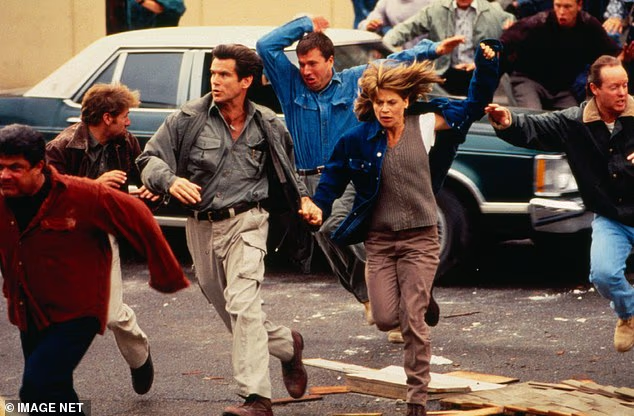
1997 saw the back-to-back release of two classics of the volcano disaster genre: Volcano starring Tommy Lee Jones, and Dante’s Peak with Pierce Brosnan.
Now we can finally say that, as far as scientific accuracy is concerned, Dante’s Peak was the far superior flick.
Dr Davies says: ‘Volcano does show some of the key signs of volcanic unrest we would look for, such as increased temperatures and gas levels.
‘But the runaway lava flow apocalypse in Volcano and the poorly chosen location of downtown LA for a large hidden volcanic threat are difficult to overlook.’
On the other hand, Dr Davies says that Dante’s Peak ‘gives more screen time to unrest phenomena and does a better job at representing the wide range of scientists involved in monitoring volcanic hazard.
‘We just have to overlook the scene where Pierce Brosnan drives for several minutes over a red-hot lava flow without his tyres popping.’

Real eruptions have a much longer period of uncertainty before the eruption, sometimes lasting days or months
Likewise, co-author Professor David Pyle, of the University of Oxford, told the Daily Mail: ‘Dante’s Peak is geologically much more realistic, starting with the volcanic setting, which is clearly reminiscent of Mt St Helens, which erupted in 1980.
‘The film does try to cram in far too many effects, but the inspiration is very much taken from things that have been seen in eruptions.’
Outside of the typical blockbuster movie, the researchers praised the accuracy of the 2006 BBC docudrama Krakatoa: The Last Days.
This is a partially fictionalised account of the 1883 Krakatoa eruption, based on eyewitness accounts, particularly the writings of Dutch geologist Rogier Verbeek.
The researchers say this film did a great job capturing the catastrophic effects of the blast, such as the tsunami waves and avalanches of volcanic ash, as well as the reality of the eruption timeline.
When it comes to the least scientifically accurate films, Professor Pyle singled out many of the disaster films that take inspiration from the 79 AD eruption of Vesuvius, such as 2014’s Pompeii, starring Kit Harington.
Professor Pyle says these films ‘run away with their imaginative dramatisations of the catastrophe’.
He adds: ‘More often than not, the motivation is to show off the special effects to the max, rather than to be more faithful to what might have happened.’

Experts say that films about Pompeii, including the 2014 flop Pompeii, are the least scientifically accurate

The most accurate piece of volcano media is the 2006 docudrama Krakatoa: The Last Days, which used eyewitness accounts to closely match the progress of the real eruption (illustrated)
However, besides the details of the eruptions themselves, one massive thing that all of these movies get wrong is the role of local communities and emergency responders.
While these movies usually show the local population ‘running around and panicking’, the reality is that people who live near volcanoes play a key role in preventing disasters.
Local groups help scientists to monitor the signs of an impending eruption and make plans for evacuations in case of an emergency,
Dr Davies says: ‘I would love to see greater value placed on the stories, knowledge and often extremely pro-social responses of local communities before, during and after volcanic eruptions.
‘The relationships built between scientists, local communities, leaders and emergency managers are complex and their combined efforts during times of volcanic crisis provide compelling stories of the power of the human spirit and community collaboration at its best.
‘Something we could all use more of these days.’