You can’t stop the clock, so you might as well enjoy the time you’ve got.
That’s the philosophy women over the age of 50 appear to share, as a new study has found they prioritise quality of life over longevity.
A survey of more than 6,000 over-50s in England reveals that older women are taking a ‘life’s for living’ approach, placing more value on quality of life than adding extra years.
Men, on the other hand, were found to be more likely to prioritise living longer.
Professor Nicholas Steel, from the University of East Anglia’s Norwich Medical School, said: ‘Women were significantly more likely to prioritise quality of life over length of life.
‘Men, meanwhile, were less likely to put quality of life ahead of simply living longer.’
While quality of life can mean different things to different people, it can include factors such as independence, comfort, mobility and the ability to enjoy everyday activities.
The authors say the findings challenge the assumption that everyone wants to maximise the number of years they live.
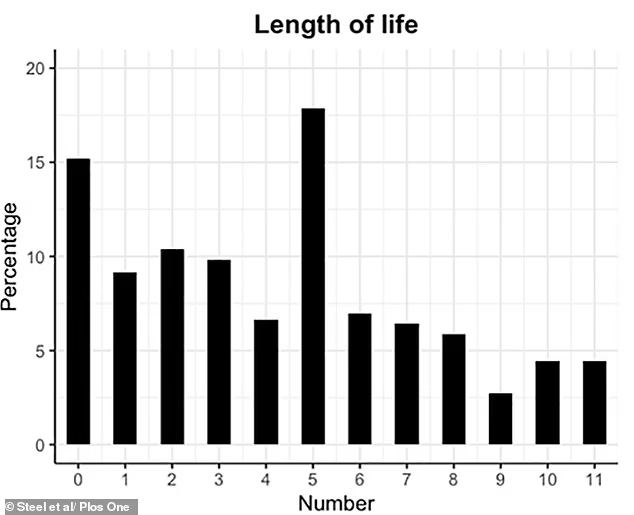
Participants rated their preferences on a scale from 0 to 10, with higher scores indicating a stronger preference for prioritising length of life. In this table, 11 represents ‘Don’t know’ answers
Instead, many people are willing to accept a shorter life if it means those years are healthier, happier and more enjoyable.
They argue that recognising these different priorities could help families and doctors better understand what matters most to older adults when discussing the future.
The results are part of a wider analysis of older people’s views on healthcare and ageing.
The study, published in the journal Plos One, also found that women are more likely to challenge doctors than their male counterparts.
But older people overall are increasingly willing to leave medical decisions in the hands of professionals.
‘We also found that older participants were more likely to prioritise how well their body functions rather than how it looks,’ Professor Steel added.
Their wider findings suggest that when it comes to healthcare, there is no such thing as a ‘typical’ older patient.
Instead, people hold strikingly different views on everything from taking risks and trying experimental treatments to whether they would rather enjoy a better quality of life or simply live for longer.
‘While age, sex and education can offer useful clues about healthcare preferences, every patient’s wishes remain unique,’ Professor Steel concluded.
‘This work provides a valuable starting point for more personalised care as Britain’s population continues to age and healthcare decisions become increasingly complex.’
A separate study recently revealed the secret to increased lifespan – and it turns out it’s mostly in our genes.
Until now, studies have suggested only around 10 to 30 per cent of a lifespan can be put down to genetics.
The rest was thought to be made up with illnesses, accidents and lifestyle factors such as eating well, not smoking and exercising.
However, a new study led by the University of Copenhagen has uncovered the role genes actually play in the human lifespan.
And according to their calculations, more like 55 per cent can be put down to genetics.
‘If lifespan is largely fixed by genetics, then the scope for influencing the rate of ageing is limited, particularly for lifestyle interventions,’ said co–authors Daniela Bakula and Morten Scheibye–Knudsen.