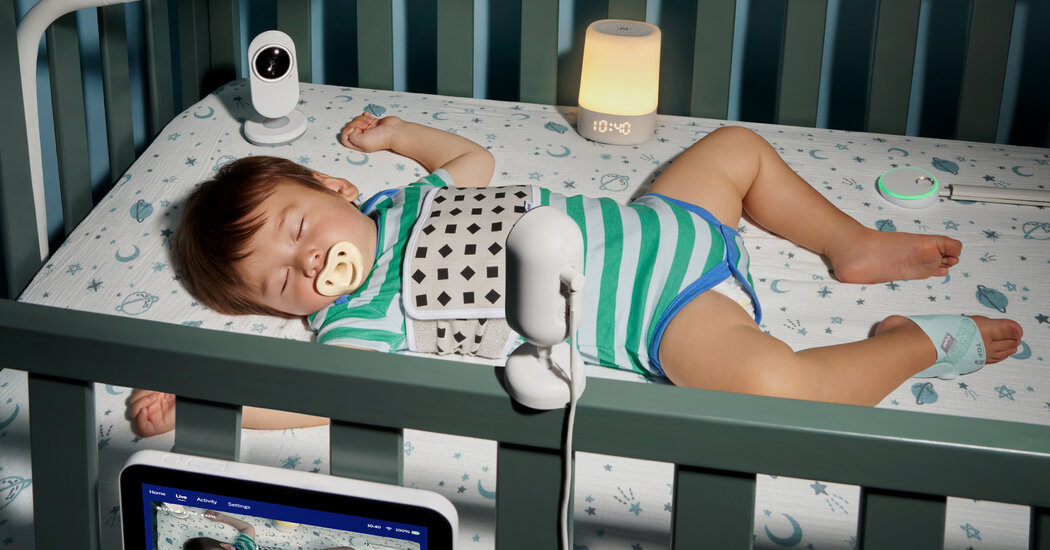
Baby monitors have their roots in fear. In 1932, American parents were horrified to learn that Charles A. Lindbergh’s toddler son had been taken from his second-floor nursery, and eventually killed, while five adults were in the home. A few years later, Zenith Radio Corporation introduced the first commercial baby monitor. The “Radio Nurse” was designed to be “on guard” for babies and the sick and elderly. An instruction manual read: “If the baby cries — if the invalid wants a glass of water — if there is a fire — if an intruder enters — YOU KNOW IT INSTANTLY!”
Nanit, Owlet and their competitors still operate in this space. The comedian John Mulaney recently riffed on his toddler son’s sleep setup, saying his bedroom looked like a “C.I.A. black site,” with a blackout tent over his crib. “I don’t know why we have 24-hour CCTV footage of my son’s crib, he’s not going anywhere — he sleeps in a bag,” he said. “We then have three sound machines going at full blast. And because we read it once on Instagram, we keep his nursery at 68 degrees. Any warmer and your infant will die automatically.”
One person who remains oblivious to all this parental anxiety is my older daughter. The Nanit is just a feature in her room. She understands that she can speak to my husband and me through the device, whose four red lights blink to power its night vision, and that we can see her at night through our phones. I imagine that she would develop sharper feelings about the camera if it started to play an extended role in her life, for years to come.
Nanit believes that one solution for that, as it looks to extend its presence in children’s bedrooms beyond toddlerhood, are new covers, known as “Cammies,” that can make the monitor look like a bunny, a bear or an elephant. Ms. Salinas said that making the camera look like a little friend or toy can “generate a lot more love” for it. But she added, “Each family is going to have to decide on their own if their child is OK with having the camera in the room as they get to the age that they’re making their own decisions.”
In her view, this is the start of a new future, a library of health data from cradle to grave. “The adoption curve accelerated significantly over the last few years,” Ms. Salinas said, “and I expect that to continue — such that it’ll be almost every parent that will have some product like Nanit that will help them have much richer insights on their child and who they’re becoming.”
Even before I first met Ms. Salinas, I had been wondering when to remove the Nanit from its perch above my older daughter’s bed. She may simply outgrow it before my husband and I come to a formal opinion on privacy versus convenience. These days, she no longer naps, and in the mornings she is as likely to greet us in our own bed than the other way around. There’s still joy on her face, and I make sure to see it there, rather than on a screen.