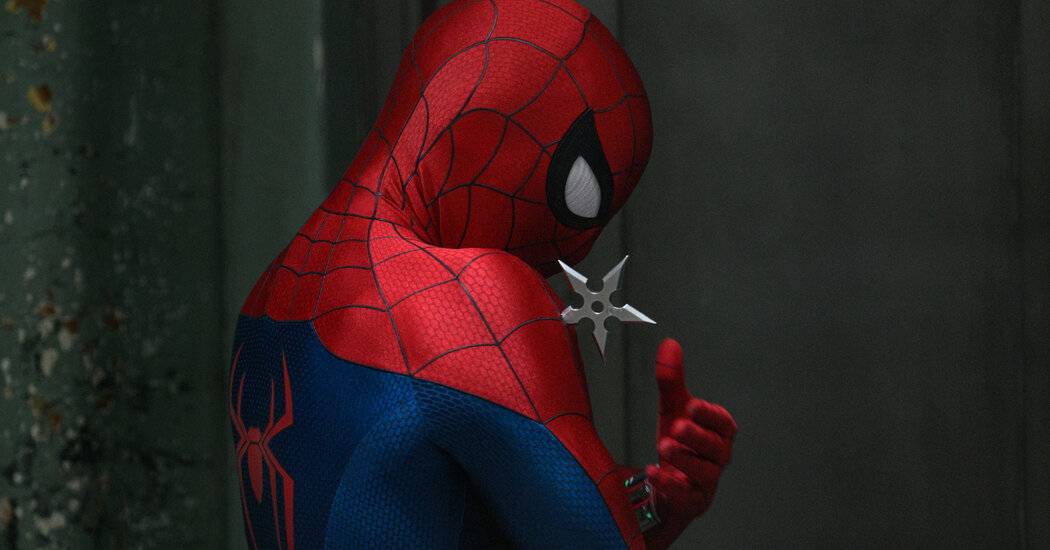
Hollywood’s superhero boom ended years ago. Spidey apparently didn’t get the memo.
Sony Pictures said on Saturday that “Spider-Man: Brand New Day,” its 11th big-budget Spider-Man movie since 2002, was on pace to collect at least $325 million at the North American box office from Thursday through Sunday. That would be one of the biggest domestic openings ever, ranking only behind Disney’s “Avengers: Endgame” in Hollywood’s history books. (“Endgame” generated $357 million in 2019, or about $467 million after adjusting for inflation.)
Directed by Destin Daniel Cretton from a screenplay by Chris McKenna and Erik Sommers, “Brand New Day” was expected by analysts to sell about $550 million in tickets overseas, for a global opening total of roughly $875 million. (Ticket sales are split roughly 50-50 between studios and theaters.) Sony spent an estimated $225 million to make the PG-13 movie, not including marketing costs.
To meet demand, some multiplexes in the United States were devoting nearly half of their weekend showtimes to “Brand New Day,” double what is typical, even for an event film. At some locations, screenings began as often as every 15 minutes.
“Brand New Day” drew especially strong turnout from Generation Z, defined as people born from 1997 to 2012, making them about 14 to 29 today. The reasons included casting — the movie features young stars like Tom Holland, Zendaya and Sadie Sink — and specific storytelling choices, according to Greg Durkin, the founder of Enact Insight, an entertainment research firm.
“Some of the themes in ‘Brand New Day’ that stoke Gen Z include mental health challenges, loneliness and being unseen by the ones you love,” Mr. Durkin said in an email. In “Brand New Day,” Peter Parker (played by a fourth time by Mr. Holland) struggles to rebuild his life after losing the personal connections that once defined him, leaving him isolated as he confronts a new threat.
That emphasis was intentional. Producers included Amy Pascal, who has been involved with the “Spider-Man” franchise since Sony first licensed the character from Marvel in 1999. She has long insisted that Parker’s emotional life and personal relationships remain at the center of the movies. Analysts say that creative approach has helped keep Spider-Man feeling distinctive even as enthusiasm for superheroes has cooled.
“Brand New Day” arrived to widespread acclaim, something that has become rare for superhero sequels. Critics lavished praise on the film, so much so that chatter about potential Oscar attention started in Hollywood. The Rotten Tomatoes audience score stood at 98 percent positive on Saturday.
There was also pent-up demand at the box office for an iconic superhero, according to David A. Gross, a film consultant who publishes a newsletter on box office numbers. Audience interest in superhero movies has waned in recent years, prompting studios to sharply reduce output. The last top-tier superhero to arrive in cinemas was Superman last summer.
“The market is ripe-ripe-ripe,” Mr. Gross said.
Sony marketed “Brand New Day” as less of a sequel and more of a new start (even the title telegraphed a reset), something analysts said made the film feel special: This is an event, not just another installment in an ever-expanding saga. Rather than mapping out the plot, the trailers withheld major story details, allowing fans to spend months debating what they weren’t seeing.
Since the 1970s, Hollywood has experienced distinct superhero eras, each resetting audience expectations and revealing a new industry strategy. Superman, who reigned from 1978 to roughly the mid 1980s, proved that the characters would resonate beyond children. In the Batman era, which began in 1989, superhero movies became megawatt franchises, replete with a dizzying number of marketing tie-ins and consumer products.
In 2008, when Iron Man ushered in the Marvel Studios era, superheroes become an industrial production, with studios like Marvel and Warner Bros. releasing interconnected films on an assembly-line schedule. It led to a glut. In 2023, one superhero movie after another disappointed at the box office, including “The Marvels,” “Ant-Man and the Wasp: Quantumania,” “The Flash,” “Aquaman and the Lost Kingdom,” “Blue Beetle” and “Shazam! Fury of the Gods.”
Spider-Man has shown that the problem may not be superheroes so much as sameness. Sony has repeatedly found ways to make each new installment feel distinct. Two of the studio’s 11 entries have been animated, embracing a comic-book visual style unlike anything else in Hollywood blockbusters. It has recast the title role three times. And now, with “Brand New Day,” it found a way to make a 24-year-old movie franchise come across as fresh — a place for audiences to jump in without feeling as if they had missed years of homework.