After years of battles over its use — and a long-running drought — states that rely on the Colorado River are facing the prospect of further cutbacks. Years of gridlock among the states prompted the federal government to step in. A new blueprint lays out new requirements for managing the shrinking river. Science correspondent Miles O’Brien explains what’s at stake for our series, Tipping Point.
Geoff Bennett:
After years of battle over its use and a long-running drought, states that rely on the Colorado River are facing the prospect of further cutbacks. The river supplies nearly 40 million people across seven states and Northwestern Mexico and is vital to agriculture across the West and Southwest.
But years of gridlock among the states have prompted the federal government to step in. A new blueprint released today lays out new requirements for managing the shrinking river. Some scenarios could eventually lead to steep cuts, but the most immediate effects will be felt over the next two years.
Our science correspondent, Miles O’Brien, is here to explain what’s at stake and what could be in store, part of our series Tipping Point.
Miles, it’s always great to see you.
So, for the unfamiliar, explain how it is that seven states rely on the Colorado River.
Miles O’Brien:
Yes, this is a problem, Geoff, that has roots that are more than 100 years old. You have to go back to when the river was divvied up in 1922, the Colorado River Compact, dividing it into the Upper Basin, Colorado, Wyoming, Utah, New Mexico, and the Lower Basin, California, Arizona, and Nevada.
Each of them was assured 7.5 million acre feet. That’s about 2.4 trillion gallons of water. And that was a number, not a percentage, kind of set in stone. The problem is that agreement occurred at a particularly wet time for the river, and over time the river has not delivered anywhere near that amount of water.
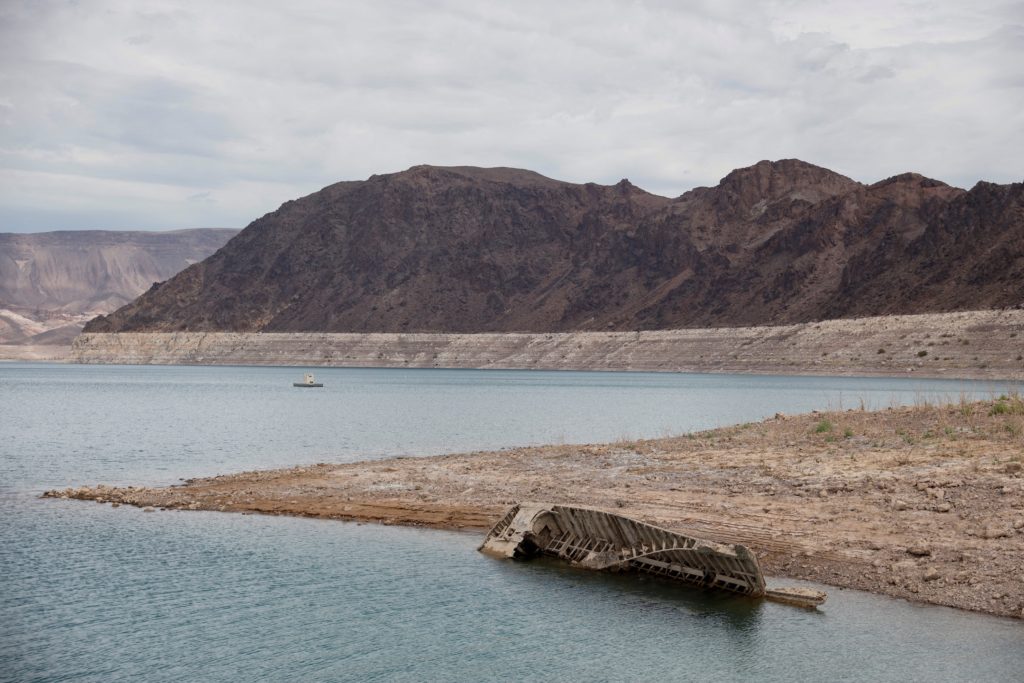
And over the past 25 years, during a climate change-fueled epic drought, it’s become even more acute. The river is now 20 percent less flow than was envisioned in 1922. And it’s very difficult for the seven states to negotiate with a pie that is shrinking that fast. And so they are at loggerheads.
Geoff Bennett:
The states have known this has been coming for years. Why haven’t they been able to reach a deal?
Miles O’Brien:
It’s just difficult to share cuts like this when things are diminishing.
And so what has happened is, the federal government, in the form of the Bureau of Reclamation, which runs the big dams along the river, the Glen Canyon Dam, which creates Lake Powell, the Hoover Dam, which creates Lake Mead, those two giant reservoirs, seeing critical shortages there, all-time lows there, has decided it’s time to step in.
And so what they’re saying, although the rules haven’t come out yet, they released an environmental impact statement which lays out a 10-year plan which allows it to adapt to the hydrology of the river. As there’s less water, they will make decisions on how much water they will discharge and making decisions about how healthy the reservoirs are and how much of a shortage farmers and cities south of those dams will have to face.
But it’s a difficult situation, and the rules will probably involve some significant cutbacks, and those cutbacks ultimately may not be enough. So we’re just going to have to wait and see how this plays out.
Geoff Bennett:
And the federal government is now stepping in? What’s the government doing about all this?
Miles O’Brien:
Well, it’s kind of unprecedented.
Sarah Porter, an expert at the Arizona State University, said it’s the first time in decades that the federal government has stepped in. It is a problem which ultimately leads us to agriculture, Geoff; 75 percent of the water used on the Colorado River is used by agriculture.
Cities in the West have grown rapidly, but they have done a very good job conserving. And so, as a result, closing the gap is, frankly, going to mean asking farmers to use less water, plant crops that need less water, or getting out of business entirely.
Here’s a little more on that from Colorado State University climate scientist Brad Udall.
Brad Udall, Colorado State University:
You have large municipalities like Phoenix, which is 40 percent dependent on Colorado River water, or Tucson, perhaps 80 percent dependent, or Los Angeles, 25 percent dependent, that, frankly, can’t take a back seat to agriculture.
You can’t have 500 farmers taking water from five million people in Phoenix. It just won’t work politically. It makes no sense economically.
Miles O’Brien:
More details on the actual plan next week, but we knew the do know the parameters now, Geoff. It’ll be interesting to interesting to see how this all shakes out.
Almost — probably almost certain this is going to end up one way or another in the Supreme Court, proving once again the adage attributed to Mark Twain, whiskey is for drinking, water is for fighting over, Geoff.
Geoff Bennett:
Miles O’Brien, our thanks to you, as always.
Miles O’Brien:
You’re welcome.