More shark attacks have been caught on camera in recent years than at any other point in history. However, many of their victims live with another trauma – not knowing which type mauled them.
A trio of experts reviewed footage of several incidents around the US to identify the species that bite humans.
Tom Hird, a marine biologist, said: ‘Sharks hit fast, hit hard and get out of there, so it’s difficult to tell what kind of shark it was.’
There were 25 confirmed attacks in US waters last year, but 15 of those involved a shark that witnesses could not identify, according to the Florida Museum of Natural History.
Hird and shark experts Kinga Philipps and Rosie Moore looked at four recent attacks in Florida, all involving children, in a special for Discovery’s annual Shark Week, airing Thursday at 8pm ET.
In three of these bone-chilling incidents, the child lost a limb, and only one was able to have it successfully reattached.
Moreover, all the attacks took place in relatively shallow water, just feet from the shore or a boat, and yet the predator still got away unseen.
The first of the victims they looked at was Jameson Reeder, who was just ten years old in August 2022 when a shark cost him his right leg.
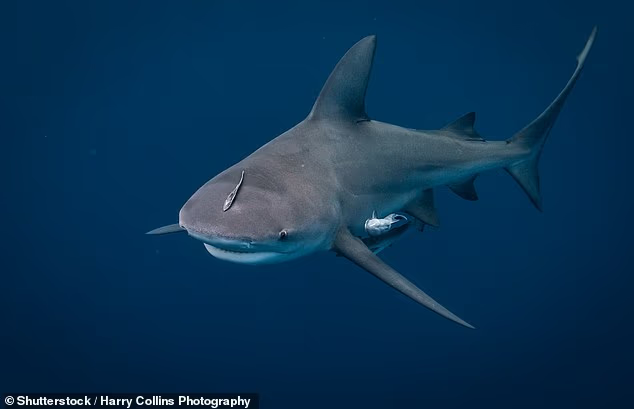
Bull sharks, which thrive in Florida, have been behind at least ten attacks in the US this year

Jameson Reeder lost his right leg when a shark attacked him as he was filming a turtle in a shallow reef in Florida in 2022
The boy was with his family off the Florida Keys, filming himself chasing a turtle when he was viciously bitten from behind. He had an amputation from the knee down and continues to swim despite missing his leg, his family said.
The shark that attacked him was never seen.
However, the experts looked at the video taken as the attack began, in which Reeder was forced to drop his camera onto the floor of a shallow reef.
They spotted a tooth which they believed had come from the shark’s mouth during the attack.
‘It seems to have that slightly irregular edge that you’d see on bull sharks but also tiger sharks as well,’ Hird said.
The experts also caught a glimpse of a massive tail fin on the shark, noting that this was an incredibly large predator that was able to sneak up on the child in extremely shallow water.
‘We’re talking [about] a shark that’s a minimum of ten feet in size,’ Moore said.
However, the final clue was spotted by Philipps, who saw the telltale indent in the animal’s fin, leading her to believe the attacker was a bull shark.

Moments before the shark snuck up on the ten-year-old off the coast of the Sunshine State

Video of the attack appeared to show a tooth that had fallen out of the predator’s mouth

The animal’s fin was captured in the footage, leading an expert to believe it was a bull shark
Bull sharks thrive in temperate water and have been described as ‘ambush predators.’
They are the number one suspect in most of the world’s shark attacks, and ten biting incidents have already been blamed on them in 2026, according to the Global Shark Attack File, a public database documenting cases as far back as the 1940s.
Another bull shark is now believed to be responsible for an even bloodier attack on a teenage girl along the Florida Panhandle in June 2024.
Lulu Gribbin, who was just 15 at the time, was diving for sand dollars when she was mauled near the shore of Seacrest Beach, losing her left hand, right leg and roughly two-thirds of her blood.
Bystanders believed it may have been a tiger shark, and Philipps said that the species has been strangely gathering at a point called Okaloosa Pier in recent years, just 33 miles from the attack.
‘There have been 32 tiger sharks sighted just from the pier, and this is right off the coast.’ Philipps said. ‘Why are they coming? Well, we think they’re there because they’re following the bait fish.’
However, Philipps and Hird noted that these sharks are extremely well fed and there were no other tiger shark attacks reported, suggesting a different predator nearly killed Gribbin.
The experts pointed out that there had been multiple reports of a shark in the area of Seacrest Beach right before the attack, all thought to be a bull shark.

In June 2024, a shark nearly killed teenager Lulu Gribbin at Florida’s Seacrest Beach

Experts believe a bull shark spotted in the area hours before the attack was responsible
In fact, the experts discovered a video of a bull shark attacking a boat just hours before Gribbin was bitten.
‘They are known to kind of bully and chase,’ Moore said. ‘I think the species that’s responsible for the Seacrest attack was definitely a bull shark.’
The teenager survived, but needed multiple surgeries and spent extensive time in hospitals for rehabilitation to learn to use prosthetics for the missing limbs.
One shark attack survivor whose limb was saved was Leah Lendel, who was just nine years old in June last year when a mystery shark bit off her right hand.
The incident took place right along the shore of Florida’s Boca Grande as she was in the water with her mother and siblings.
Video and audio recordings captured Lendel’s mother sobbing as she told police how the shark left her daughter’s arm dangling from her body.
The child’s hand would later be successfully reattached
Experts noted that witness Raynel Lugo had seen that the shark looked like a paddleboard, had a round head and kept pursuing the girl as people pulled her from the water.
Lugo added that the shark appeared to be seven or eight feet long.
The experts believed these clues point to another bull shark attack because the predators patrol shallow waters and become very territorial when other creatures enter their habitat.

Leah Lendel was just nine years old when a shark attacked her in shallow water and bit off her right hand last year
Meanwhile, an entirely different species is believed to have ambushed Doyle Nielsen from Georgia, who was just 16 when he was attacked in September 2021.
The teenager was on his board surfing near Florida’s New Smyrna Beach – known as the shark attack capital of the world.
Cameras captured the moment Nielsen was struck by a fast-moving shark that was seen stalking the local surfers, suffering a bite on his right arm and needing nine stitches.
Hird said that the video contained some very telling clues, including the strange sight of the shark seeming to leap and twist in the air as it bit Nielsen.
‘This really is pointing towards a young spinner shark. It’s got all the hallmarks. They’re well known to play in the surf. It’s got that spinning leap that people will see that is actually the key to the shark’s own natural predation method,’ Hird explained.
This species can grow up to eight feet long and has a unique corkscrew-like spin when they attack prey.

Surfer Doyle Nielsen was caught on camera being attacked by a shark at Florida’s New Smyrna Beach in 2021

The then-16-year-old needed nine stitches to close the wounds of his shark bite

Experts believe a spinner shark attacked Nielsen
The Shark Week special also tackled a number of mysterious attacks from around the globe, including savage maulings in Australia, Brazil and French Polynesia.
Overall, the experts noted that there are more than 500 species, and each has their own style when it comes to hunting and attacking prey.
Despite the danger, Philipps said if there were no sharks to be the apex predator of the sea, the entire ocean ecosystem would collapse as marine life would be thrown out of balance.