The Federal Reserve is at an inflection point in its yearslong campaign against elevated inflation. On Wednesday, officials will decide whether to raise interest rates to tame price pressures or keep them unchanged as they wait and see what happens with the economy. Rates are currently set in a range of 3.5 to 3.75 percent.
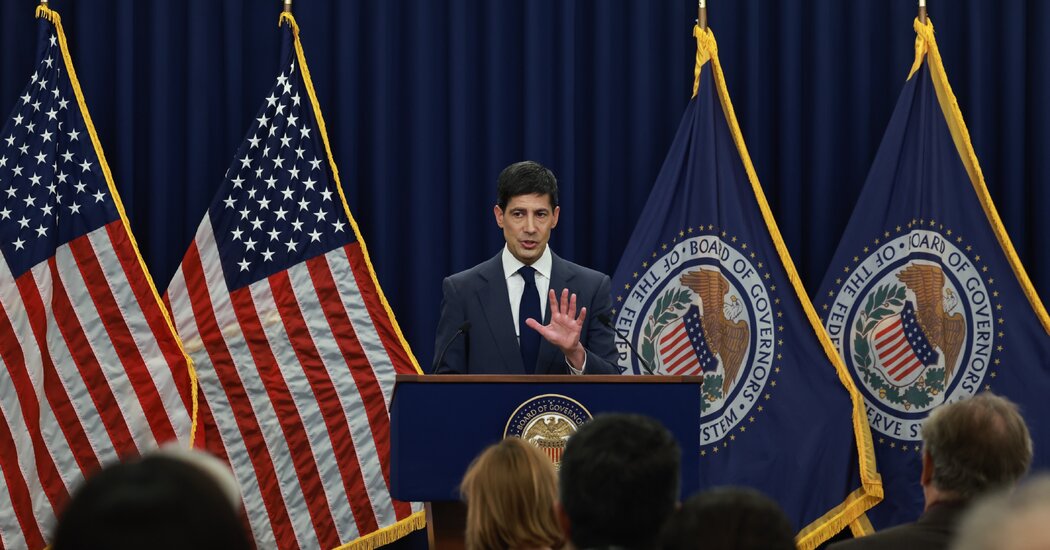
Kevin M. Warsh, who will be presiding over his second meeting since taking over as chairman, has long vied for policymakers to engage in a “good family fight” before determining the most appropriate policy settings. That, coupled with Mr. Warsh’s opposition to providing any signal about the trajectory for rates, has injected considerable uncertainty into the outcome of July’s gathering.
On Wednesday, the Fed will release its rate decision at 2 p.m. in Washington. Mr. Warsh will hold a news conference at 2:30 p.m.
Here is what to watch:
Raise or Hold?
Many expect the Fed on Wednesday to hold rates steady. But a sizable contingent believes that Mr. Warsh’s best bet is to usher in a quarter-point increase.
The case for a rate increase centers on the notion that inflation, while cooler in June than in previous months, is unlikely to get back to the central bank’s 2 percent target in a timely fashion on its own. The Fed has missed that goal for roughly half a decade.
Mr. Warsh has made price stability his top priority since taking over as chairman. Delivering a rate increase on Wednesday would help to fortify that pledge and put to rest criticism that he is not independently minded when it comes to setting policy. President Trump, who handpicked Mr. Warsh for the job, has long demanded lower borrowing costs. Asked on Monday about the chance that the Fed could raise rates, Mr. Trump reiterated that “rates should be lowered.”
Raising rates now could have other downsides, beyond setting off Mr. Trump.
A rate rise could seem rushed and ill-timed given it comes on the heels of relatively benign inflation data and further evidence that the labor market is not a source of inflationary pressure. Oil prices, which topped $100 a barrel last week amid a re-escalation in the war with Iran, have fallen after a pause in fighting over the weekend. Against this backdrop, an aggressive move could sow confusion about how officials will react to incoming data.
Keeping rates unchanged would allow for officials to gather more information about the economy before making a move. Many expect inflation to ease in the latter half of the year. By the time the Fed meets again in September, officials will have two more months of data in hand. Most investors, according to financial markets that wager on what the Fed will do, see a rate increase then as more likely than not.
Given Mr. Warsh’s insistence that the central bank has “no tolerance” for elevated inflation, inaction on Wednesday will keep him on the defensive and having to talk tough about the Fed’s resolve to tame price pressures.
How Many Dissents?
In the lead-up to July’s meeting, only two policymakers indicated an urgency to raise rates. Lorie K. Logan, president of the Federal Reserve Bank of Dallas, and Beth M. Hammack of the Cleveland Fed, both emphasized the strain on consumers and businesses caused by elevated inflation and the potential for price pressures to further broaden out. Prices across the services sector, including transportation and shipping costs, as well as expenses tied to eating out or traveling have all risen compared with the same time last year.
Ms. Logan and Ms. Hammack contend that higher borrowing costs are necessary to achieve the Fed’s 2 percent target. Both are voting members on this year’s policy-setting committee and are likely to dissent against a decision to hold rates steady.
There could be at least one more dissent, but by and large, the Fed’s most senior decision makers signaled this month that the central bank could afford to stick with its wait-and-see approach for now. They all stressed, however, that they would be ready to act if inflation did not soon ease. That suggests that should the Fed choose to raise rates on Wednesday, it is unlikely to face much pushback.
Searching for a Signal
Mr. Warsh will be under heightened pressure on Wednesday to provide more substance around his policy views regardless of what the Fed ultimately decides to do.
The public has been left wondering what his assessment is of the economic backdrop and the primary drivers of inflation, along with whether he believes that the Fed should respond to price pressures that are mostly a result of supply constraints rather than demand. Little is also known about how effective he believes rate adjustments are for what currently ails the economy and to what extent he is relying on financial markets to do some of the Fed’s work for it.
Mr. Warsh’s predecessors often signaled in advance how the Fed was likely to react to changes in the economic data. If inflation came in stronger than expected, for example, markets would anticipate that the Fed was more likely to raise rates or at least hold them steady for longer than otherwise would be the case. That then would help tighten financial conditions, which capture the availability of credit across the economy, long before the Fed made any policy decision. Higher borrowing costs, the thinking goes, would help dampen economic activity in a bid to keep inflation in check.
“That is actually a great division of labor, because financial markets are always going to be a lot quicker than central bankers,” said Jan Hatzius, chief economist at Goldman Sachs. “Central bankers ultimately have to decide whether the move that was anticipated is actually correct, and they have the option of not delivering on it.”
Mr. Warsh has broken with that tradition by choosing to keep mum on how he plans to steer the Fed as the economic backdrop shifts. Instead, he has said that he wants investors to price what they think is optimal policy, therefore providing another crucial data point for the Fed.
But that is hard to achieve in practice, creating a risk that markets could more easily be wrong-footed if they misinterpret Mr. Warsh’s scant signals.