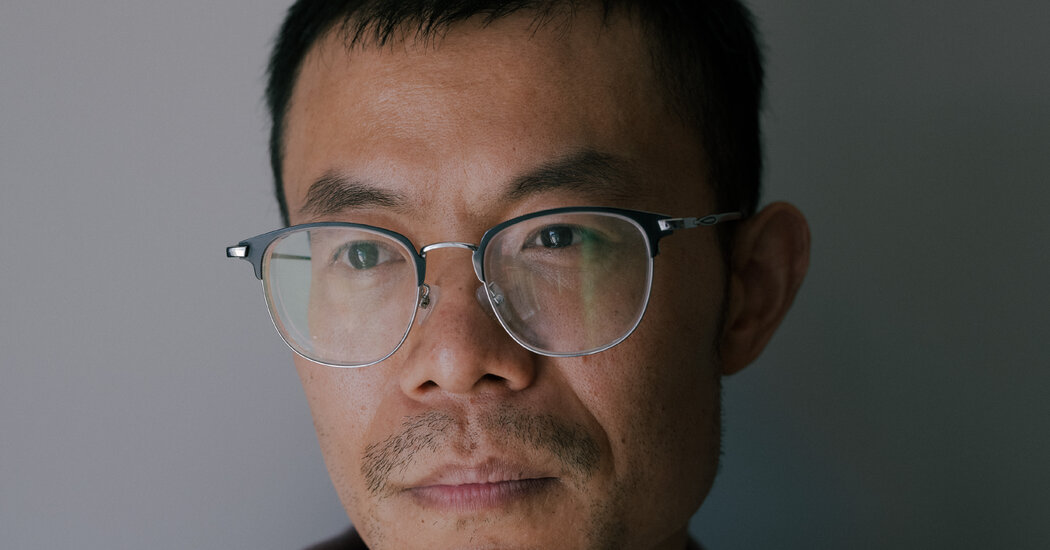
Halfway through a short speech he was giving at the German Bundestag, Zhang Yabo began to choke back tears.
Mr. Zhang had served for nine years as a police officer in Xinjiang, an enforcer in China’s campaign to surveil, detain and indoctrinate that region’s Uyghur population. At the campaign’s height, an estimated one million Uyghurs and other Muslim minorities were held in internment camps.
Tens of thousands of police officers carried out China’s state oppression in Xinjiang, but Mr. Zhang is a rare voice speaking out about it. Standing before German lawmakers and human rights activists in June, he described Xinjiang as a giant prison enclosed by an “ironclad wall.” “That wall imprisoned not only countless innocent Uyghurs,” he said, “but also the souls of those ordered to enforce it.”
Mr. Zhang related the pressure of participating in China’s security apparatus: endless shifts, sleeping in the office and constant fear of punishment. After he requested asylum in Germany last summer, Chinese authorities froze his bank accounts, he said, branded him a traitor and harassed his family.
By the end of the speech, he was sobbing “like a child,” he later told me. He hurried from the room and did not return.
“All the pressure, all the fear, all the emotions that he had carried with him” seemed to break loose, said Adrian Zenz, a Xinjiang expert who attended Mr. Zhang’s speech, “like a huge dam holding back a huge amount of water.”
Mr. Zhang’s account of his time in Xinjiang corroborates what has long been documented about the Chinese Communist Party’s brutal repression of the Uyghurs while adding detail and an inside perspective to that record. It also reveals what an ordinary man pursuing upward mobility could gain, and lose, by helping to carry out those repressive policies.
Mr. Zhang provided extensive documentation of his service history, including copies of his police identification and pay and social security records, as well as photos of him at interrogations and political propaganda sessions. But I could not corroborate exactly what he did or did not do in Xinjiang; I relied on his telling of the story, and there may have been things he did not share.
The Chinese government denies committing human rights abuses in Xinjiang, describing the camps as vocational training centers created to combat terrorism and religious extremism. It says the centers were closed in 2019.
With China’s record of retaliating against citizens in exile, Mr. Zhang has shown considerable courage in coming forward as a witness to injustice. But he is asking for something more than praise; he wants to be recognized as a victim himself — a victim of the apparatus he participated in for nearly a decade.
A Grim Path Out of Poverty
For Mr. Zhang, moving to Xinjiang, and later joining its police force, offered a way to move up in the world. Born in 1986 into a poor rural Han Chinese family, Mr. Zhang lived in a village in central Henan Province that did not have electricity until he was 8. He moved to Xinjiang for college in 2006 and stayed to teach mathematics at a rural primary school. He married a woman from his home province, and they had a son in 2011.
In late 2014, he left teaching for better pay as a guard at a detention center in the Hotan region, where about 90 percent of the population was Uyghur. His monthly wages rose to about $650, from $400 as a teacher.
For nearly two years, he said, his duties included monitoring surveillance footage, distributing food and medicine and gathering incriminating information from detainees, most of them Uyghurs. He heard screams from the interrogation rooms and saw detainees beaten up and deprived of sleep. He sometimes found broken batons when picking up the detainees. At the time, he said, he accepted the government’s claims that the men being interrogated were terrorists and separatists.
Seeking even higher pay and greater social status, Mr. Zhang took the civil service exam and formally joined the police force in late 2016 just as Beijing was about to intensify its mass detention campaign in Xinjiang. He was proud of his uniform, he said, and his monthly pay rose to about $900.
In early 2017, Chen Quanguo, the new Communist Party secretary of Xinjiang, called for a “smashing, obliterating offensive,” including, according to leaked government documents, the detention of anyone who displayed “symptoms” of religious radicalism or antigovernment views. Those symptoms could be the wearing of long beards, studying Arabic and praying.
Mr. Zhang took part in nighttime raids on Uyghur homes to confiscate Qurans and other religious items. “I was usually the first to charge in,” he recalled. “I believed they were bad people. That was what had been drilled into us at the time, that they were all bad people.”
For much of 2017, Mr. Zhang traveled in bus convoys transporting hundreds, and sometimes thousands, of Uyghur detainees to prisons across Xinjiang, which is nearly four times the size of California. The detainees were handcuffed, hooded and ordered to use plastic buckets as toilets during the journey. Mr. Zhang distributed bread and water.
“My job was serving the passengers on the bus,” he said.
In late 2018, when he was assigned to a police station, he began to grow despondent. His colleagues brought in Uyghur prisoners at all hours, he said, and he was responsible for searching them and helping determine where they would be sent. His sleep was constantly interrupted, and his superiors were short-tempered.
He was pleased to be briefly reassigned to supervise about 3,000 Uyghur laborers who had been sent to pick cotton for Han Chinese farmers. They rose at 5 a.m., traveled for hours to the cotton fields and were not returned to their dormitories until late at night.
For Mr. Zhang, it was a nice break. His main task was to make sure no one ran away or prayed.
He learned of the international criticism of forced labor in Xinjiang through statements by China’s foreign ministry and accepted the government’s claim that the accusations were false and intended to vilify China. “I didn’t think much about it,” he said. “I never paused to consider whether it was true or not.”
Privilege and Punishment
For years, Mr. Zhang largely accepted the orders he was given. But during the pandemic, governmental coercion began to feel personal. He said he had once been confined for about 10 days inside a village police post and, after a work trip, quarantined for nearly a month in an abandoned police station. “The pandemic was more painful because it involved me personally,” he said.
In August 2021, he was assigned to Yurushikai, a village of about 1,700 Uyghurs. About 40 percent of the adults in the village had spent time in internment camps, and some 100 were still serving time in jail, which meant that some households consisted of only children and grandparents. It was Mr. Zhang’s job, with the help of two Uyghur assistants, to investigate reports of people praying at home or missing the weekly national flag-raising ceremony or even jogging or exercising.
The government’s surveillance system generated automatic alerts for “abnormal” activity. If a household’s electricity use rose, he said, the officers would visit and ask what had kept the family awake.
Police work brought Mr. Zhang money, status and privileges: expedited treatment at hospitals, free parking. By 2023, his monthly take-home pay had risen to about $1,250.
But within the police hierarchy, he said, he was disposable. Superiors routinely insulted officers, calling them donkeys that needed to be whipped to work, Mr. Zhang said. After he missed a walkie-talkie call in December of his first year in the village, a superior punished him with 72 hours of continuous duty at a road checkpoint in freezing conditions without adequate clothing.
The overtime was relentless, and he was separated from his family for long periods. He had not celebrated Lunar New Year with his parents since 2017 and was denied leave for his sister’s wedding. On average, he could visit his wife and his son once a month.
There were also quotas to meet. Starting in 2023, he was required to produce one lead a week that could be used to justify a detention. Mr. Zhang said he had frequently failed to hit the quota and had to submit self-criticism reports and work 24-hour shifts as punishment. Working closely with the villagers began to challenge the stereotypes he had absorbed about Uyghurs. He became increasingly reluctant to enter their homes or search their private communications, even as he continued to carry out the surveillance his job required.
Self Re-education
By September 2023, Mr. Zhang left his post.
He moved to Guangzhou in southern China to study English, hoping eventually to study abroad. He began using a VPN to get around China’s internet firewall. The first subjects he searched were “Xinjiang” and “Chen Quanguo,” the name of the region’s hard-line former party secretary. He could not believe, he said, that the facilities where he had worked, known to him as “re-education centers” and “vocational training centers,” were described online as concentration camps. Until then, he had encountered the term only in movies about World War II.
“What I found gave me terrible headaches: One side of my head said one thing, and the other said something completely different,” he said. “The conflicting accounts battled in my mind, and I couldn’t sleep at night.”
After officially resigning in early 2024, feeling wounded and in need of solace and strength, he turned to faith. He had found peace in a book about Bible stories that he had read to his son at bedtime, and in April 2025, Mr. Zhang was baptized as a Catholic in Guangzhou. Four months later, he joined a European tour with his 14-year-old son. He had already decided that if he could get away from the group, he would seek asylum.
As their tour group entered Neuschwanstein Castle, the Bavarian palace that inspired Disney’s Sleeping Beauty Castle, Mr. Zhang and his son sneaked away. They traveled to Munich and went to the headquarters of the World Uyghur Congress, an advocacy group whose name Mr. Zhang had heard many times in Xinjiang, told it was a separatist terrorist organization.
He has applied for asylum and lives in a shelter in southern Germany, where his son is staying at a foster facility not far away. Over a dinner of pasta, the 15-year-old told me that he missed Xinjiang’s spicy stir-fried rice noodles. Mr. Zhang’s wife remains in Xinjiang, and the couple have filed for divorce.
Mr. Zhang now spends his time speaking with academics, journalists and human rights groups to document how the persecution of Uyghurs was carried out.
“Of the millions of Chinese police officers, he is the only one who has come forward to speak the truth,” said Haiyuer Kuerban, an official at the World Uyghur Congress who has been helping Mr. Zhang settle in Germany. He said his organization had initially viewed Mr. Zhang with deep skepticism, but that its doubts had begun to ease after reviewing his documents.
Mr. Zenz, the Xinjiang expert who is director of China studies at the Victims of Communism Memorial Foundation, a nonprofit organization in Washington, said Mr. Zhang supplied “the ground-level reality of what we had mostly inferred” from government documents, state media reports and survivor testimony.
Bjorn Alpermann, a China scholar at the University of Würzburg who has interviewed Mr. Zhang extensively, said his account offered unusually granular evidence of how repression continued after the height of the mass-internment campaign and became “routinized” in village life.
But people who have worked with Mr. Zhang in Germany told me that we knew only what he wanted us to know and that he probably knew more than he shared.
He remembers the forms he filled out, the orders he followed and the humiliations he endured in vivid detail, but is fuzzier on the worst abuses. He described hearing screams and seeing detainees after interrogations but offered fewer details about death, sexual violence and torture in detention facilities. He insisted he had been honest and forthcoming.
He also wants the world to recognize what he endured.
“My suffering was equal to, or in some respects greater than, that of the Uyghurs,” he told me repeatedly. “Why don’t you journalists write about me? Why do you only focus on the Uyghurs?”
Han Chinese officers, of course, were not forced to abandon their language or culture and, however difficult it might be, they could leave the police or Xinjiang. They were not subject to arbitrary detention, forced labor or torture. They would not be considered potential terrorists for playing basketball or doing push-ups.
“No matter how much you suffer at work, you can still go home, eat a good meal, and imagine a future,” said Mr. Kuerban, the Uyghur activist. “You do not live with the constant, paralyzing fear that something you said 10 years ago will make you disappear tomorrow.”
Still, Mr. Zhang’s experience showed how inhumanely the system treated its own operatives, Mr. Alpermann said. And for Mr. Zhang, leaving China and speaking publicly was itself a way of confronting the system.
Mr. Zhang insisted that he had never personally tortured or mistreated any Uyghurs. He described himself as a small cog in the state machinery who filled out forms, guarded facilities and handled logistics. Responsibility lay with senior officials and with the Uyghur police assistants who, he said, carried out many of the most direct and abusive tasks. Low-level Han Chinese police officers like him, he insisted, were innocent.
It is unclear whether Mr. Zhang’s self-exoneration is a form of self-protection, an inability to bear what a fuller recognition would mean or simply a habit of mind formed by years inside the system. Mr. Kuerban said he did not believe the blindness was deliberate. After repeatedly pressing Mr. Zhang, I had come to a similar conclusion: He seemed genuinely unable to see his role in the wider context of the immense injustice inflicted on the Uyghurs.
His struggle also reflected the country he came from, where the state has suppressed public memory of the Great Famine, the Cultural Revolution and the 1989 Tiananmen crackdown. Unlike Germany, where there has been decades of reckoning with Nazi complicity, China provides little space for sustained debate about complicity, guilt and responsibility.
Working inside an abusive system did not automatically make someone a monster, Mr. Kuerban said. But neither did performing a minor function, or not personally carrying out the worst abuses, eliminate responsibility.
Mr. Zhang said his faith had taught him that his responsibility now was to speak out.
“If you stay silent,” he said at the end of his Bundestag speech, “you’re part of the problem.”