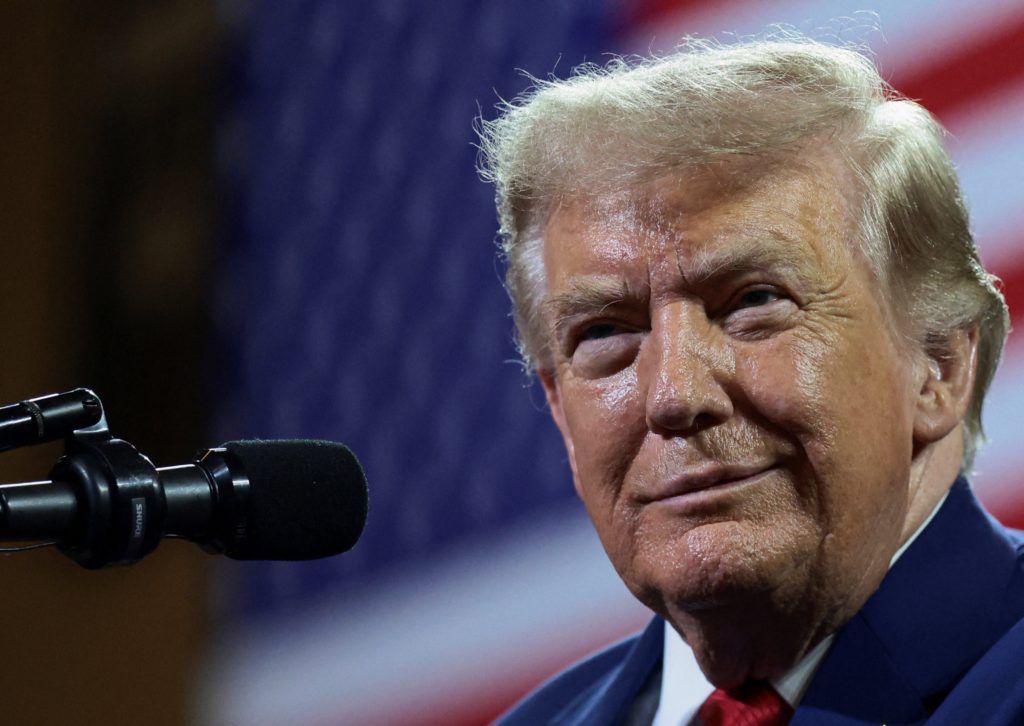
MILFORD, Mich. (AP) — President Donald Trump is touting his handling of the economy during a visit to suburban Detroit on Monday, defending sweeping tariffs in a swing state where their effects have hurt many businesses as midterm election season heats up.
The president is expected to speak at 2:50 p.m. EDT. Watch live in the video player above.
Trump is visiting a General Motors facility in Milford, that’s a testing and proving grounds for its vehicles. Before his speech, he’ll view a drag race demonstration ahead of an IndyCar race in Washington next month, which the president has promoted as part of America’s 250th birthday celebrations.
Early voting is underway for Michigan’s Aug. 4 primary, which features fierce nomination fights in both major political parties.
Republican Mike Rogers is unopposed in the Senate primary, but the GOP gubernatorial contest pits Trump-backed Rep. John James against Perry Johnson, a businessman turned politician who has launched unsuccessful campaigns before, including for president in 2024.
READ MORE: Trump to travel to Michigan ahead of swing state’s primary election
Johnson is now trying to style himself in the president’s mold — despite missing out on his endorsement. The Democratic Senate primary between Rep. Haley Stevens and progressive Abdul El-Sayed has drawn national attention for the right to face Rogers, who was narrowly defeated by Democrat Sen. Elissa Slotkin in 2024.
Trump’s new Canada tariffs could hurt Michigan
Michigan was one of the 2024 battlegrounds Trump flipped after it backed Democrat Joe Biden in 2020. But the state has also seen parts of its economy affected by the president’s tariffs, including on imported cars and auto parts.
WATCH: Trump raises tensions with Canada by announcing new 50% tariffs
A new round of steep import levies is taking effect on dozens of U.S. trading partners. But Trump has singled out Canada with tariffs as high as 50% on a wide array of its products, including cars.
The president is visiting Oakland County, which encompasses much of Detroit’s northern suburbs. Once a Republican stronghold, it has increasingly leaned Democratic, backing Biden against Trump in 2020 and Vice President Kamala Harris against Trump four years later.
The Milford area home to the GM testing area is suburban enough that, in a wooded space nearby, a convincing wood cutout painted all in black and shaped like bigfoot seems to be emerging toward a major road.
Dating from 1924, GM says its facility is the oldest dedicated vehicle testing facility in the U.S. where 4,200 employees work to refine nearly every vehicle the company makes before they reach consumers.
The White House says Trump will talk up having generated manufacturing jobs and foreign investment in the U.S. while making the case that his policies and leadership have boosted the auto industry.
“The President pledged to put Michigan workers back to work, and he’s doing it,” White House spokesperson Liz Huston said in a statement.
Michigan’s economy relies heavily on Canada, however, meaning the new tariffs — coupled with inflation still running high and gas prices rising again as the already unpopular war in Iran escalates — have created additional economic concerns statewide.
Those come at a time when voters across the country were already increasingly dissatisfied with Trump’s handling of the economy.
Jason Roe, a former executive director of the Michigan Republican Party who tried unsuccessfully to distance it from Trump’s “Make America Great Again” movement in 2021, said that more than coinciding with his new round of tariffs, Trump’s visit is a function of Michigan’s relatively late primary and is meant to ensure that James secures the nomination.
But Roe also predicted that it was a risk for the president to tie himself too closely to top Republicans ahead of the general election, calling it “kryptonite to November voters.”
Trump, who won the White House on a promise to lower the cost of living, also has seen his approval ratings sag, meaning kitchen table issues could be a liability for Republicans trying to hold control of Congress after Election Day on Nov. 3.
“We’re happy to have the president here, campaigning with Republicans. We think it highlights the fact that the only thing they care about is Donald Trump and refuse to stand up to him,” said Curtis Hertel, chairman of the Michigan Democratic Party. “It’s good for us every time the president is here because he’s incredibly unpopular.”
The U.S. and Canada have squabbled over a new border bridge
The Supreme Court struck down many of Trump’s sweeping tariffs, but his administration has tried to find ways around that, including by arguing that he can impose them on Canada because that country is discriminating against American exports of products including automobiles.
But Trump’s latest round of tariffs came after he voiced frustration with Canada for having retaliated and imposed its own levies on U.S. imports in response to Trump’s initial tariffs last year. Trump launched the first round after alleging Canada should do more to stop fentanyl smuggling.
It is Trump’s third trip to Michigan in his second term.
In January, he visited a Ford plant in Dearborn and addressed the Detroit Economic Club, offering a defense of tariffs even as auto industry leaders blamed them for increasing the cost of doing business. The outcry is part of the reason Trump extended rebates to domestic car companies on some tariffs on imported auto parts.
The president marked his second term’s first 100 days with a rally in Warren, where he mostly mentioned grievances left over from the 2024 campaign, even scoffing at what Biden might look like in a bathing suit.
His latest visit coincides with tensions between his administration and Canada that have marred the opening of a new bridge linking Detroit and Windsor, Ontario.
Canada on Friday held its own event hailing the opening of the $4.7 billion Gordie Howe International Bridge instead of a planned celebration with officials in the U.S. after Trump announced the new Canadian tariffs.
An earlier, joint ceremony had been set for June but was scrapped after Trump suggested the U.S. wanted a “better” deal on the bridge it co-owns with Canada.
That eventually led to an agreement on splitting tolls that was supposed to allow for the rescheduled joint U.S.-Canada celebration — until the new tariffs derailed that, too.