Given the vast size of the universe, many astronomers believe that it is almost certain that humanity is not the only advanced civilisation living amongst the stars.
However, this leaves one very puzzling question: If the universe is full of life, why haven’t we found any yet?
Scientists have tried to grapple with this problem, better known as the Fermi Paradox, for decades.
Now, researchers say we haven’t found aliens because we have been tuned in to the wrong radio channel.
One of the most common ways scientists look for aliens is using huge radio telescopes to scan for ‘technosignatures’ such as strong electromagnetic signals or messages.
However, astronomers from the University of Manchester say that we have been looking in the wrong place.
Lead author Dr Louisa Mason says: ‘For decades, SETI searches have concentrated on a relatively small part of the radio spectrum.
‘We wanted to ask what might happen if we looked somewhere very different.’
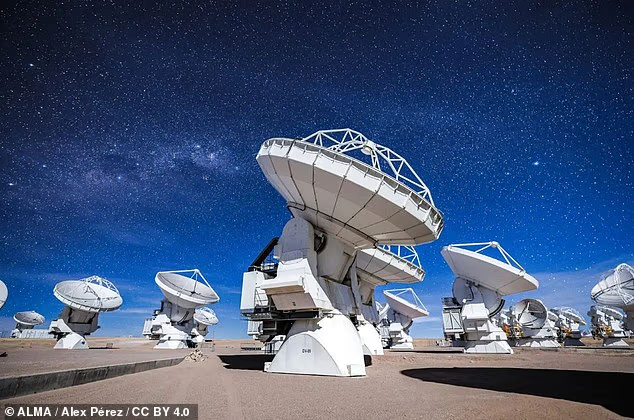
Researchers say we haven’t found aliens because we have been tuned in to the wrong radio channel. Pictured: The ALMA radio telescope in Chile
In new research, presented at the Royal Astronomical Society’s National Astronomy Meeting in Birmingham, Dr Mason points out a major blind spot in our search for alien life.
Previous radio surveys have focused almost exclusively on radio frequencies between 1.42 and 1.66 gigahertz.
This part of the spectrum is known as the ‘water hole’ because it lies between the natural frequencies emitted by the molecules that come together to form water – hydrogen and hydroxyl.
The reasoning is that any lifeform intelligent enough to communicate with the universe would realise that life requires these two molecules to come together and make water.
It would make sense, therefore, that an advanced civilisation would recognise the importance of hydrogen and hydroxyl and put its transmissions in this band.
That assumption has meant the search for extraterrestrial intelligence (SETI) has spent most of its time listening for radio transmissions inside the water hole.
Meanwhile, the so-called millimetre and submillimetre radio bands remain ‘almost completely unexplored’.
Dr Mason says that researchers should open up ‘a new area of parameter space to search’ by looking at higher radio frequencies where alien civilisations might be hiding their broadcasts.

Previous searches for aliens have focused almost exclusively on radio frequencies between 1.42 and 1.66 gigahertz because these are associated with water. Pictured: The frequency coverage and power of a signal that each observatory can search for; none of the observatories is looking for aliens at higher frequencies
To put her ideas into practice, Dr Mason used archived observations from the Atacama Large Millimeter/submillimeter Array (ALMA) in Chile.
This data had already been collected for astrophysical research, but no scientists had ever used the telescope for SETI.
While she didn’t end up finding any potential technosignatures in her small sample, that doesn’t rule out the possibility of alien signals lurking in higher radio frequencies.
The researchers only looked at four archived ALMA sessions, and a full search for alien life would need far more data.
Luckily, Dr Mason also discovered that researchers have been unwittingly making headway towards this goal for years.
When astronomers point a radio telescope at the sky, they also capture data from many other stars within the telescope’s field of view.
In the past, scientists estimated how many stars were in this ‘stellar bycatch’ using maps of the universe like the Gaia catalogue.
However, when Dr Mason estimated the full stellar population contained within each observation with a new galactic model, she found that scientists have surveyed far more stars than previously thought.

Luckily, scientists have actually surveyed millions more stars than previously thought due to ‘stellar bycatch’ observing stars in the background of telescope scans. Pictured: A graph showing the population of stars surveyed by stellar bycatch
Including stars too distant, too faint or too difficult to identify reliably in existing catalogues, telescopes have captured millions of stars by accident.
Applying this to a previous SETI survey involving 1,327 telescope observations, researchers increased the number of stars included in the search from around 288,000 to more than 6.1 million.
This means much more of the galaxy has already been searched for technosignatures than previously thought, narrowing down the areas scientists still need to look.
Dr Mason adds: ‘Even a very small observation can contain a huge number and diversity of stars that we might never have intended to study.’
By combining high-frequency observations with galactic simulations, we can better understand exactly what we’ve searched and where we should look next.
WHAT IS THE FERMI PARADOX?
The Fermi Paradox questions why, given the estimated 200-400 billion stars and at least 100 billion planets in our galaxy, there have been no signs of alien life.
The contradiction is named after its creator, Italian physicist Enrico Fermi.
He first posed the question back in 1950.
Fermi believed it was too extraordinary that a single extra-terrestrial signal or engineering project has yet to be detected in the universe — despite its immense vastness.
Fermi concluded there must a barrier that limits the rise of intelligent, self-aware, technologically advanced space-colonising civilisations.
This barrier is sometimes referred to as the ‘Great Filter’.

Italian physicist Enrico Fermi devised the so-called Fermi Paradox in the 1950s, which explores why there is no sign of alien life, despite the 100 billion planets in our galaxy
If the main obstacle preventing the colonisation of other planets is not in our past, then the barrier that will stop humanity’s prospects of reaching other worlds must lie in our future, scientists have theorised.
Professor Brian Cox believes the advances in science and engineering required by a civilisation to start conquering the stars will ultimately lead to its destruction.
He said: ‘One solution to the Fermi Paradox is that it is not possible to run a world that has the power to destroy itself.
‘It may be that the growth of science and engineering inevitably outstrips the development of political expertise, leading to disaster.’
Other possible explanations for the Fermi Paradox include that intelligent alien species are out there, but lack the necessary technology to communicate with Earth.
Some believe that the distances between intelligent civilisations are too great to allow any kind of two-way communication.
If two worlds are separated by several thousand light years, it’s possible that one or both civilisations would become extinct before a dialogue can be established.
The so-called Zoo hypothesis claims intelligent alien life is out there, but deliberately avoids any contact with life on Earth to allow its natural evolution.