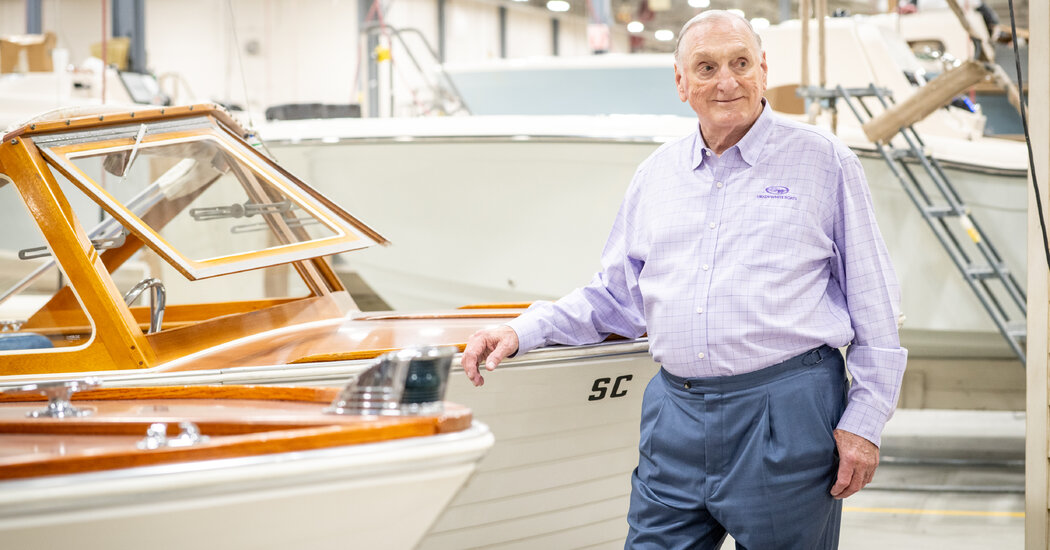
Back in 1968, Eddie Smith Jr. bought a fledgling boat maker based in Greenville, N.C. It was a risky move. The company, Grady-White Boats, was in trouble.
But Mr. Smith turned it around, and now the maker of high-end recreational fishing boats designed for coastal waters pulls in hundreds of millions of dollars in annual revenue. Along the way, Mr. Smith kept full control of the company, never taking on outside investors or selling stock to the public.
Now, Mr. Smith, who is 83, has made one last big move: He renounced a potential $400 million payday and pledged all of Grady-White’s future profits to charity.
“God has really blessed me to put me in a position to give away the vast majority of my net worth,” he said in an interview. “I don’t need a 200-foot yacht or to spend the winters in the Mediterranean. I’m really happy here in eastern North Carolina.”
At a time when billionaires are shunning the Giving Pledge and artificial intelligence start-ups are minting thousands of new millionaires, Mr. Smith’s forfeiture of wealth stands out as an act of principled rebellion.
He said he was inspired by Yvon Chouinard, the founder of Patagonia, who gave away his stock and set up a nonprofit organization to distribute the outdoor apparel company’s profits in 2022.
In recent weeks, he transferred Grady-White’s voting stock, which is a small percentage of the company’s overall shares, to a legal entity known as a purpose trust. The trust will hold those shares in perpetuity, ensuring that Grady-White remains independent and can never be sold — and continues to operate in accordance with Mr. Smith’s values, including profit-sharing.
The remainder of the company’s shares, which do not have voting rights, are being transferred to a newly created 501(c)(4) nonprofit organization. The trust and the nonprofit will be run by independent boards that do not include Mr. Smith. He will stay on as chief executive emeritus and take an annual salary.
Grady-White will distribute tens of millions in annual profits not reinvested in the company to the nonprofit organization, which will give the money away to causes including conservation, health care and education.
Most successful companies take on investors, are acquired or sell shares through an initial public offering. The number of companies that have transferred their ownership to purpose trusts is minuscule — just 81. But that number has grown from seven in 2018, according to Purpose Owned, a consultancy that helped Grady-White structure the transaction, with 15 announced this year.
“For decades we have taught founders they have only two options: Sell out, or let investors slowly take the wheel,” said Eric Ries, an entrepreneur and author who studies alternate forms of corporate governance. “These transactions show a third way is possible: an enduring company built around a long-term mission.”
Succession
Mr. Smith lives on a 3,500-acre property that was previously a plantation belonging to a Confederate general. He manages the land for wildlife, including bald eagles, white-tailed deer, black bears, turkeys and owls. He also owns a nearby 3,000-acre nature preserve. His family foundation has more than $350 million in assets and has made major gifts to medical programs and the University of North Carolina.
He is also a regular donor to Republican candidates and conservative political action committees, but politics is not his passion, and he said he did not want Grady-White’s profits to flow to political causes.
“It is a nasty game,” Mr. Smith said of politics. “But I figured out a long time ago that you’re either in the game or you’re out of the game, and I needed access for some of the industry issues.”
When Mr. Smith was a boy in central North Carolina, the family was poor, sometimes eating Spam three meals a day. His father struggled to get by as a cabdriver, but then started a mail-order women’s hosiery business. The company flourished.
Mr. Smith began working with his father when he was 10. And even though he was the first in his family to graduate from college, he expected to keep working with his dad.
“They would have these career days, and you would go interview with Westinghouse or General Electric,” he said. “I never did that, because I knew I was going to sell ladies’ pantyhose by mail order for the rest of my life.”
That plan changed, however, when Mr. Smith, then 26, met Don White, a co-founder of Grady-White. The company was making wooden boats in a dilapidated tobacco warehouse, and losing money. Mr. White was preparing to shut the company down, but Mr. Smith offered to buy it.
“I just had a burning desire — probably unhealthy, really — to prove to myself, not to anybody else, that I could do something on my own,” he said.
His father lent him some money, and against the advice of their accountant, he took over Grady-White.
For several years, Mr. Smith said, he worked 100-hour weeks as he tried to save the company. By the mid-1970s, sales were growing. The company has been profitable for 50 years.
Until 2021, Mr. Smith expected his son, Chris, his only child, to inherit the business. But Chris died five years ago from amyotrophic lateral sclerosis, the paralyzing neurological disease also known as Lou Gehrig’s disease. Mr. Smith’s wife of 57 years, Jo Allison, had died a year earlier.
“It was God’s plan,” he said. “Sometimes we don’t understand it. I’m looking forward to getting to heaven and asking a few questions.”
‘This Company Has a Soul’
After the deaths of his wife and son, Mr. Smith was forced to reconsider his succession planning.
He first hired an investment banker to explore a sale of the company. Offers came in, including several for around $400 million. But Mr. Smith didn’t believe that any of the potential buyers would retain the company’s culture.
Grady-White offers its 350 employees extensive benefits, which include generous retirement plan funding, a profit-sharing plan, financial literacy programs, on-site health care and a company chaplain. Preserving these perks was a major reason Mr. Smith decided to give the company to a purpose trust.
“I had no confidence that a new owner would keep that kind of culture going,” Mr. Smith said. “This company has a soul, and I didn’t want to lose that.”
After learning about Patagonia, Mr. Smith hired Natalie Reitman-White, the founder of Purpose Owned, to help him set up a purpose trust.
Some critics assailed Mr. Chouinard’s move as an elegant tax dodge. Because he did not sell the company and his children did not inherit it, Mr. Chouinard avoided paying what could have been a billion-dollar tax bill to the Internal Revenue Service.
But the structure used by Patagonia — and now Grady-White — generated no profits for the I.R.S. to tax. Neither Mr. Chouinard nor his children gained any wealth by donating the company.
Mr. Smith is also forfeiting his claim to any profits from the sale of the company, or any tax benefit from the donation of his stock, and expects to pay a multimillion-dollar tax bill to set up the trust.
“I’m not getting any kind of benefit, tax or otherwise,” he said. “And I’m giving away a vast majority of my net worth.”
Ms. Reitman-White said the donation of Grady-White was the largest such transaction since Patagonia. Some major European companies, including Rolex and IKEA, operate with similar structures that fund charitable giving.
“This is an alternative for people who really care about the continuity of the company, and have explored other options and need something else,” she said. “It solves this problem of ‘I’ve spent my whole life building this company — what do I do with it?’”