Amna Nawaz:
Well, prosthetics are typically designed to blend in as replacements for missing body parts, but, increasingly, they’re becoming tools for creative expression, especially in the niche community of ocular prosthetics, or artificial eyes.
Our senior arts correspondent, Jeffrey Brown, meets a Portland eye maker whose designs are helping clients see themselves in a new light. It’s part of our ongoing coverage of the intersection of arts and health for our Canvas series.
Rachel Yee, Prosthetic Eye Wearer:
If I’m going to wear something like this.
Jeffrey Brown:
Many people accessorize with jewelry or purses.
Rachel Yee:
Getting more formal.
Jeffrey Brown:
Thirty-six-year-old Rachel Yee does it with eyes.
Rachel Yee:
I will do my first ever fun eye, which is this gold one, and have the two together.
Jeffrey Brown:
You accessorize. That’s how you think of the — all the eyes you have now?
Rachel Yee:
Yes. I’m lucky enough that I get to accessorize with something that is a medical necessity.
Jeffrey Brown:
Yee lost your left eye to cancer at 18 months old and spent years wearing a prosthetic designed to mirror her natural eye.
Rachel Yee:
I knew I was different. I never felt like I was missing something. It wasn’t until I was older that I got a little more self-conscious about it. I felt like a prosthetic in general wasn’t to make me feel good about myself, but it was to make others feel comfortable looking at me.
Jeffrey Brown:
Everything changed in 2021 when she started wearing a new eye featuring a shimmering gold iris that was meant to grab attention, not deflect it.
Rachel Yee:
Standing out to me is more important, in fact, than just hiding who I am to make others around feel comfortable.
Jeffrey Brown:
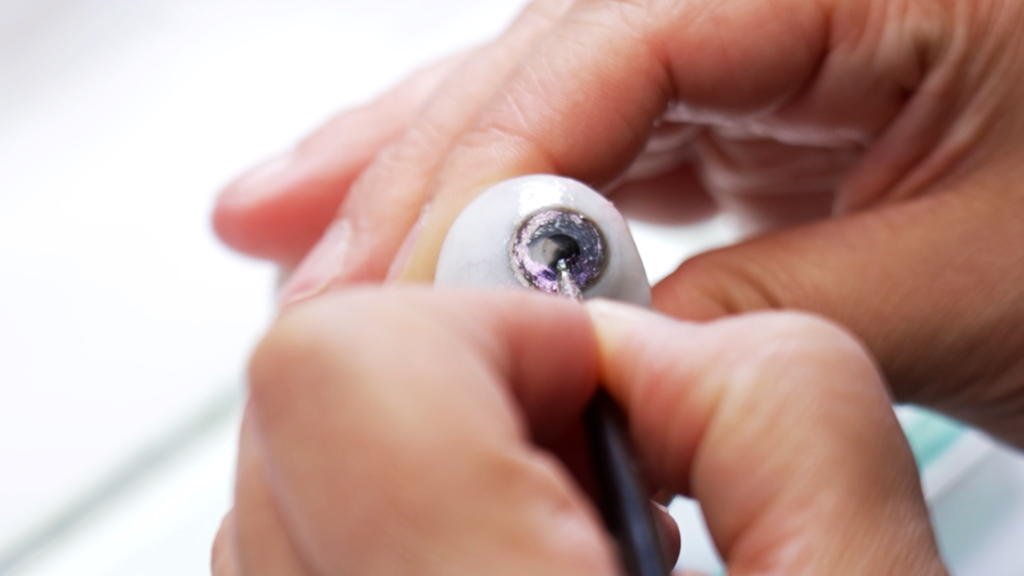
In an office in nearby Portland, Oregon, where decorative eyes watch from nearly every corner, Christina Leitzel, board-certified as an ocularist, crafts the bull designs that have now become her trademark, so-called fun eyes.
Christina Leitzel, Center for Ocular Prosthetics: I think there’s something in me that I have always wanted to help people. I originally wanted to make prosthetic limbs.
Jeffrey Brown:
As an art student in Philadelphia, she was drawn to artists like Sophie de Oliveira Barata, who turned prosthetics into powerful art pieces.
Christina Leitzel:
I just thought it was such a beautiful art form to blend both art and science and then give someone back something that they lost.
Jeffrey Brown:
Most eye prosthetics have two parts, a custom acrylic shell and a surgically implanted sphere that restores volume to the eye socket. The implant is often made from a porous material that allows tissue to grow into it, helping the prosthetic move with the wearer’s natural eye.
Half of Leitzel’s work is still creating prosthetic eyes that seamlessly match the real thing. But it’s the fun eyes where her artistry comes alive, each one telling a story.
Christina Leitzel:
They could be anything from a cat eye, where it’s a pet that had just passed.
MAN:
I asked Christina to make me an eye so I can remember Noodles more, and just kind of have her with me all the time.
Christina Leitzel:
Or a portrait of a wife who died. The message that I got was, can you paint the portrait of my wife? Because I would like to have her see everything I’m seeing.
Jeffrey Brown:
Wow.
Christina Leitzel:
It’s moving, and it’s like, wow.
Jeffrey Brown:
On social media, her creations range from glittery glow-in-the-dark and color-shifting eyes to American flags, sparkling night skies, and soccer balls.
Christina Leitzel:
When you have an ocularist, most people, like, they confide, they share their stories.
Jeffrey Brown:
So this is a very close relationship.
Christina Leitzel:
Very, very personal. And it’s kind of scary to be so vulnerable and share that part of you. So I think it’s special in that way to be a part of someone’s life and change them.
Jeffrey Brown:
Some come to Leitzel with the trauma of having recently lost an eye.
Bree was 27 when she lost her eye to ocular melanoma, a rare form of cancer.
Bree, Prosthetic Eye Wearer:
I went under with perfect vision 20/20, no pain, and then I woke up with only one eye and no depth perception. I couldn’t grab anything in front of me. It — it broke me.
Jeffrey Brown:
Her first prosthetic was a close match to her remaining eye, but:
Bree:
When I first got it and looked in the mirror, it felt like somebody else was looking back at me. It felt very uncanny. I have always loved to stand out. And I wanted an eye that reflected that.
Jeffrey Brown:
So the eye that’s in now is — it’s a cat eye.
Bree:
It is a replica of my current cat, who only has one eye as well. He actually has the opposite eye of me. So when he’s up on my shoulder and we look at each other, we see eye to eye.
Dan Roche, Author, “Eyes by Hand: Prosthetics of Art and Healing”: So many people who wear eyes talk about their close relationship with their ocularist and how just being able to talk through it with somebody who has seen this over and over is therapy.
Jeffrey Brown:
Dan Roche is a professor at Le Moyne College in Syracuse, New York, and author of the book “Eyes by Hand: Prosthetics of Art and Healing.” He also wears a prosthetic eye himself.
Dan Roche:
This one.
Jeffrey Brown:
So it’s your right eye.
Dan Roche:
It’s my right eye, yes. And it’s — sometimes I look in the mirror and I can’t tell which — I forget which is which.
Jeffrey Brown:
His book traces the long history of prosthetic eyes, from the inlaid eyes placed in mummified bodies in ancient Egypt, to rudimentary eye coverings designed by a French surgeon in the 1500s, to eyes made by glass blowers in Venice in the 18th century and on.
Dan Roche:
It’s a very slow history, not a lot of major changes over the course of time.
Jeffrey Brown:
Today, there are fewer than 200 board-certified ocularists in the United States and Canada, who serve the roughly 20,000 people who lose an eye every year.
Dan Roche:
Which is a smaller number than it used to be once OSHA regulations came in. It used to be farm accidents and industrial accidents. People would be losing eyes all the time, relatively.
Jeffrey Brown:
Most opt for a matching eye, like Roche, who spent his first 50 years with a cataract that clouded and blinded his right eye.
Dan Roche:
I just dreamed for years and years about having two eyes that match, just sort of a normal gaze. And when I looked in the mirror the first time and saw that, that thing that I’d been dreaming about for decades, it was — I mean, it’s trite, but kind of a dream come true in that regard, yes.
Jeffrey Brown:
Because ocularistry sits at the intersection of art, medicine, and psychology, insurance coverage is often inconsistent. Some plans will cover the cost of a traditional prosthetic eye, which can range from $2,000 to $10,000. But insurance will not cover a fun eye.
Rachel Yee:
Having access to someone that will create fun eyes was hard enough on its own, and paying for it on top of that is not doable for a lot of these families who have already gained so much medical debt.
Jeffrey Brown:
Twelve-year-old Gracie Corrigan lost her eye at 2 years old to retinoblastoma.
Gracie Corrigan, Prosthetic Eye Wearer:
See, there’s my eye.
Jeffrey Brown:
The same rare and aggressive eye cancer that impacted Rachel Yee. She also shared a frustration with traditional prosthetic eyes.
Gracie Corrigan:
People could tell, like this one wasn’t matching this one or it wasn’t moving the same. Some kids have said something. Like, some kids are rude about it.
Jeffrey Brown:
In 2022, Corrigan decided she was ready to get a fun eye of her own. Rachel Yee decided to help.
Rachel Yee:
I am raising the money for Gracie to get a fun eye.
I went to social media and I said, is there any chance that you guys want to donate? Within an hour, we had paid for Gracie’s eye. By the next morning, three more eyes had been paid for.
Jeffrey Brown:
The extra dollars became The Fun Eye Fund, a nonprofit that helps people afford custom prosthetic eyes.
Gracie Corrigan:
Having the fun eye is way better than a regular eye that would match this eye. It’s just fun. It looks cool.
(Laughter)
Jeffrey Brown:
Looking cool, looking like your own version of you, it’s a new, perhaps unexpected mix of medical care and art.
For the “PBS News Hour,” I’m Jeffrey Brown in Portland, Oregon.