The luminous, hot star Wolf-Rayet 124 (WR 124) is prominent at the center of the James Webb Space Telescope’s composite image combining near-infrared and mid-infrared wavelengths of light from Webb’s Near-Infrared Camera and Mid-Infrared Instrument.
After years of hiding in plain sight, a giant planet has finally been uncovered by astronomers using NASA‘s James Webb Space Telescope, thanks to a groundbreaking technique that could reveal countless more hidden worlds.
Astronomers using NASA’s James Webb Space Telescope have discovered a giant exoplanet hiding within one of the most closely studied planetary systems in the Milky Way, revealing a new way to search for worlds beyond our solar system.
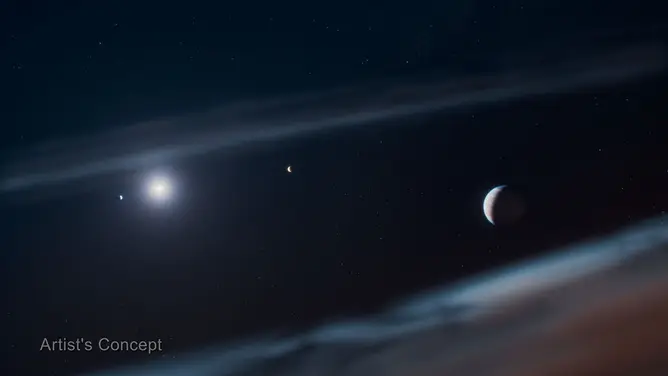
This artist’s concept depicts the young Beta Pictoris planetary system with the newly discovered giant exoplanet, Beta Pictoris d, at the right. Beta Pictoris c circles closest to the star (left in this artist’s concept), Beta Pictoris b follows on a wider orbit, and the newly discovered Beta Pictoris d lies farther out, just inside the debris disk’s inner edge.
(NASA, ESA, CSA, STScI, Ralf Crawford (STScI) / NASA)
Located about 63 light-years from Earth, Beta Pictoris is a relatively young star system at just 23 million years old. While that may sound ancient to humans, it’s still young enough to offer astronomers a rare glimpse into how planets form and evolve, according to a new study published in The Astrophysical Journal Letters.
NASA’S ARTEMIS PROGRAM: PAVING THE WAY FOR HUMANKIND’S RETURN TO THE MOON AND BEYOND
Astronomers already knew the star Beta Pictoris hosted two giant exoplanets: Beta Pictoris b, one of the first exoplanets ever directly imaged, and Beta Pictoris c. The newly discovered Beta Pictoris d makes it only the second known planetary system to contain at least three directly imaged planets, according to NASA.
Unlike its planetary siblings, Beta Pictoris d wasn’t found by spotting a bright object in an image. Instead, Webb detected the planet through the chemical fingerprint of its atmosphere, identifying planetary molecules like carbon monoxide, methane and water vapor.
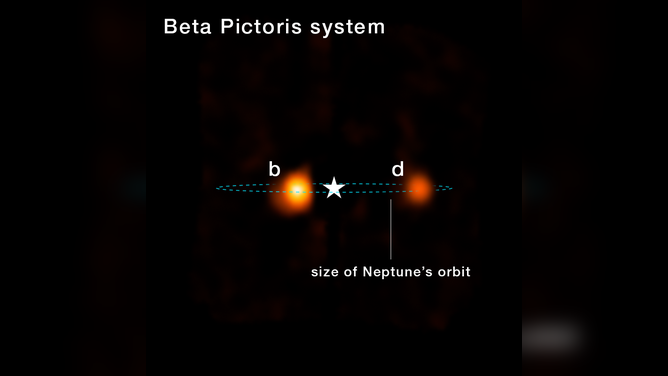
The newly discovered third planet orbiting Beta Pictoris, Beta Pictoris d, appears in a reconstructed image from NASA’s James Webb Space Telescope. Using the telescope’s Near-Infrared Spectrograph (NIRSpec), researchers confirmed the bright point of light was a planet by detecting the chemical fingerprint of its atmosphere. Models suggest it orbits its star at a distance similar to Neptune’s orbit around the Sun.
( NASA, ESA, CSA, STScI; Science: Aidan Gibbs (UC San Diego), Jean-Baptiste Ruffio (UC San Diego); Image Processing: Alyssa Pagan (STScI) / NASA)
The breakthrough marks the first time a directly imaged exoplanet has been discovered using the revolutionary method of moderate-resolution spectroscopy.
While Beta Pictoris was a system well-known to astronomers, Pictoris d remained hidden for years in what was described as a hide-and-seek game.
The exoplanet lies within one of the brightest known debris disks, that serves as a layer that hides the planet.
PAN AMERICAN PLANE FOUND 2,000 FEET UNDER ATLANTIC OCEAN AFTER CRASH 74 YEARS AGO
The dusty disk acts like a fog, scattering the star’s light and making it difficult for conventional imaging techniques to distinguish planets from the surrounding dust.

James Webb Space Telescope’s primary mirror at NASA Goddard. Webb’s mirrors are covered in a microscopically thin layer of gold, which optimizes them for reflecting infrared light.
(NASA)
The team of researchers using the NASA telescope were able to effectively ignore the dust using a unique method that allowed them to isolate a planetary atmosphere, which in turn allowed them to make the ground-breaking discovery.
Beyond adding a new member to the famous Beta Pictoris system, researchers said the discovery demonstrates a powerful new approach for finding new planets and potentially opens the door to uncovering many more previously hidden worlds.