A young endangered sea turtle was returned to the wild on Wednesday after months of rehabilitation following his stranding on the beach in winter. (Courtesy: Wildlife Conservation Society)
VIRGINIA BEACH, VA – A leatherback sea turtle has set up shop along Virginia‘s Atlantic coast, making history with the first recorded nest ever discovered in the state.
As the world’s largest sea turtle, the leatherback’s presence on Virginia Beach didn’t go unnoticed by wildlife officials.
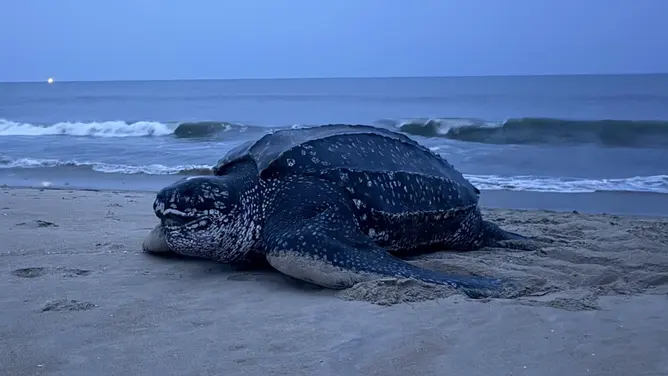
A leatherback sea turtle crosses the beach in Virginia. The species is the world’s largest sea turtle, growing up to 8 feet long and weighing up to 2,000 pounds.
(courtesy of Miakayla / U.S. Fish and Wildlife)
According to the U.S. Fish and Wildlife Service, the unprecedented nesting marks the first recorded time a leatherback sea turtle has laid eggs in Virginia.
Wildlife officials at Naval Air Station Oceana quickly located and identified the nest before fencing off the area to give the eggs the best possible chance of hatching.
SCIENTISTS MAKE BREAKTHROUGH DISCOVERY OF INSECT SPECIES THAT IS SURE TO GIVE YOU NIGHTMARES
For its inaugural Virginia nest, the leatherback chose a well-protected stretch of the Atlantic Ocean coastline in front of Naval Air Station Oceana Dam Neck Annex.
The nesting site is protected from both national security threats and curious beachgoers alike, giving the eggs an added layer of security.
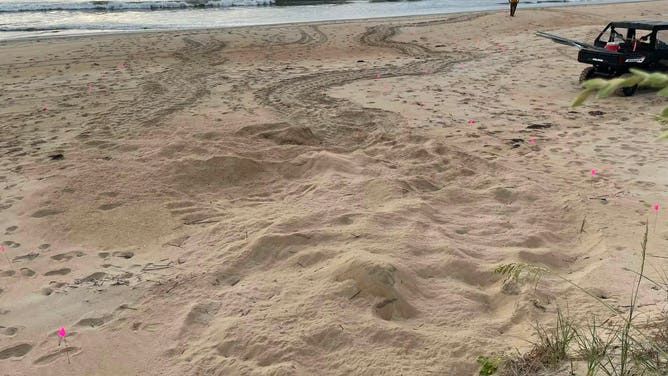
Fresh leatherback sea turtle tracks lead to a historic nest in the sand at Virginia Beach, marking the first recorded nesting of the species in Virginia.
(NAS Oceana / U.S. Fish and Wildlife)
It’s also a reminder that conservation and national defense can sometimes go hand in hand.
Though built for national defense, many military installations have become unexpected havens for wildlife, with expansive, restricted beaches serving as critical nesting habitat for sea turtles and countless other species.
WHAT IS YOUR STATE ANIMAL? SEE THE OFFICIAL LIST FEATURING ALL 50 STATES
This is no small sea turtle. According to the U.S. Fish and Wildlife Service, leatherback sea turtles can grow up to 8 feet and weigh up to 2,000 pounds.
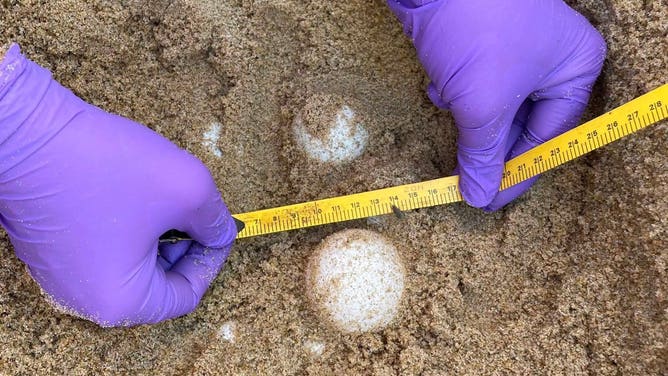
U.S. Fish and Wildlife Service partners carefully measure a leatherback sea turtle egg after the historic nest was discovered in Virginia Beach.
(Courtesy of NAS Oceana / U.S. Fish and Wildlife)
Unlike other sea turtles, leatherbacks don’t have a hard shell. Instead, they’re named for the thick, leathery skin covering their backs that helps them dive deeper and travel farther into colder waters than any other sea turtle.
With leatherbacks typically nesting on warmer beaches from Florida through the Caribbean, the unprecedented Virginia nest marks a remarkable milestone, with wildlife biologists now eagerly awaiting the moment the eggs begin to hatch.