
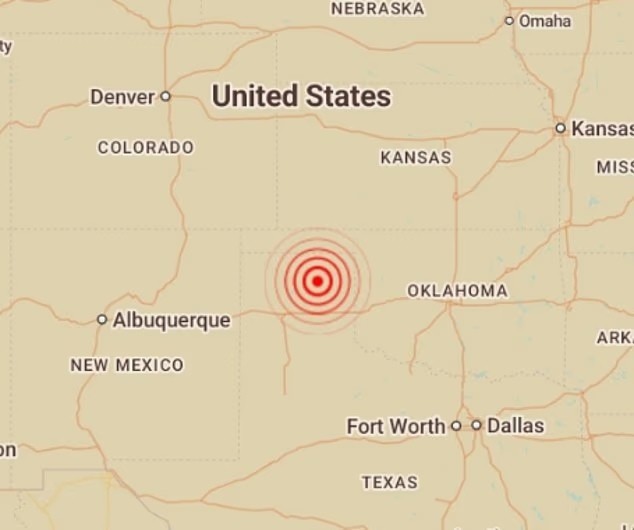
A magnitude 5.0 earthquake struck the Texas Panhandle on Thursday morning, marking the strongest quake recorded in the region in more than 100 years.
The epicenter was about 23 miles from Spearman but shaking was felt across state lines in Oklahoma and Kansas. The seismic activity was detected at 4.21am MT.
Texans reported their homes trembling, with one resident writing on X: ‘I definitely didn’t expect to start my day with my bed vibrating, only to find out there was a 5.1 earthquake about an hour away!’
Another Spearman resident said they felt disoriented by the shaking.
Oklahoma resident Connor Mellace also reported ‘very light shaking’ in Norman after receiving an earthquake alert.
While earthquakes of this size can cause minor structural wear, emergency services reported no initial damages or injuries.
According to the US Geological Survey (USGS), it was the strongest earthquake recorded in the Texas Panhandle and only the fourth magnitude 4.0 or greater quake to strike the region since 1900.
Thursday’s seismic activity is being reported as a natural tectonic occurrence, caused when subterranean rock masses slip past each other along a fault line within the Earth’s crust, releasing pent-up energy
The epicenter was about 24 miles south of Miami, Texas, but shaking was felt across state lines in Oklahoma and Kansas
Micah Starrett of Miami, Texas, said on Facebook: ‘Whole house shook really good for 10-20 seconds. All my kids woke up.
‘Motion sensor lights all turned on. I went outside to see if Pantex exploded lol.’
Others in the area said they heard loud bangs before their homes shook and things fell off shelves.
Melissa Davis Hale from Miami said: ‘Sounded almost like a tornado roar and whole house shook & rattled for 45 seconds or so!’
Earthquakes near Spearman and throughout the Texas Panhandle are typically caused by the reactivation of ancient, buried faults triggered by human activities related to oil and gas operations.
While the region sits on deep geological fault lines that can naturally generate very infrequent tremors, the sharp increase in seismic activity is directly linked to the injection of large volumes of drilling and extraction wastewater into deep disposal wells.
This fluid injection increases underground pore pressure, which acts as a lubricant and causes rock masses to slip along pre-existing fault lines.
While the Texas Panhandle is reeling from the earthquake, Tropical Storm Bertha is set to make landfall hundreds of miles away in the Houston area.
A Tropical Storm Warning is in effect along the Gulf Coast from the Terrebonne-Lafourche Parish line in Louisiana to Sargent, Texas.
The storm is currently located about 145 miles west-southwest of New Orleans.
Bertha is forecast to track along the Louisiana and upper Texas coast on Thursday afternoon before pushing inland across Texas later in the evening.
NOAA warned that the Texas Gulf Coast and South Texas could receive two to four inches of rain through Thursday night, with isolated totals reaching six inches.
The downpours could trigger flash flooding, particularly in urban areas.
Coastal communities face tropical-storm-force gusts, pounding surf and life-threatening currents, while areas north of Houston may receive little to no rain.
A heat advisory is also in effect north and west of the city, where the heat index could climb to around 108°F.


