The math on solar panels is getting tougher.
President Trump ended the federal tax credit last year, but the story goes back further than that. Over the last decade, more than a third of U.S. states have changed their rules to allow utilities to pay homeowners less for the energy they send to the grid.
In some places, those changes have reduced savings for homeowners by hundreds or thousands of dollars each year, making solar a less appealing investment and dealing a blow to the industry.
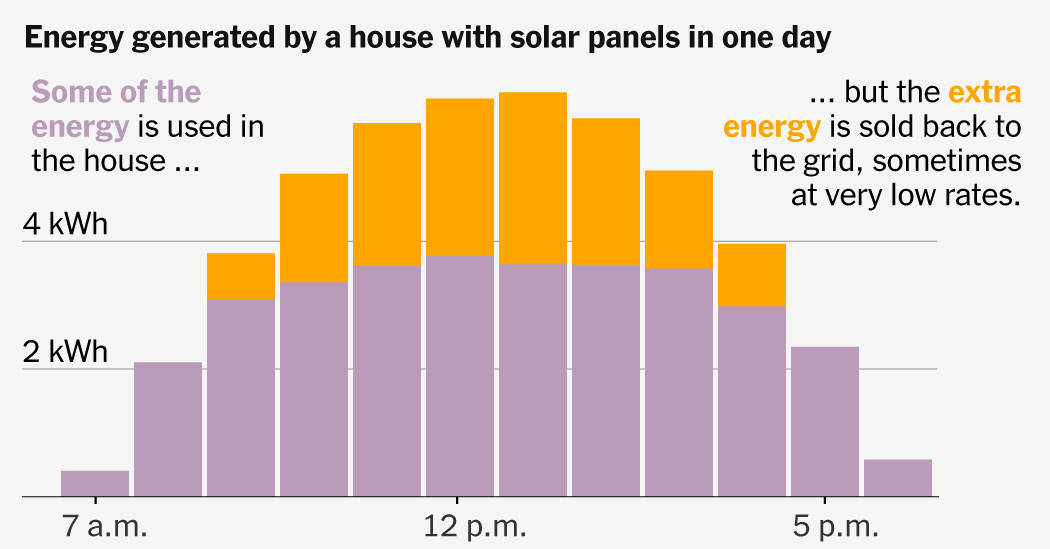
The changes all spin out from a simple fact: Solar generates most of its power in the middle of the day, but houses use power all day. Here is a hypothetical home in Arkansas:
What the utility does with that extra energy makes a big difference.
Many utilities pay homeowners the same rate they charge for electricity, meaning the energy sent to the grid when the sun is out offsets the cost of the energy pulled from the grid at night. That’s called net metering, a system where the energy you send is worth typical U.S. prices of 10 to 30-plus cents per kilowatt-hour.
Under newer policies, often called net billing, utilities buy the extra energy back at a lower rate, often 2 to 10 cents.
Arkansas switched from net metering to a net billing system in 2024, lowering the value of extra electricity from around 12 cents to closer to 3 cents. Houses with solar were grandfathered into the old system, but homeowners adding solar now will be paid less for the extra electricity they send back. Here’s how it would look for our hypothetical house under both scenarios:
Utilities have long waged a campaign to get rid of net metering, and over the last decade, many have succeeded. Since the mid-2010s, major utilities across the country have moved away from traditional net metering (most notably in California) and toward programs where extra solar is credited at lower rates.
Some states passed laws ending net metering statewide; in others, regulators gave individual utilities permission to move to new programs. A few states and utilities kept net metering intact but added fees or changed their rules in other ways that lower savings.
These changes are happening in very different places and don’t map neatly onto politics or how much sun and solar energy a state has:
Net metering policies began to appear in the 1980s, as a way to kick-start rooftop solar when installation costs were extremely high.
“Net metering was created in a different era,” said Leah Stokes, a professor at the University of California, Santa Barbara, who specializes in energy and environmental policy. “It wasn’t envisioned by legislators and utilities to get as big as it got.”
In the early 2010s, utilities had a relatively small number of customers who sent electricity back to the grid. But as panels got cheaper, millions of homeowners installed them and enrolled in net metering programs.
And as home solar got bigger, those programs became more expensive for utilities, who started to petition their regulators to let them pay less for all that rooftop solar.
In their fight against net metering, utilities have long argued that they don’t just source and generate power, but also build and maintain the grid, costs that are included in the price of electricity. Houses with solar pay less for the grid but still rely on the same poles and wires as everyone else.
That means, utilities say, maintenance costs are shifted from houses with solar to those without. (The research on this is limited, but one analysis found that net metering added less than half a cent per kilowatt-hour to average electricity costs in most places in recent years, and up to 2 cents in places with more solar like California.)
Utilities can also get energy from other places at lower prices than they have to pay homeowners. In Vermont, for example, utilities will soon pay 46 percent more for rooftop solar than they do for other sources of solar energy, according to the state’s public utility commission.
But net metering incentivizes people to install panels, which can make a bigger difference in states with small home solar markets like Indiana and Louisiana. In these states, electricity is already relatively cheap, lowering the incentive to install solar, and both ended net metering in recent years.
And more rooftop solar, advocates for solar power say, lowers the burden on the grid, reducing expensive upgrade costs for everyone. (It’s especially useful in summer, tamping down peak demand in heat waves.) The energy is also easy to transmit from neighbor to neighbor and can quickly increase the supply of clean electricity.
For states that end net metering, how they do it matters.
California, which has more than a third of the country’s residential rooftop solar, ended its net metering program abruptly in 2023 and replaced it with much lower payback rates that vary by day and hour. The solar industry staggered after the decision but has begun to rebound. (California’s electricity is so expensive that panels can pay themselves off quickly even after the end of net metering.)
In Illinois, by contrast, lawmakers decided to let homeowners sell excess energy for about half the retail rate, and the transition took place over more than three years.
“California got rid of traditional net metering, and Illinois got rid of traditional net metering,” said Amy Heart, vice president of public policy at Sunrun, the country’s largest residential solar and storage company. “You didn’t hear about it in Illinois because it was planned out.”
The battery solution
Debates over solar in Illinois, California and other states have reflected solar’s central — and growing — problem: Power generated in the middle of the day just isn’t worth as much when there’s an abundance of solar on rooftops and in large-scale solar farms.
On some days, California has so much energy and low enough demand that it has to throw away extra solar. Even in New England, an influx of rooftop solar has pushed down demand on spring afternoons, only for gas plants to ramp up after sunset.
This is where batteries come in.
Illinois is one of several states that subsidize home batteries. Instead of selling back their excess solar energy for cheap, homeowners can store it in their battery to use in the home in the evening, saving money. That helps reduce emissions and demand on the grid; in some places, homeowners can even be paid to discharge their batteries.
The battery and solar market is growing rapidly, according to data from Lawrence Berkeley Lab. In Hawaii, where rooftop solar is popular and net metering long gone, the vast majority of new solar installations come with a battery. In California, the share of new solar installations that came with a battery soared after net metering ended.
Excluding California, the average rate in the U.S. rose more modestly, to 8 percent from 5 percent.
But like solar panels, battery installation can be so expensive that homeowners might not recoup their costs. And the math has changed there too: Last year, President Trump ended the federal subsidy for residential batteries.