In China, the humble egg, a longtime supporting act in many dishes, is now center stage.
Around dining room tables, budget-conscious families are griping about its sudden spike in price. In the countryside, befuddled farmers who complained of a glut of eggs last year now fret about scarcity. At food stalls, frustrated cooks are reeling from the one-two punch of egg prices and rising energy costs from the Iran war.
Even state media has taken to using the term “rocket eggs” to describe skyrocketing prices.
Egg prices are up by more than 40 percent from a year ago, according to an index that tracks the top producing provinces. They recently hit a 10-year high by another benchmark that tracks prices at a wholesale market in Guantao, in northern China, catching industry insiders by surprise.
In a country that consumes more eggs per capita than almost any other in the world, the surging price is especially painful. And it has become a paradox in an economy still struggling to shake off widespread deflation, in which industrial overcapacity and reluctant consumers have led to falling prices for several years. (The price of pork, for example, recently hit a 16-year low.)
The war in Iran has pushed up energy prices and stoked nascent inflation, but this has been accompanied by a slowdown in economic growth, an unwelcome combination.
The price of eggs is the kind of issue that can hit a nerve, and not only in China. The United States had its own egg crisis not long ago, because of supply chain snarls and an avian influenza outbreak. Eggs became a talking point during the 2024 presidential election campaign, with Donald J. Trump using the rising cost of groceries to berate his opponents.
In China, the problem began with overenthusiastic poultry farmers.
Two years ago, farmers started expanding after several bumper years, adding more egg-laying hens from 2024 to 2025 than ever before, according to Aspen Li, an analyst who studies the egg market. Suddenly, there were too many eggs and the price plunged. Farmers then found themselves short of money to feed all their chickens.
So they culled them, at a rate that experts considered excessive. Eventually, there were not enough egg-laying hens to meet demand, sending prices to levels that Mr. Li said were “even higher than my expectations.”
At the same time, demand has been particularly strong, which economists attribute to various factors like hungry teenagers studying for a high-stakes national exam and the summer celebration known as Dragon Boat Festival.
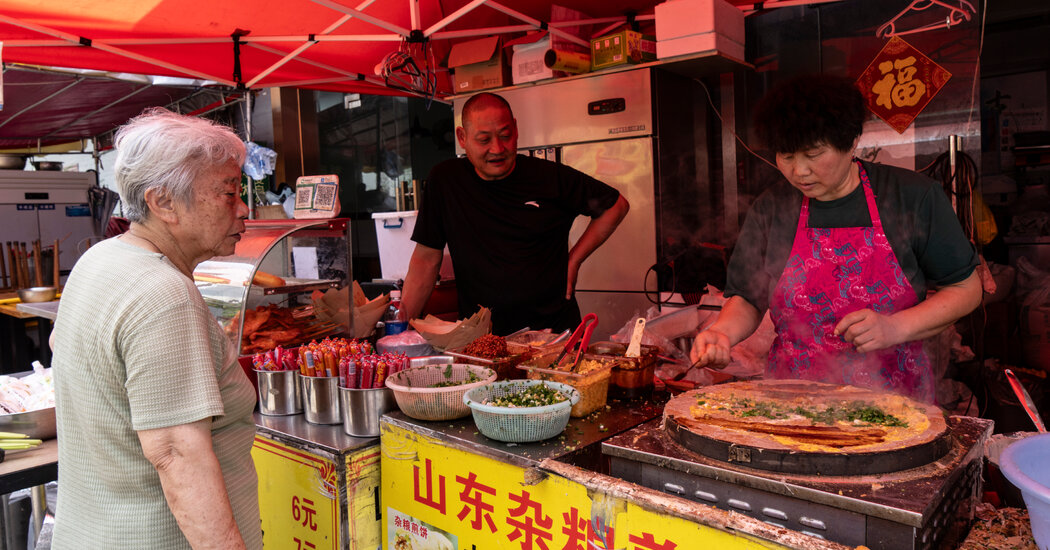
And some pin the blame for climbing costs on one person: President Trump. The war in Iran has made cooking gas pricier. Owners at one restaurant in the coastal town of Tianjin stuck a sign in their storefront window to explain that they were raising the price of jianbing, a crepe of eggs, greens and deep fried crackers, by the equivalent of seven cents because of “Trump driving up prices.”
Axuan Bu, 25, who runs two stalls called “Jianbing Man” in the eastern city of Jinhua, says he can’t pass the cost of his savory egg pancakes on to his regular clients. “If you raise the price, people just won’t buy them anymore,” he said.
Mr. Bu goes through 360 eggs every two to three days and he’s seen the price tick upward by a few cents each time he restocks. A carton, which once cost $25, is now $35. To make things worse, the gas canisters he needs to heat his pan have also risen, to $22 each from $16, a purchase he has to make every five days.
“You bustle around month after month and by the end of it, there’s simply nothing left,” he said.
Unlike meat, eggs aren’t easily substituted, said Hellen Zhang in the eastern province of Jiangsu, who together with her boyfriend consumes as many as seven eggs a day — boiled for breakfast, scrambled in dishes with tomatoes for lunch and as batter for rice cakes.
It accounts for a tenth of their monthly food bill, Ms. Zhang said. “But no matter how expensive eggs get, you still have to eat,” she said. “Prices go up, but you can’t skip your protein.”
Harriet Hua, from the southern province of Guangdong, noticed that the price of eggs started creeping up in April on the grocery-buying platform she uses, known as Pinduoduo. They have since risen by 20 percent.
“My first reaction was, ‘Oh my god, why is it so expensive?’ So I stopped buying them, thinking I’d wait for the price to drop,” said Ms. Hua, who normally buys a batch of 30 eggs each month. While she was jobless for six months, even the smallest price increase was painful.
“The price never did drop,” said Ms. Hua, who landed a new job last month. “Eventually I just had to buy them anyway.”