Following weeks of relentless heatwaves, many Brits will be praying for a bit of rain to cool everything down.
Now, a study has revealed this really can work – but only in some places.
Researchers at Yale University have found that in certain regions of the world, precipitation becomes more likely with every day it doesn’t rain.
That means if there is a long, dry spell and people turn to the heavens for divine intervention, it’s likely the weather will turn soon after.
Over time, these ‘successful’ prayers can strengthen belief that worship influences the weather.
‘If the (religious) leader happens to pray at a good time, such that rain is more likely to fall during prayer, it may persuade the people that the prayer has caused the rain,’ the team wrote in The Quarterly Journal of Economics.
‘Such leaders will be more likely to gain support, and their rainfall prayers will therefore persist over generations.’
However in regions where this rainfall pattern is not as predictable, such as the UK, people don’t tend to bother asking for supernatural help.
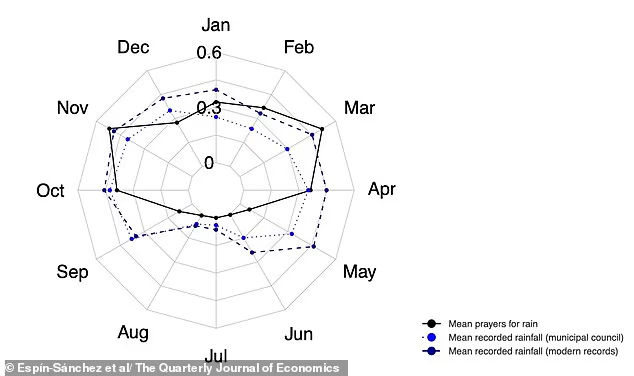
Researchers discovered a strong link between the number of prayers for rain per month and the average recorded rainfall

Their study involved analysing the number of prayers for rain in Murcia, Spain, and comparing it to recorded rainfall
For their study, the researchers analysed more than 200 years of records from churches in Murcia in Spain.
They found that when the church held official prayers for rain, rainfall often arrived soon afterwards.
This is not necessarily because the prayers caused the rain, they said, but because they tended to happen when rain was already becoming increasingly likely.
‘In some places the rainfall hazard is flat,’ the scientists wrote. ‘The probability of rain on a given day is always about the same, regardless of whether it rained recently.
‘In other places, the rainfall hazard is increasing. In a drought, it become more and more likely to rain the further one gets from the last rainfall.’
The analysis revealed that in Murcia, prayer is ‘highly predictive’ of future rainfall.
‘With an increasing hazard, prayers that start during drought will both have a higher probability of rain during prayer and deliver rain when the demand for rain is at its highest,’ they said.
‘We find that prayer for rain in the last month predicts a 71 per cent increase in the probability of a notable rainfall on a given day.’


The UK’s prolonged hot, sunny and dry weather is visible from space. Comparing satellite images from late May and now, much of the landscape has turned from green to brown

Some parts of the UK are on course to have gone almost a month without any measurable wet weather. Pictured: A woman resting on a bench during a heatwave in Wimbledon
The researchers said a person will choose to support a religious leader when they believe it is more likely than not that prayer works.
‘That is, God hears the leader’s prayer and delivers rainfall,’ they explained.
Previous studies have found that, in Murcia, the more severe a drought the greater the number and intensity of prayers.
The team reference a 19th century manual that instructed priests-in-training: ‘In times of drought, hail, epidemic, earthquake, etc. What a bounty you can make with the prayers for God!’
As well as Murcia, the study identifies parts of Namibia and China as regions where this phenomenon also occurs.
The same effect is likely to be weaker in the UK, where rainfall is largely controlled by passing Atlantic weather systems rather than steadily becoming more likely as a drought drags on.
For baking Britons, heatwave conditions are set to continue in many areas over the next few days. Some parts of the country are on course to have gone almost a month without any measurable wet weather.
Large swathes of England have so far recorded 0 per cent of the rainfall they would normally expect in July.
Meanwhile Wisley in Surrey has gone 27 consecutive days without any rain. Rainfall in Wales and Northern Ireland is also far below average.
More than eight million households in England are now living under hosepipe bans while the ongoing dry weather means a continued risk of wildfires, with blazes already in areas including Greater Manchester and Conwy.
High pressure will dominate the UK forecast for at least the next week, with highs of up to 33°C possible in southern England, meaning rain will be in very short supply.
While some locations have seen isolated showers or thunderstorms, these have been very localised.