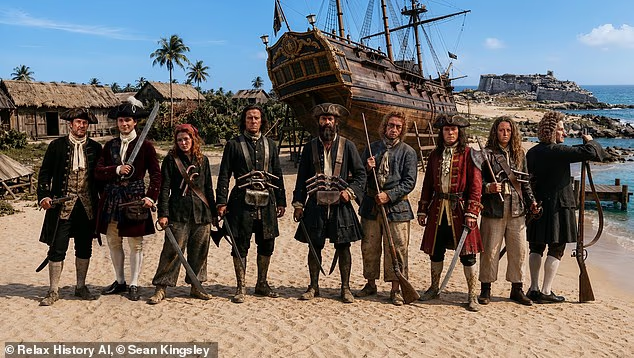
The real–life home of the Pirates of the Caribbean has been brought back to life for the first time in more than 300 years.
Using archaeological evidence, historical records and cutting–edge 3D technology, experts have created the first scientifically accurate reconstruction of Nassau during the Golden Age of Piracy.
The digital model strips away centuries of Hollywood myth to reveal what the notorious pirate stronghold actually looked like in the early 1700s.
Far from a bustling colonial city lined with grand stone buildings, Nassau was little more than a ramshackle settlement of wooden huts, pirate camps and crumbling ruins.
The reconstruction also revives some of history’s most infamous buccaneers, including Blackbeard, Anne Bonny, Calico Jack Rackham and Benjamin Hornigold, using AI based on historical engravings and contemporary descriptions.
The recreations will feature in the finale of Wreckwatch TV’s series about the real pirates of the Caribbean, Mystery of the Pirate King’s Treasure.
‘We can now sail back into Nassau in the year 1718, peer at pirates’ ships and their shoreside storehouses, be a fly on the wall to beach action, look down on the fort and stroll along “Piratetown’s” main street, its taverns and market,’ Chris Atkins, co–founder of Wreckwatch TV said.
‘The pirates are back from the dead.’
The infamous pirates of Nassau recreated from engravings published in 1724. From left to right: Benjamin Hornigold, Calico Jack Rackham, Anne Bonny, Charles Vane, Blackbeard, Thomas Anstis, Howell Davis, Mary Read & Stede Bonnet

Nassau’s famous fort was in a sorry state, with cracked walls, a collapsed bastion and sections defended by little more than wooden fencing
For the recreation, researchers spent months analysing hundreds of historical documents describing Nassau at the height of its lawless heyday between 1680 and 1720.
The team estimates that between 700 and 1,000 pirates lived in Nassau during its peak in the 1710s, alongside around 200 civilians.
During this time it was home to a who’s who of infamous sea dogs from Blackbeard to Anne Bonny.
The famous pirate captains were transformed into lifelike moving portraits using AI trained on surviving 18th–century engravings and archaeological evidence, including artefacts recovered from Blackbeard’s ship.
Some bear an uncanny resemblance to characters such as Captain Jack Sparrow and Elizabeth Swann from the Pirates of the Caribbean franchise.
In total, digital artists recreated around 40 individual characters representing pirates, civilians and formerly enslaved Africans, each with historically accurate clothing and equipment.
The team also carried out LiDAR laser scans to map the harbour and surrounding landscape before painstakingly recreating the town in 3D.
Traditional Bahamian architecture, native plants and wildlife, pirate ships and even period clothing were all reconstructed using the latest historical evidence.


A modern recreation from an engraving published in 1724 of pirate Edward Thache, better known as Blackbeard (left). He bears a resemblance to Captain Jack Sparrow in the Pirates of the Caribbean film (right)


A recreation of the pirate Anne Bonny, who was based at Nassau (left). She has some similarities to Elizabeth Swann from the Pirates of the Caribbean franchise (right)
Rather than elegant taverns and imposing forts seen in films, the reconstruction reveals a rough shanty town built almost entirely from timber.
Many pirates lived in tents and makeshift shelters cobbled together from old ship planks and discarded sails.
The harbour was littered with wrecked vessels abandoned after raids, while the surrounding town had become overgrown with vegetation.
Even Nassau’s famous fort was in a sorry state with cracked walls, a collapsed bastion and sections defended by little more than wooden fencing. The town’s church had also fallen into ruins after earlier attacks by Spanish and French forces.
‘It was a small shanty town built with wooden cabins, few more than one–storey high,’ said Dr Sean Kingsley, who led the reconstruction team.
‘A ramshackle pirate camp of tents and lean–tos made from ships’ sails and old wrecked ships’ planks fronted the shore.
‘The church lay in ruins. The fort, which looks like a great English castle in films and video games, had partly fallen into the sea.
‘The real pirates of the Caribbean didn’t build to last. They lived for today, free from law, and damn tomorrow.’

The team carried out LiDAR laser scans to accurately map the harbour and surrounding landscape before painstakingly recreating the town in 3D

Rather than elegant taverns and imposing forts seen in films, the reconstruction reveals a rough shanty town built almost entirely from timber
Despite its rough appearance, Nassau occupied one of the most strategically important locations in the Caribbean.
Situated between the Windward Passage and the Gulf of Florida, it gave pirates easy access to lucrative shipping routes carrying gold, silver, pearls and other riches between the Americas and Europe.
The natural harbour was capable of sheltering hundreds of ships behind what is now Paradise Island.
According to historical accounts, most residents lived modestly, growing little food beyond potatoes and yams while relying heavily on fishing and supplies seized from captured ships.
Pirates dined on turtles, fish and even large lizards known as goannas, supplemented with stolen cargoes of rice, meat, sugar and rum.
‘Nassau has been imagined as everything from a city and democratic republic to a refugee camp,’ Dr Kingsley said.
‘From the 1952 film Blackbeard the Pirate to the hit TV series Black Sails, Nassau was thought to be a place of substance, built with elegant colonial taverns, a mighty fort – both of stone – and wooden houses.
‘After combing through hundreds of historical accounts, for the first time in history we can reveal what Nassau’s ‘Piratetown’ really looked like 300 years ago.’
Life in Piratetown: What was Nassau really like?
Home to 1,000 pirates
At its peak in the early 1700s, between 700 and 1,000 pirates lived in Nassau, outnumbering the town’s roughly 200 civilians.
More shanty town than paradise
Forget grand stone buildings – most pirates lived in wooden huts, tents and shelters built from salvaged ship timbers and old sails.
Living off the sea… and stolen loot
Pirates survived on fish, turtles and giant iguanas, as well as food plundered from captured ships, including meat, sugar, rice and plenty of rum.
A lawless refuge
Nassau’s remote harbour and weak government made it the perfect hideout for infamous pirates including Blackbeard, Anne Bonny, Calico Jack Rackham and Benjamin Hornigold.
A town falling apart
The settlement’s fortifications were crumbling, the church lay in ruins and many buildings had been damaged by earlier attacks from Spanish and French forces.
The gateway to untold riches
Its position near major shipping lanes carrying gold, silver, pearls and other treasure between the Americas and Europe made Nassau the ideal base for launching pirate raids.

Many pirates lived in tents and makeshift shelters cobbled together from old ship planks and discarded sails