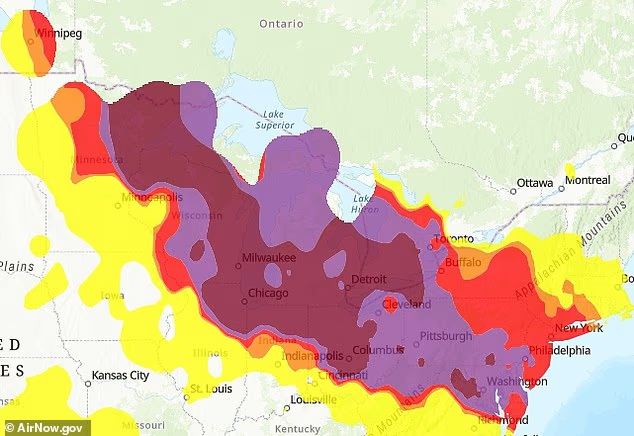
Millions in the US remain under dire air quality warnings as wildfire smoke from Canada makes the air worse for your health than smoking a dozen cigarettes a day.
The situation has deteriorated to the point where major metropolitan areas, including Chicago, Detroit, Washington and New York are now ranked as the worst polluted cities in the world on Friday.
The National Weather Service has issued air quality alerts in 16 states, stretching from Minnesota and Illinois in the Upper Midwest to New York, New Jersey and Virginia along the East Coast.
According to the EPA, the air is now considered ‘hazardous’ from northern Minnesota to Columbus, Ohio – the agency’s most severe air quality rating.
The wildfire smoke pouring down from hundreds of forest fires in Canada, mainly in the province of Ontario, is filled with microscopic pollutants called fine particulate matter, or PM2.5.
These are toxic compounds typically created by burning wood or industrial pollution, which are small enough to penetrate human tissue and cause severe breathing issues or even death among people with heart and lung disease.
Health officials have noted that breathing in PM2.5 in the amounts currently seen in Detroit (292.6 µg/m³) on Friday equates to smoking more than 13 cigarettes in a single day.
According to live air quality-tracking website IQAir, Chicago’s air is currently filled with more than 240 µg/m³ (micrograms per cubic meter) of PM2.5 pollution – the equivalent of smoking more than 10 cigarettes in a day.
This is a breaking story. More details to follow.
Air quality monitors have deemed the air to be ‘hazardous’ in multiple US cities on Friday, July 17

Weather experts have said the intense smoke with create vivid sunrises and sunsets this week, like one seen in New York Friday morning

On Thursday, Chicago (Pictured) was covered in wildfire smoke pouring south from Canada
Berkeley Earth, a nonprofit research organization known for analyzing climate and air quality data, estimated that breathing air with 22 µg/m³ of PM2.5 pollution for one full day has roughly the same long-term impact as smoking one cigarette.
Dr Jonathan Tan from the Children’s Hospital of Philadelphia told AccuWeather: ‘When the AQI climbs into the 150+ range for a full day outside, that’s in the ballpark of [smoking] seven to nine cigarettes.’
Typically, the Air Quality Index (AQI) is measured on a scale from 0 to 500: ‘good’ (0–50) carries little risk, ‘moderate’ (51–100) may affect sensitive individuals, ‘unhealthy for sensitive groups’ (101–150) poses increased risk and ‘unhealthy’ (151–200) impacts everyone, limiting outdoor activity.
When outdoor air quality reaches the 300 to 500 ‘hazardous’ zone or surpasses that mark, the EPA warns that everyone should avoid all physical activity outside.
As of 9am ET on Friday, both Detroit and Chicago had surpassed 380, according to IQAir.
Washington DC registered at 247, the third-worst polluted major city on the planet, and New York was fourth at 165 – all in the unhealthy to very unhealthy ranges.

The city of Detroit, Michigan (Pictured) has been ranked as the most polluted city on Earth due to the Canadian wildfire smoke

Residents in New York (Pictured) struggled to breathe outdoors on Thursday due to intense air pollution from the Canadian wildfires