
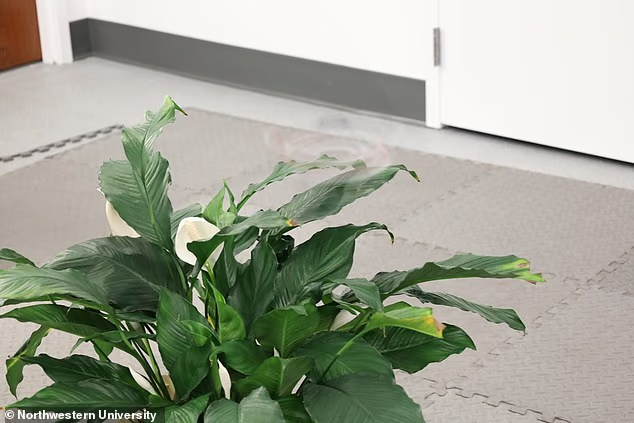
The battlefield of the future could feature invisible drones, if the latest model is anything to go by.
Scientists at Northwestern University have designed a drone that spins so fast it disappears before your eyes.
Called the ‘Phantom Twist’, the drone spins up to 25 times every second, which is too fast for the human eye to see.
While it isn’t completely invisible, the drone is about 10 times less visible than a conventional quadcopter.
Its developers describe its appearance as a ‘ghostly smudge’, claiming it blends ‘seamlessly into the background’.
‘Most efforts to hide drones focus on making them look like their surroundings,’ said Michael Rubenstein, who led the work.
‘Instead, we asked whether we could design the drone itself around the way humans perceive motion.
‘This idea of low visibility through persistent motion is something few people have explored.’
Scientists at Northwestern University have designed a drone that spins so fast it disappears before your eyes

Called the ‘Phantom Twist’, the drone spins up to 25 times every second, which is too fast for the human eye to see
To come up with the unusual design, the team first used a computer to generate roughly 20,000 different configurations.
Then, using AI, they tested different arrangements of the major components, before coming up with a shortlist of designs.
Mr Rubenstein said: ‘The design process was fully automated.
‘Then, when we were confident that a drone met all our criteria, we built it.’
While drones typically feature four separate rotors, Phantom Twist has just one motor and one propeller, which spins in one direction.
‘For a typical quadrotor drone, the propellers are spinning, but the robot is stationary,’ Mr Rubenstein explained.
‘So, you still see its body. For our drone, the whole thing is rotating, so there are no stationary parts.’
According to their intitial tests, the drone is about 10 times less visible than standard drones.

While it isn’t completely invisible, the drone is about 10 times less visually perceptible than a conventional quadcopter


While it’s nearly invisible, the drone still has some limitations. Notably, you can still see the drone’s wires and support rods, while it also makes a loud noise
Emma Alexander, who also worked on the project, said: ‘The human eye takes time to accumulate signals, roughly analogous to the exposure time of a camera.
‘When an object spins quickly, we perceive it as blurring out and losing distinct features.
‘Because this new drone is almost entirely transparent, its few opaque components are visually averaged with the background for an overall appearance of a slight haze.’
While it’s nearly invisible, the drone still has some limitations.
Notably, you can still see its wires and support rods, while it also makes a loud noise.
However, the researchers hope that the work could eventually lead to drones that can monitor wildlife, survey the environment and inspect infrastructure with less visual disruption.
Invisible drones would also have implications for modern warfare, according to Peter Lee at the University of Portsmouth, who was not involved in the research.
Speaking to New Scientist, he cautioned that there are some ‘serious limitations’ with the design.
Looking at the drone when it’s stationary, you’ll notice that it is very sparse – so adding any sensors would make it more visible, he explains.
What’s more, adding any weight would affect the centrifugal forces, ‘potentially making flight impossible.’
‘This style of drone is not manoeuvrable in the way that quadcopters are highly manoeuvrable,’ he said.
‘So because of the rotation, it won’t be able to bank at steep angles.
‘It would slow the speed of the rotation, and therefore it would become more visible and it’s probably getting unstable.’


