From meat grown in labs to intense fires raging across the globe, life in 2100 could look very different from today.
That’s according to a new study that predicts what we can expect next century.
Experts say that significant global warming is now ‘more likely than not’, with temperatures potentially rising by as much as 4°C.
This could trigger extreme ‘fire weather’ across parts of the world, threatening the survival of countless species.
Livestock herds could be dramatically scaled back as grazing animals are replaced with lab-grown meat and milk.
Meanwhile, advances in gene editing could also be used to eliminate troublesome invasive species such as destructive pests.
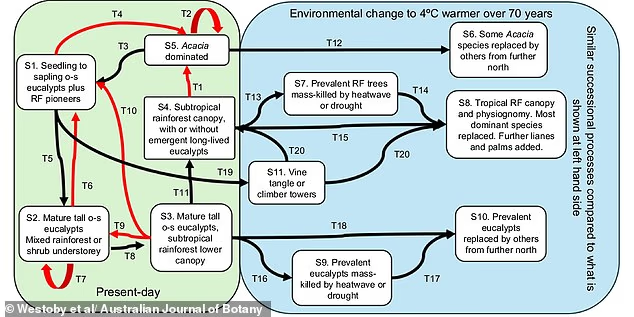
’70 years from now, many ecosystems will be substantially different,’ the researchers wrote in the Australian Journal of Botany.
‘Climate change is one driver, with associated changes in incidence of fires, extreme temperatures, droughts, floods and atmospheric carbon dioxide. But other drivers may also become important, such as large-scale replacement of livestock by cell culture products and genetic technologies for suppression of selected species.’
The researchers analysed a series of possible scenarios in a world where average global temperatures have risen by 4°C

Significant global warming could trigger extreme ‘fire weather’ around the world, they warned. Pictured: Firefighters battle the flames of the Vouzela wildfire in Cercosa, Portugal, earlier this month
For their study the team, from Macquarie University in Sydney, developed a series of possible scenarios for Australia’s ecosystems by the year 2100.
They focused on a world in which average global temperatures rise by around 4°C above pre-industrial levels.
One of the strongest themes to emerge from the research was the growing impact of more frequent and intense bushfires fuelled by blistering heat.
This extreme ‘fire weather’ is likely to transform vegetation and threaten the survival of species.
‘Some important vegetation types, such as rainforests, depend on long intervals between hot fires,’ study author Professor Mark Westoby said.
‘As extreme fire weather becomes more common, it will become harder and harder to maintain those ecosystems.’
The warning comes after a string of catastrophic fires in recent years, including Australia’s Black Summer bushfires, Canada’s record 2023 wildfire season and destructive blazes in California.
Researchers have already linked all of these to hotter, drier conditions increasing the risk of extreme fire weather.

One American firm is already developing sustainable chocolate – by growing it in the lab from harvested cocoa cells. Pictured: Broken up cacao seeds

Scientists are developing genetically engineered mosquitoes to suppress disease-carrying populations. Pictured: The Egyptian mosquito (pictured), otherwise known as the yellow fever mosquito
Among the other possibilities they identified was a dramatic reduction in traditional livestock farming, with cattle and sheep increasingly replaced by meat and dairy products grown from animal cells.
This technology is already beginning to move beyond the laboratory.
Cultivated chicken has been approved for sale in Singapore, the US and Israel, while companies are producing milk proteins without cows using precision fermentation.
Scientists have even created lab-grown chocolate and coffee as alternatives to crops threatened by climate change.
The researchers also envisage gene-editing technologies being used to selectively suppress invasive species that cause the greatest damage to native wildlife.
Similar technologies are already being explored today, with scientists developing genetically engineered mosquitoes to suppress disease-carrying populations.
Experts are also investigating gene-editing techniques that could one day control invasive pests such as mice, rats and cane toads.
While the study was focused on Australia, the researchers said the themes explored in their paper apply globally.
Join the discussion
Which of these predictions do you think is most likely to become reality by 2100?
A report recently warned that fossil fuel use must halve by 2035 if we’re to avoid catastrophic climate change.
The report, by Climate Analytics, looked at the measures that need to be taken to keep global warming below 1.5°C by the end of the century.
This threshold is the critical global climate limit established by the Paris Agreement to avoid the most devastating impacts of climate change.
According to the analysis, to hit this goal we must halve fossil fuel use by 2035.
What’s more, experts say the use of fossil fuels must be phased out entirely by 2070 at the very latest.