The French government said this year that it would replace Zoom and other American videoconference software with a French-developed alternative. Germany is building a homegrown platform for artificial intelligence. Companies in both countries are teaming up to build A.I. chips to rival those of the United States and China.
These are modest steps in Europe’s high-stakes race to catch up to America and China in the global sprint for digital independence. Without it, Europe’s political and business leaders worry, they will be vulnerable to sudden losses of access to critical technologies, as after President Trump’s recent decision to cut off foreigners from some of Anthropic’s latest artificial intelligence models. They will also miss out on revenues from a booming industry.
Yet interviews with industry leaders, public officials, entrepreneurs and economists suggest there is currently little question about whether Europe can wean itself off tech dependence anytime soon.
It cannot.
Instead, political and business leaders across the continent are wrestling with a more limited, but still daunting, question. If full independence is impossible, where should Europe focus its digital efforts, in pursuit of at least partial autonomy?
“One hundred percent autonomy in digital services is not at this stage something that is feasible,” said Anne Le Hénanff, France’s minister for artificial intelligence and digital affairs. “We just need to decide what we don’t want to be dependent on.”
Europe’s consumers and businesses rely heavily on American and Chinese imports for their digital lives, including social media, national security systems and artificial intelligence. They store data with American companies, like Amazon, despite European concerns over the comparative laxness of American data protection rules. European-based multinational companies, like Mercedes-Benz, hone some of their most important new technology in Chinese labs.
Europe has one homegrown large language model, Mistral A.I., a three-year-old start-up that is France’s national champion in artificial intelligence and is now valued at $14 billion. Mistral’s three founders worked for Google and Meta before starting the company.
Technology executives acknowledge that France does not yet have a financing culture, like that of Silicon Valley, to incubate promising start-ups. In France and across much of Europe, business leaders complain that companies must move to America to scale up.
Continental leaders have begun to call that reliance dangerous, strategically and economically, as Washington and Beijing more boldly wield raw power to bend other countries to their will. They say it leaves them more vulnerable to cyberattacks, and to economic and diplomatic pressure by powerful governments that may not share Europe’s democratic values.
“We need nothing more and nothing less than technological sovereignty in Europe, and therefore also in Germany, at least wherever it is attainable,” Friedrich Merz, the German chancellor, said last fall. Europe’s technological dependencies, he warned, were “being exploited for power politics.”
Last week, the Netherlands announced plans to create government-controlled data centers to prevent sensitive information from falling into the hands of foreign companies.
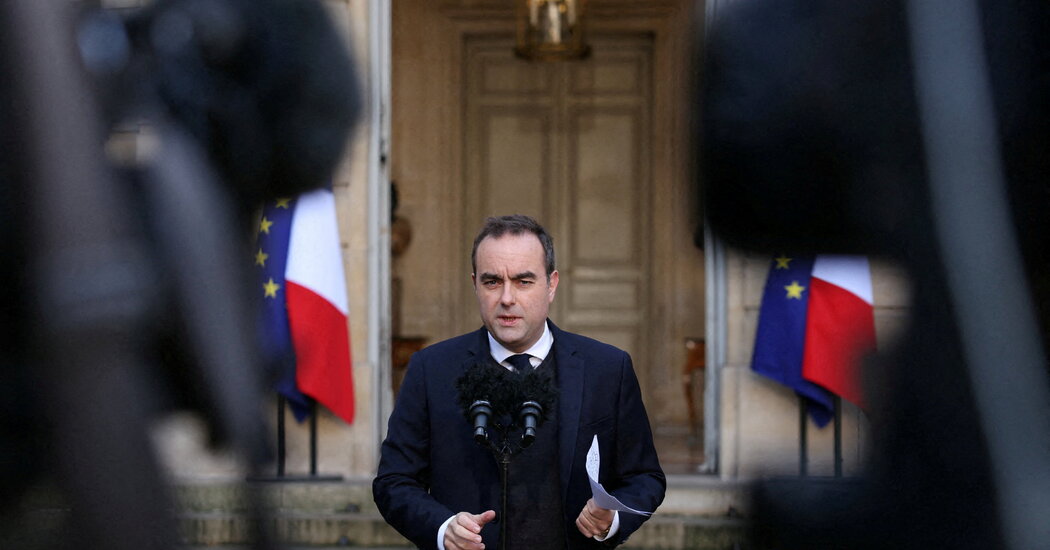
Last month, France’s prime minister, Sébastien Lecornu, said his country’s domestic intelligence service would stop using A.I. data tools from Palantir, an American tech company, in favor of those from a French company, ChapsVision.
“Just as we would not agree to transfer our national archives to California, we must use our own A.I. tools,” Mr. Lecornu said in a video posted on social media.
Relying on foreign technology can be dangerous for the private sector, too. Many European companies depend on Chinese products for data storage and cannot guarantee that their data will not be shared with Chinese intelligence, said Sebastian Kurz, a former chancellor of Austria. He is now the president of Dream, a company that sells A.I. security systems that exist entirely within one country to Western clients, including governments.
That dependence, Mr. Kurz said in an interview, is problematic if it affects “sensitive data in sectors like health care, where people feel a need that their data is protected.”
Governments across Europe are spending billions of euros to try to shake those dependencies for themselves and their companies — at least in select areas.
The French government has committed to spending roughly $5.3 billion to buy digital tools from French companies.
The German government plans to spend more than $20 billion over the next several years in six key tech sectors, including artificial intelligence and biotechnology. It has contracted with the German companies Deutsche Telekom and SAP to build a government A.I. platform that can be entirely disconnected from rivals like China and America.
A German government agency for innovation has started a fund worth roughly $140 million to catalyze investment in European start-up companies in areas like A.I. At a conference the agency sponsored this spring, officials said they were hoping less to fully supplant American and Chinese tech companies than to work with them — and to become indispensable in their operations.
Dorothee Bär, Germany’s federal minister for research, technology and space, noted in an interview at the conference that German start-ups had played a role in the launch of NASA’s Artemis II rocket.
“These mutual dependencies are also important, and the Americans in particular see that we have our own strengths,” Ms. Bär said. America in the Trump era, she added, “reacts exclusively to strength.”
German tech leaders are particularly enthusiastic about their chances of building on the country’s legacy strength, manufacturing, to pioneer exportable high-tech products like advanced versions of toolmaking equipment for factories.
“There are certain areas where Europe has an edge, actually,” said Antonio Krüger, the chief executive of the German Research Center for Artificial Intelligence. “This is an asset that I think the U.S. and China currently don’t have at that level of quality and amount.”
Europe’s technological strengths also include basic research, said Anne Bouverot, a chairwoman of a government committee for generative artificial intelligence. She pointed to a collaboration between the Fraunhofer labs in Germany and the French research lab CEA in developing next-generation chips for A.I.
Europe, however, remains weak in generating capital to fund tech companies as they grow larger, Ms. Bouverot said. Mistral raised $1.5 billion by selling a stake to a Dutch company. But that remains an exceptional case.
“We need to be able to finance start-ups better in Europe,” Ms. Bouverot said. “There’s lots of savings in Europe. Today, those savings are not used enough for start-ups. They either go to the U.S. or they stay in nonrisky investments.”
Ms. Bouverot said Europe would never cast itself off completely from Silicon Valley. She said the idea was for European countries to carve out autonomy in strategic digital areas — making them less vulnerable, for example, to an interruption of service or a breach of sensitive data.
That’s very different from the full vision of digital independence some leaders are promising. And it is not enough for those who say that Europe needs to break free of America and China for a purely economic reason — to profit from the next wave of booming technology sales.
“The whole point of sovereignty for me is not security and resilience,” said Cristina Caffarra, chair of the EuroStack Initiative Foundation, which works to strengthen Europe’s digital industries.
“It’s not democracy and all that,” she said. “It’s value capture.”
Ségolène Le Stradic contributed reporting from Paris.